
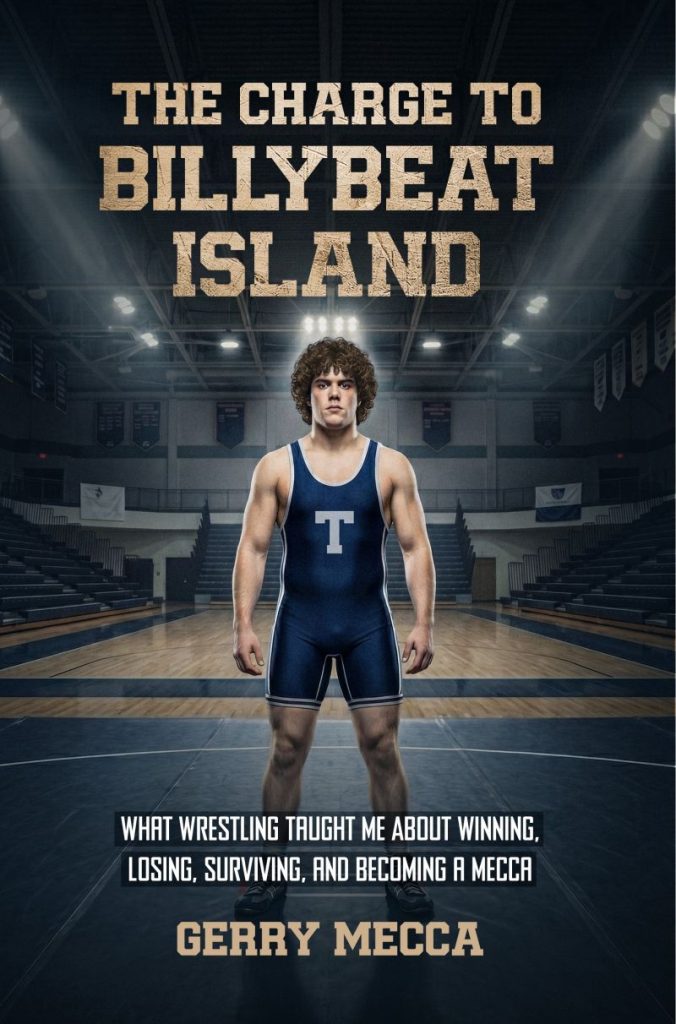
Billybeat Island was a bed. A sagging one, in a bedroom in Camden, New Jersey with five boys in it. The floor around it was lava.
Gerry made the rules. He drew a map of the island in crayon, red for the volcanoes, green for the safe zones. No dirty socks. No stomping. Nobody sets foot on it without permission. Then he defended the border every night against his own brothers, who came over the lava screaming and didn’t respect the map at all.
I love a memoir that starts small, and this one starts with a bed and a crayon map. Most sports books open on the big match because the author’s afraid you’ll leave. Mecca trusts you to stay for five boys fighting over a mattress, and that trust told me within a page that I could rely on him.
His brothers had rules too. Don’t cry. Don’t run. If you’re going down, take somebody with you. Randy added that cheating was fine as long as nobody caught you. George held that if you were losing, you should at least make it hurt.
That’s chapter one, and most of the book is already in it.
A wrestling family that had never wrestled
Nobody in the family wrestled before that generation. Gerry says it plainly: five boys in one room with too much testosterone and not enough space, who invented the sport for themselves.
Len went first. Ten years older, out of the room and into a gym before Gerry reached grade school, calm and calculated.
George followed and won RL Turner its first gold medal. He came home to a pep rally. What Gerry remembers is George not smiling, finding him in the stands, and holding the look.
Randy is the one you remember. One leg, two crutches, and the dirtiest fighter in the house because he had to be. He used misdirection years before anyone taught him the word for it. Randy’s my favorite character, and I’d have put him on the cover. A kid on crutches who fights dirtiest in a house of wrestlers because the fair way was never open to him. Mecca writes him with affection and without a drop of pity, and I’d happily have read another chapter of him.
What is The Charge to Billybeat Island?
A wrestling memoir that runs from that bedroom to a state championship in Texas and then well past it. The family moved from Camden to Malvern, back to Haddonfield, then to Texas. Gerry wrestled for RL Turner High School under a coach named Mickey Martin. The program won the school its first state title in any sport. His father’s line, drilled in during backyard games, was that Meccas don’t quit. A teammate named Tommy Jennings wrestled with Tourette’s. Gerry watched him on the bus one day and worked out that Tommy wasn’t fighting the condition. He was moving with it.
The coaches
Paul Aubrey ran the junior high room with a stopwatch and a clipboard. Randy lost a match to a bigger kid and shrugged about it. Aubrey told him at least he didn’t quit, then dropped to the mat and showed him the exposed shoulder that lost it. Nothing to do with strength. He caught Gerry watching from the bleachers at twelve. There’s no such thing as just watching, he said. You’re learning or you’re wrestling.
Mickey Martin came later. He phoned out of nowhere before Gerry’s senior year and asked what he had been doing all summer to get ready. In the room he barely spoke. One word changed the speed of everything. When somebody made a mistake he said negative. That meant rewind three seconds and find where it started. That’s a different instruction from try harder.
The negative instruction is my favorite single detail in the book. Plenty of coaches yell try harder, and it tells the athlete nothing he can use. Rewind three seconds and find where it started is a real instruction, and I wish more people who teach anything would steal it.
Keep reading
How to write a memoir that turns a life into an argument: the blend of personal story and larger point that gives a book like this its force.
The chapter the book turns on
Three days after a lake party he shouldn’t have attended, Gerry’s father knocks on his bedroom door before seven in the morning. Coach Martin is in the kitchen.
Gerry is certain his season is over. He puts on jeans and a T-shirt with his hands shaking. Martin is standing at the window with his back to him.
What happened was that his teammates went to the coach the day before and vouched for him. Martin doesn’t throw him off the team. He makes him run twenty-five miles.
Sports books usually build toward a win. This one builds toward a coach who forgives him and then makes him pay anyway, and that’s a better story.
Work with me
Tell the story only you can tell: I help athletes, leaders, and professionals shape a life into a book that carries real weight.
The antagonist
Danny McGiboney was a teammate. A hundred and eighty-five pounds of antagonism, and for most of a year he made Gerry’s life miserable. It started with taunting out a car window during an evening run and escalated to something that nearly ended his season. Three weeks later, at the Paul’s Valley Invitational in Oklahoma, Gerry pins his man in the final. His teammates carry him up. One of the first pairs of hands under him belongs to Danny, who tells him it was a great match and means it. Looking down from up there, Gerry decides Danny was never a villain. He was a teammate, and both things had been true the whole time. Most memoirs keep the enemy an enemy. This one doesn’t. This passage moved me. The temptation to settle a score with a teammate who nearly wrecked his season must have been enormous, and plenty of memoirists would have taken it. Mecca lets Danny be generous at the moment it counts and gives up the easy villain, and I respect that more than any match he could have written up.
Team victory, personal defeat
The state tournament is at the University of Texas, six matches running at once in a gym built for combat. His team wins the championship. Gerry loses his final to Clarence Laster and takes silver.
Then the all-sports banquet, which he attends only because his mother makes him. He wears the letterman jacket with the new patch. He drives the same beat-up Plymouth station wagon that carried his celebrating teammates home. He’s spent eight weeks replaying one match.
And they name him high point scorer for the team he feels he let down. A school’s first state title in any sport, and he calls it hollow. Anyone else writes that night as the triumph. He writes it as the emptiest night of his life, and that’s why the book is worth reading.
What comes after
Wrestling was his laboratory. Preparation doesn’t guarantee a win. Going in unprepared guarantees a loss. He took that into software and into running teams, along with the harder edge of it: a man who commits completely expects the same from everyone else and gets difficult when they fall short.
The chapter on life after high school opens with the questions arriving before the sweat dried. What are your plans.
Which school. Would you like to talk to our program. He folds a singlet for the last time, thinks the Olympics sounds like a decent goal, and admits he had no idea how to turn four years of discipline into a life.
Most sports memoirs stop before that. This one is about legacy, not medals, so it keeps going. There’s also a good deal here that’s nothing to do with the mat. A childhood friendship in Haddonfield with a girl named Candy Baker. An afternoon on Crystal Lake that ends with Gerry going through the ice. The Crystal Lake afternoon is the chapter I’d point a doubter to if they assumed the book had no range. The wrestling gives the memoir its spine, and these side chapters give it a pulse, and I’d have been sorry to lose any of them.
About Gerry Mecca
Mecca has spent more than forty years in enterprise technology. His work has run from Fortune 500 boardrooms to private equity carve-outs. He’s an MBA from Baylor and executive credentials from Wharton.
He also teaches. He runs IT seniors through capstone projects at the University of Texas at Dallas and coaches kids in the Texas Rangers MLB Youth Academy program. The book barely mentions any of it, and that’s the right call. The wrestling is where he learned the things he later used in the boardroom.
I’d hand this book to anyone who thinks a sports memoir has to be about trophies. It’s about a family, a pair of coaches who knew exactly what they were doing, and a man who still counts his school’s first state title as the emptiest night of his life. That’s a braver book than most athletes would dare to write, and it deserves readers well outside wrestling.
Explore the hub
The Writing Hub: memoir, argument, and the craft of telling your story, gathered in one place.
Frequently Asked Questions
Other Books in the Books I Contributed To Series




Other Books From – Biography and Memoir


About the author
