Latest
The Ghost Story TraditionThe Gothic TraditionThe Christmas Ghost Story TraditionResurrection as a Narrative StructureBooks to Give a WriterThe Beach Read ArgumentWhy It’s a Wonderful Life Failed on ReleaseWhat to Read in SpringWhat to Read in SummerWhat to Read in OctoberHow Warner Bros. Dismantled a $17 Billion Cartoon EmpireThe Imaginary Scarcity TrapThe Graph That Goes Vertical Is Usually Somebody Else’sSubstack Is Not Collapsing. The Promise Was.The Disasters That Happen to Ordinary PeopleToba: The Winter That Almost Ended UsJay Stifflemire: Nothing Ever Gets Written DownGeorgie-Ann Getton: I Forgot I Had Free WillAI Detection Cannot Be Evidence, and Publishing Is Using It That WayAI Consciousness Left Philosophy and Entered the LaboratoryThe Office Block Where the Bedrooms AreBlack Tuesday: The Web Ring War Nobody Outside It NoticedWhat the AI Visibility Industry Sells, and What the Evidence SaysThe Web Got Fenced: What AI Search Costs Small SitesBlack Tuesday: The Original ring-master.net Page, 2000Behind the Book: Peacekeeper, The Dissolution WarsBehind the Book: Real World SurvivalBehind the Book: Publish Your BookBehind the Book: ReincarnationBehind the Book: Sell Your BooksBehind the Book: Selling on eBayBehind the Book: Show Don’t TellBehind the Book: Stuck in the MiddleBehind the Book: Street-Smart Management WisdomBehind the Book: The ADHD MarketerBehind the Book: Suddenly UnemployedBehind the Book: The Blonde With a Violin TattooBehind the Book: The Blog-to-Book BlueprintBehind the Book: The Death of ThinkingBehind the Book: The Day Your Website DiedBehind the Book: The Ethical WorkplaceBehind the Book: The Emasculation of AmericaBehind the Book: The Gig EconomyBehind the Book: The Ghostwriting AdvantageBehind the Book: The Ultimate Bug Out Bag GuideBehind the Book: The Villainization of AmericaBehind the Book: The Wild Tiger, The Wrong AnswerBehind the Book: The Wild Tiger and the Answer BotBehind the Book: Turn Off the TV, Get Off Your Ass, and Do SomethingWe Lifted a Running Computer Off the Floor
The Writing King Your Ethical Ghostwriter. Your Story, Done Right.

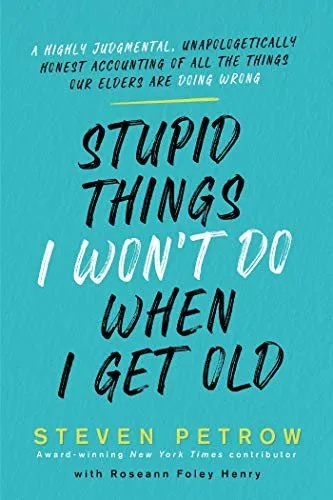
Stupid Things I Won’t Do When I Get Old

Stupid Things I Won’t Do When I Get Old

A Highly Judgmental, Unapologetically Honest Accounting of All the Things Our Elders Are Doing Wrong

Publisher:Citadel Press
Published:September 9, 2026
ISBN:9780806541006
Language:English
Share:

Buy Now

Description:

TL;DR

7/10. Petrow started a list after turning fifty, cataloging what his seventy-something parents were doing wrong. Then they died, and the list became something else. Forty-three short essays in three sections, and the last section is the one that earns the book.

It began as a New York Times essay and it began as judgment. You won’t have to shout at me that I’m deaf. I won’t blame the family dog for my incontinence. The subtitle is honest about the register, and it is a register that gets less comfortable as you read on.

Petrow is an award-winning journalist who has written on aging, health, and LGBTQ issues for the Times and the Washington Post, and the book grew from a column that got an enormous response.

The structure is three parts: things he won’t do today, things he won’t do tomorrow, and things he won’t do at the end. Forty-three short essays plus a foreword and an epilogue.

How did the book change while he was writing Stupid Things I Won’t Do When I Get Old?

This is the most interesting thing about it and it happened to the author instead of being designed.

The first section is the weakest and is the one people quote. It is a snarky catalog by an adult child watching parents make choices he cannot influence: refusing to get a hearing test, lying about their age, lying to their doctor, holding on to a house nobody can maintain. There is real frustration in it and it has not yet become anything else.

Then his father declined, his mother developed dementia, and both of them died. What was a list of criticisms turns into a set of instructions to himself, and the tone changes without the book announcing it.

You can watch it happen across the sections, which is unusual. Most books get edited into a consistent voice. This one keeps the seam, and the seam is where the value is.

What is in the last section?

The third part is where it becomes a good book, and the titles do most of the work.

Not dying without somebody holding your hand. Not letting anything stop you saying you love someone and saying goodbye. Writing letters to the people you leave. Being clear about what you want in your obituary, which sounds morbid and is a kindness to whoever has to write it.

And clearing out your house so that somebody else does not have to do it while grieving. That last one is practical advice disguised as sentiment, and it is correct. Anybody who has emptied a parent’s house knows it is a task performed at the worst possible moment by the least capable version of yourself, in a building full of objects that each require a decision.

What does Stupid Things I Won’t Do When I Get Old get wrong?

The prose is light, and the publisher’s comparison to David Sedaris and Nora Ephron sets an expectation the writing does not meet. It is competent journalism arranged in short pieces and it is not stylish.

The first section is also the part most often quoted from it, which is unfortunate, because it is the least interesting and it gives readers a wrong impression of what the book becomes.

And some essays are thin. Forty-three pieces is a lot to fill, and a few of them make one small point and stop, which reads as padding in a book that elsewhere earns its length.

When should you read Stupid Things I Won’t Do When I Get Old?

Before you need it, which is the difficulty with the entire category.

The publisher pitches it at readers over fifty-five. The practical material, particularly on paperwork, on the house, and on saying things to people while they can still hear them, is more useful the earlier you meet it.

It is also worth reading if you are currently watching a parent age, and it will be uncomfortable, because the first section is precisely the position you are in and Petrow is not flattering about it. That discomfort is the point and he arrives at it before the reader does.

Verdict

Lightweight prose and a heavier book than it looks. Push past the judgmental opening, which the author himself grew out of during the writing, and the last third is worth the whole thing.

Best read before you need it, which is the difficulty with the entire category and is not a reason to wait.

Explore further

Real Life, Handled: the parts of adult life nobody hands you a manual for.

Frequently Asked Questions

What is Stupid Things I Won’t Do When I Get Old about?
Forty-three short essays on aging, arranged in three sections covering what the author will not do today, tomorrow, and at the end. It grew out of a New York Times essay listing what he thought his seventy-something parents were doing wrong.
Is Stupid Things I Won’t Do When I Get Old a mean book?
It starts that way and does not stay that way. The first section is a snarky catalog by an adult child watching parents make choices he cannot influence. Then both parents died during the writing and the tone changes without the book announcing it.
Why does the seam matter?
Because most books get edited into a consistent voice and this one keeps the change visible. You can watch a set of criticisms of other people turn into a set of instructions to himself.
What is the strongest section?
The third. Not dying without someone holding your hand, saying you love people and saying goodbye, writing letters to those you leave, and clearing out your house so somebody else does not have to do it while grieving.
Why is clearing out the house good advice?
Because emptying a parent’s house is a task performed at the worst possible moment by the least capable version of yourself, in a building full of objects that each require a decision.
Who is Stupid Things I Won’t Do When I Get Old for?
Anyone in their fifties or sixties, and anyone currently watching a parent age. The publisher pitches it at readers over fifty-five, though the practical material is more useful the earlier you meet it.
What is the weakness?
The prose is light and does not meet the publisher’s comparison to Sedaris and Ephron, the first section is the least interesting part and the most quoted, and a few of the forty-three essays make one small point and stop.
Will Stupid Things I Won’t Do When I Get Old be uncomfortable?
Yes, if you are currently watching a parent age, because the first section is precisely the position you are in and Petrow is not flattering about it. He arrives at that discomfort before the reader does.

About the author

Steven Petrow

Steven Petrow is an American journalist and author who has written on manners, aging, health, and LGBTQ life for the New York Times, the Washington Post, and USA Today. He spent years as the Digital Life columnist for USA Today and wrote the Civilities advice column for the Washington Post, and has published several books on etiquette, including Steven Petrow's…

More about Steven Petrow

Back