Latest
You Don’t Own Anything AnymoreThe Budget Decided How My Department Was ShapedWhy Your Competitor’s Book Is Working and Yours Would NotWhy Are These Guys Smiling? A Business Book That Became a Wrestling MemoirPangram Wants to Decide Who Gets PublishedWhat You Have Enough Material For Right NowWhen a Book Is the Wrong ToolThe Woke VirusGalactic InvasionChatGPT Turns Four: From a Free Research Preview to GPT-6What’s New at The Writing King: Week of November 1, 2026Diwali: The Festival of Lights and the Story Behind the LampsHow Much Water and Power Does Heavy AI Use Take? I Ran My Own NumbersBad Boys: Ride or Die (2024)Anti-Communism Week: Remembering the Writers Communism SilencedVesuvius Day: The Teenager Who Wrote Down Pompeii’s Last DayVoyager 1 One Light-Day: Fifty Years to Travel One Day of LightVellum Added an Optional AI Feature. A Pile-On Killed It in a Day.Are AI Subscriptions Losing Money? The Gym Membership Math Says NoAI Terms Every Writer Should Know, and Why Each One MattersWorking While Sick: What 24/7 On Call Cost MeHe Banned AI From His Writing Group. His Own Cover Got Called AI Slop.Who Writes the Fake Fan Mail Authors Get? Inside the Scam CompoundsSMS Appointment RemindersJoe Rockey: Ghostwriting His BookFree BooksDarrell Stern: Stop Being Invisible, Become UnmissableHow to Turn Your Expertise Into a Book People Want to Read | The Expert MethodWhat’s New at The Writing King: Week of October 25, 2026Challenger Remembrance Day: The Engineer Who Wouldn’t SignJoel Salomon: The Truth About MoneyReddit Is Putting Up a Login Wall. Wikipedia Won’t Be Far Behind.Victoria Chemko: The Body Is the First TechnologySir Patrick Stewart: A TributeA Year in the Bank: ADHD, Face Blindness and the Freedom to Walk Out | The Impossible Puzzles Show, Episode 326A Yale Economist Says We Won’t Be Missed. He Forgot the Bread Line.Walter Koenig: A TributeAI Has Paid Off Outside Tech. Apollo Is Reading the Wrong Scoreboard.I Don’t Post Bad ARC Reviews. I Send the Author a Note.The Little Red Book of Stuff That Works!Your Kids Are Your Own FaultGrow a PairYou’re Broke Because You Want to BeIt’s Called Work for a Reason!No Time for TactShut Up, Stop Whining, and Get a LifeWilliam Bessette: AI Enablement and Child Welfare TechnologyFree Book Planning ToolsWhat’s New at The Writing King: Week of October 18, 2026Ghostwriting by the Numbers: Timelines, Word Counts and the First Call

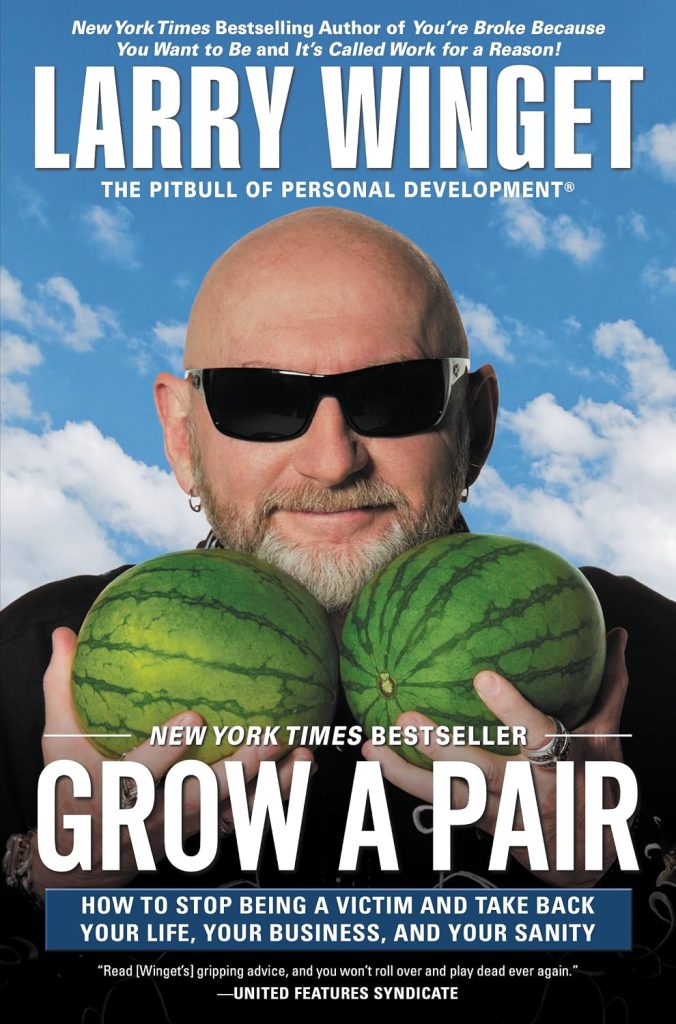
Grow a Pair

Grow a Pair

How to Stop Being a Victim and Take Back Your Life, Your Business, and Your Sanity

Author:Larry Winget
Category:Self-Help
Publisher:Gotham
Published:September 12, 2013
Pages:160
ISBN:9780698138612
Language:English
Share:

Description:

TL;DR

Larry Winget against victimhood. Grow a Pair takes on entitlement culture, the self-help industry and political correctness, and tells readers to stop playing the victim, stand up for themselves and take responsibility. The title is about attitude, and the book is short.

Grow a Pair is one of Larry Winget’s later books. Gotham Books published it in September 2013, a short hardcover of about 160 pages, with an audiobook edition alongside. Its subject is victimhood: the habit of seeing yourself as someone things happen to, and the culture that encourages it.

The publisher is careful to explain the title. Everyone has heard the phrase, but Winget’s advice isn’t about anatomy. In the book’s words, “Growing a pair is a state of mind, an attitude, and a way of thinking.”

The diagnosis

Harvey Mackay, reviewing the book in his syndicated column the week it came out, summed up Winget’s starting point: people will do anything and everything they can until someone stops them. The fix is to let people get away with less, which means no longer tolerating stupidity, poor performance and bad behavior, starting with your own and moving out to your family, co-workers and employees.

Winget lays part of the blame on entitlement culture. The publisher says he takes on that culture, the self-help movement and political correctness, and challenges the positive-attraction and law-of-attraction gurus with a commonsense approach. Publishers Weekly, in a skeptical review, noted his argument that a sentimental, therapeutic culture has taught people they are owed things.

What the ten chapters cover

The book moves from the problem, to a self-test, to how to change, and then applies the idea to each part of life:

  1. The Problem
  2. Do You Have a Pair?
  3. How Do You Grow a Pair?
  4. Grow a Pair with Your Money
  5. Grow a Pair in Business
  6. Grow a Pair at Home
  7. Be a Citizen with a Pair
  8. The Benefits of Growing a Pair
  9. The Side Effects of Having a Pair
  10. Final Thoughts

“Do You Have a Pair?” is a quiz. Mackay quotes some of the questions: do you allow people to take advantage of you, do you pick up the slack for lazy co-workers, do you compromise your opinions to get along? On the other side: do you stand up for yourself and your beliefs even in the face of conflict, and do you speak up when you see someone else being mistreated?

Winget on the book

In a September 2013 interview with Early To Rise, Winget said the book is about refusing to become a victim. Bullies, he said, will always exist at work, on the road and online. He suggested writing down on a blank sheet the four or five things you will never compromise on. He also described how he circled the wagons when his speaking bookings fell during the recession, reassessing his business and building other income, a story the book tells too.

Two of his lines from that interview capture the tone: “I can’t demand respect from you but I can refuse to be disrespected by you,” and “You never go along to get along.”

The practical advice is direct. “No one ever wrote down a plan to be fat, broke, stupid, lazy, unhappy, and mediocre,” Winget writes, and “Priorities determine your actions, and your actions determine your results.”

Keep reading

Winget’s ten ways people get in their own way: People Are Idiots and I Can Prove It!

Who should read Grow a Pair?

It suits readers who keep waiting for someone else to fix their situation, people who let co-workers, customers or family walk over them, and anyone who wants a fast, blunt push toward standing up for themselves. The chapters on money, business, home and citizenship make it broader than the title suggests. Readers put off by the title will likely be put off by the rest; Winget doesn’t sugar-coat, and he isn’t afraid to make people uncomfortable.

Where this book fits in Winget’s work

It comes after his run of responsibility books on life, work, money and parenting, and widens the target from personal habits to the culture around them. The earlier books concentrate on the excuses people make for themselves; this one goes after the excuses the culture hands them.

Explore the hub

The Psychology of Writing Hub: motivation, accountability, and the mental side of the work, gathered in one place.

Frequently Asked Questions

What is Grow a Pair by Larry Winget about?
It is a short book about rejecting victimhood. Winget argues that people get away with whatever others tolerate, so the fix is to stop tolerating poor performance and bad behavior, starting with your own, and to stand up for yourself at work, at home and with money.
What does the title Grow a Pair mean?
It is about attitude. The book calls growing a pair a state of mind, an attitude and a way of thinking: refusing to be a victim and taking control of your own life.
What chapters are in Grow a Pair?
Ten: The Problem, Do You Have a Pair?, How Do You Grow a Pair?, Grow a Pair with Your Money, Grow a Pair in Business, Grow a Pair at Home, Be a Citizen with a Pair, The Benefits of Growing a Pair, The Side Effects of Having a Pair, and Final Thoughts.
Is there a quiz in Grow a Pair?
Yes. The chapter Do You Have a Pair? asks questions such as whether you let people take advantage of you, pick up the slack for lazy co-workers, or compromise your opinions to get along.
When was Grow a Pair published?
Gotham Books published it in September 2013, at about 160 pages, with an audiobook edition.
Categories and tags
CategoriesPersonal Growth

About the author

Larry Winget

Larry Winget is an American business speaker, television personality, and bestselling author of personal development and small business books, widely known by his trademark nickname the Pitbull of Personal Development. His style is bluntly direct, anti-self-help, and built on personal accountability, and his books have sold in the millions across multiple bestsellers. His best-known titles include Shut Up, Stop Whining,…

More about Larry Winget

Back