
Walter Koenig died on Sunday, October 25, 2026, at his home in North Hollywood. He was 90. His agent said he died of natural causes, with his daughter and his niece beside him.
It hit me hard. He was Ensign Pavel Chekov, the young Russian at the navigation console of the starship Enterprise, and he’s been part of my life since I was a kid.
I watched Star Trek when it first came out in the 1960s, and I watched it all the time. One Christmas my parents gave me one of the very first Star Trek model kits, the Enterprise. I even had the version with the lights in it. That one is super hard to find now.
I liked him. He was a good guy, and I’m sad to see him go. This is my thank you.
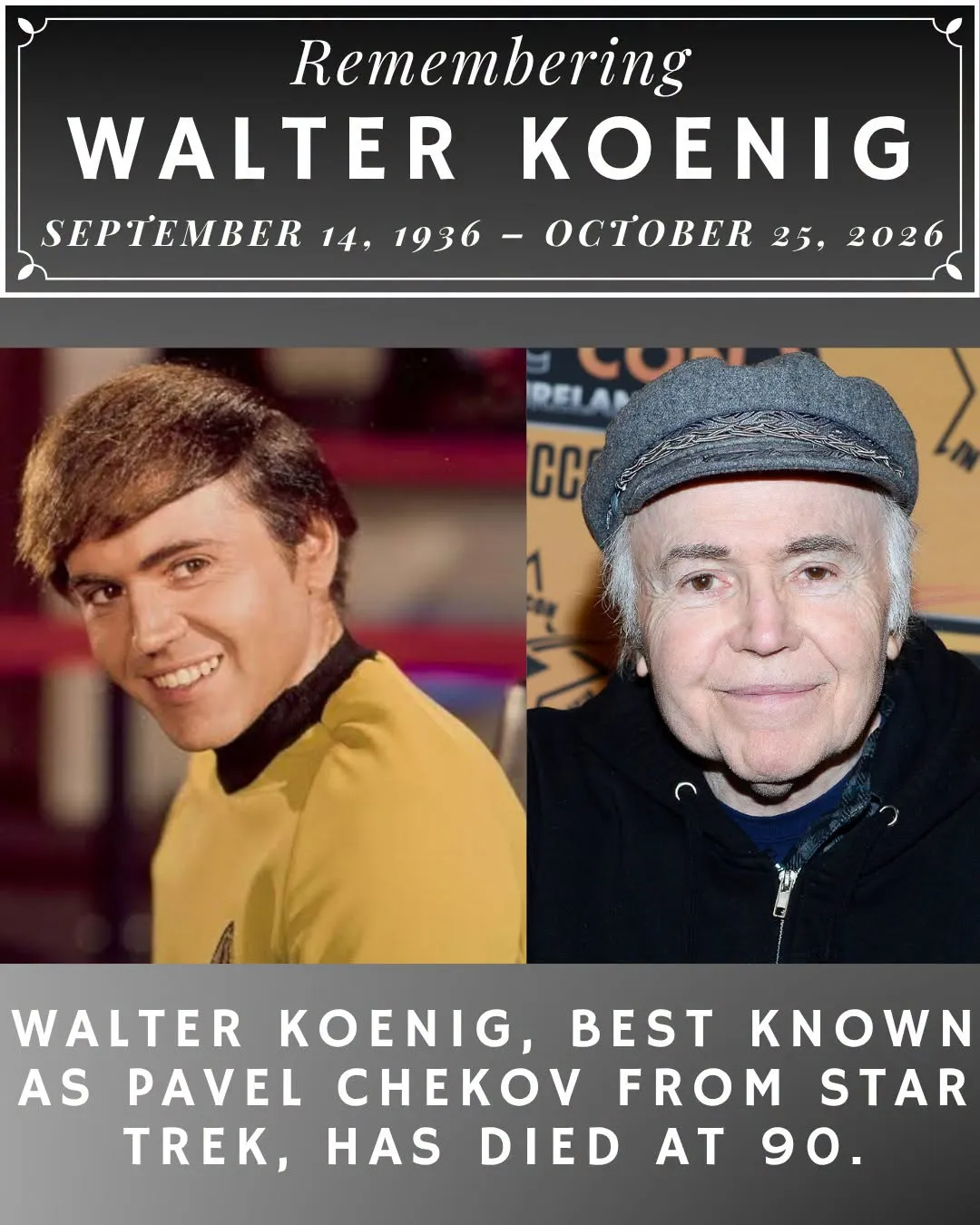
Ensign Chekov joins the bridge
Chekov arrived at the start of the second season of the original Star Trek, in “Amok Time,” in 1967. Koenig played him in 36 episodes across the show’s last two seasons on NBC.
It never felt like there was much of him. In my memory he was in just a few episodes, because he came in late and the scripts belonged to Kirk, Spock and McCoy. But whenever he was on the bridge, I was glad to see him.
He was one of only two actors who auditioned for the part. “Quite extraordinary,” he called that later. The studio wanted somebody young who looked a little like Davy Jones of the Monkees, to pull in a younger audience, and Koenig fit. His hair was already receding, so the costume department gave him a moptop wig.
The accent came from home. His parents were Russian Jewish immigrants who’d lived in Lithuania, and Koenig said he modeled Chekov’s voice on his father’s speech. The famous “w” for “v” came from his father, too.
In 1967, at the height of the Cold War, a Russian officer sat on the bridge of the flagship of the Federation, proud, loyal, a little hotheaded and forever claiming that everything worth having had been invented in Russia. Roddenberry wanted him for comic appeal, and he was funny. He was also a statement that rival nations could crew the same ship. I wrote about that bridge on Star Trek Day, and Chekov is a big part of why it mattered.
I loved the accent. He was different from everybody else on that ship, and he was all-around good. To me he epitomized the idealism of the show. A kid from the other side of the Iron Curtain was standing watch next to Americans, and nobody on the bridge thought twice about it.
I wish they’d used him more. He’d have been a natural to drop in on The Next Generation as an old admiral, and it never happened.
The cast member who wrote an episode
When the crew came back for the animated series in 1973, Chekov was cut. The budget wouldn’t stretch to him, and Koenig was the one regular left out. By his own account, he learned the news from a convention stage.
He wrote them an episode anyway. “The Infinite Vulcan” is his script, a story about cloning with a giant Spock clone in the middle of it, and it made him the first member of the original cast to write Star Trek for television. I covered the whole sorry casting story in my review of the animated series. Losing the part and writing the show anyway tells you a lot about the man.
Chekov in the Star Trek movies
He came back for the films and stayed for all of them, seven in all, from The Motion Picture in 1979 through Star Trek Generations in 1994. He kept a journal while they made the first one and published it as Chekov’s Enterprise.
In The Wrath of Khan, Chekov is the first officer of the Reliant, and he walks straight into Khan on Ceti Alpha V. Khan recognizes him on sight. Fans have teased about that for forty years, since Chekov wasn’t aboard for “Space Seed.” Then a Ceti eel goes into his ear, and Koenig sells the pain and the horror so well that nobody watching cares about continuity. He earned a Saturn Award nomination for that film.
He earned another for The Voyage Home in 1986. Everybody quotes that one.
Chekov and Uhura walk the streets of 1986 San Francisco, asking strangers where the “nuclear wessels” are. Most of the people on the sidewalk were extras told not to answer. One woman, Layla Sarakalo, stopped anyway and told them she thought they were across the bay in Alameda. Leonard Nimoy kept it in the film. He did finally find where the nuclear wessels were. In Alameda.
Chekov got more to do in the movies than he ever got on the show. He ran the tactical board, got captured, got wounded, fell off an aircraft carrier and kept his dignity through all of it. In The Search for Spock, he’s one of the crew who steal the Enterprise to bring Spock home. He was never the star. He was the man you could always count on to be at his post.
Who was Alfred Bester on Babylon 5?
Bester was a Psi Cop, a telepath who hunted other telepaths for the Psi Corps, the agency that controlled every human telepath in Earth’s government. He wore the black uniform and the black gloves, and he smiled while he read your mind.
J. Michael Straczynski wrote the part for Koenig, and the day after Koenig died he told the story of how it happened.
The two met through their mutual friend Harlan Ellison, mostly at Harlan’s dinners and birthday parties. Straczynski grew up watching Koenig on Star Trek and called himself too shy to call a star, so he didn’t. Then, in August 1990, Koenig invited him to The Boys in Autumn by Bernard Sabath at the Los Angeles Art Theater. Koenig played an aging Tom Sawyer opposite Mark Lenard’s Huck Finn, the two of them meeting one last time.
Straczynski called it “a two hour masterclass in acting,” and said Koenig “was a revelation.” Sitting there, he got angry at the fans who mocked Koenig online as a lightweight. Afterward he promised Koenig he’d find him a role equal to his talent, even if he had to write it himself. Koenig smiled the way actors do when they hear that, and Straczynski never forgot the promise.
His first try was a part in the episode “And the Sky Full of Stars,” written with that stage performance in mind. Koenig loved the script. Then, just as production ramped up, he had a heart attack and quadruple bypass surgery and had to drop out. He was devastated. On the phone from his office, with Koenig still laid up in bed, Straczynski told him not to worry, because he’d find him something better.
That something was Bester, in “Mind War,” which aired on March 2, 1994. By Straczynski’s count, it went before the cameras about a month after the bypass, and Koenig showed “not a flicker of weakness.” Straczynski named the character after Alfred Bester, the science fiction writer whose novel The Demolished Man is about a police force of telepaths.
On the first day of that shoot, Koenig carried his lunch tray toward the table where the actors playing Earthforce officers sat. Michael O’Hare, the show’s lead, called “Attention!” and the whole table stood. When Koenig asked why, O’Hare told him junior officers always stand in the presence of a senior officer until given leave to sit. Koenig told them to sit, took the head of the table, and, in a Yiddish word Straczynski learned from Ellison, kvelled.
I don’t remember seeing him in much outside Star Trek, and Babylon 5 fans would tell me I missed his best work. The people who loved that show loved Bester.
He was meant to appear once. Koenig was so good that Bester kept coming back, in 12 episodes across the run of the series, always billed as a special guest star. At the end of the third season, the production company submitted him for an Emmy. Koenig called the role “one of the best, most satisfying experiences I’ve ever had.”
When the casting was announced, some fans sneered that he’d spend the whole time asking about nuclear wessels. Straczynski’s answer, after Koenig died, is the best line anyone has written about him: “Chekov was (to a degree) a one-note character because he was written that way. But that wasn’t Walter. Walter was an entire symphony.” When “Mind War” aired, he wrote, the mockers went quiet very fast.
Bester was manipulative and calculating, and he was the hero of his own story. He frightened people because he believed every word he said. He loved the Corps the way other men love a country, and he’d do anything for it, including things that would sicken a decent person. He turned Garibaldi into a sleeper agent and called it necessary.
Then Straczynski complicated him. During the Shadow War, Bester helped Sheridan, partly to save Carolyn, the woman he loved, who’d been taken by the Shadows. For a few episodes the monster had a reason you could understand.
Fans describe a performance full of gravitas, with glimpses of dry humor that made Bester worse. Critics who reviewed “Mind War” called him charismatic and chilling, and evil without ever going over the top. Plenty of viewers say that when Bester showed up, they knew they were in for a great episode.
Why do Babylon 5 fans call Bester Walter Koenig’s best role?
Chekov never gave him the room. Chekov was a good-natured young officer written as the kid on the bridge, and for thirty years, that’s all most casting directors saw.
Bester was the opposite in every way. Older, colder and smarter than anybody in the room, and certain of his own righteousness. Koenig played a man who could do terrible things and sleep fine afterward, and he made you believe that man was also lonely, loyal and capable of love. That’s hard to do. Most actors pick one side of a villain and play it. He played the whole man.
He was supposed to bring Bester back in the spinoff Crusade, but the series was canceled before that episode was made. Bester got one more life in the Babylon 5 novels.
What else was Walter Koenig in?
Star Trek and Babylon 5 were the big two, but he worked steadily for sixty years. In 1973 he played Oro in two episodes of The Starlost, a Canadian science fiction series. In 1976 he turned up as Sergeant Johnson in “Fade in to Murder,” an episode of Columbo starring William Shatner as the killer.
He played Colonel Jason Grant, an astronaut who finds an alien threat on the Moon, in the 1989 film Moontrap. He voiced Vladimir Pavel Maximov in “Russian About,” a 1990 episode of The Real Ghostbusters, and in 2002 he voiced himself in the Futurama episode “Where No Fan Has Gone Before,” the one where the crew goes looking for the lost Star Trek episodes.
He played Pompey in a 1983 television production of Antony and Cleopatra, and he wrote, starred in and executive produced the 2007 science fiction film InAlienable. He also appeared as himself in the documentaries Trekkies and William Shatner’s Star Trek Memories.
He kept poking fun at Chekov, too. In 2001 he played General Dimitri Sukitov on Son of the Beach. Later came Pastor Dylan in Mad Cowgirl, Coogan in the TV movie Bone Eater and Ray Nabroski in Neil Stryker and the Tyrant of Time. From 2017 to 2018 he voiced Mr. Savic in eleven episodes of Stretch Armstrong and the Flex Fighters, when he was past eighty.
His full list of screen work runs from an uncredited part on Combat! in 1962 to his last film this year.
| Year | Title | Role |
|---|---|---|
| 1962 | Combat! | Uncredited, his television debut |
| 1963 | General Hospital | Charlie Turner |
| 1963 to 1965 | Mr. Novak | Alexsei Dubov, Jim Carsey, Paul Ryder |
| 1963 | The Great Adventure | Cy Bedrozian |
| 1964 | The Lieutenant | Sgt. John Delwyn |
| 1964 | The Alfred Hitchcock Hour | Tiger |
| 1965 | Ben Casey | Tom Davis |
| 1965 | Gidget | Gunnar |
| 1966 | I Spy | Bobby Seville |
| 1966 | Jericho | Paul |
| 1967 to 1969 | Star Trek: The Original Series | Ensign Pavel Chekov |
| 1968 | Mannix | Recovering addict |
| 1970 | Medical Center | Harry Seller |
| 1970 | The Virginian | Paul Elrich |
| 1971 | Ironside | Leo |
| 1971 | Goodbye, Raggedy Ann | Jerry |
| 1973 | The Starlost | Oro |
| 1973 | Star Trek: The Animated Series | Writer, “The Infinite Vulcan” |
| 1974 | The Questor Tapes | Administrative assistant |
| 1974 | Nightmare Honeymoon | Deputy sheriff |
| 1976 | Columbo | Sgt. Johnson |
| 1979 to 1994 | Seven Star Trek films, The Motion Picture to Generations | Pavel Chekov |
| 1982 | Bring ‘Em Back Alive | Toder |
| 1983 | Antony and Cleopatra | Pompey |
| 1989 | Moontrap | Col. Jason Grant |
| 1990 | The Real Ghostbusters | Vladimir Pavel Maximov (voice) |
| 1991 | Star Trek 25th Anniversary Special | Himself |
| 1994 to 1998 | Babylon 5 | Alfred Bester |
| 1994 to 2010 | Star Trek video games | Pavel Chekov (voice) |
| 1995 | William Shatner’s Star Trek Memories | Himself (documentary) |
| 1996 | Sworn to Justice | Dr. Breitenheim |
| 1997 | Drawing Down the Moon | Joe Merchant |
| 1997 | Trekkies | Himself (documentary) |
| 2001 | Son of the Beach | General Dimitri Sukitov |
| 2002 | Futurama | Himself (voice) |
| 2003 | Roddenberry on Patrol | Mr. Lofcheck (short film) |
| 2006 | Star Trek: New Voyages | Lt. Pavel Chekov |
| 2006 | Mad Cowgirl | Pastor Dylan |
| 2007 | InAlienable | Dr. Shilling, and also writer and executive producer |
| 2007 | Star Trek: Of Gods and Men | Captain Pavel Chekov |
| 2008 | Bone Eater | Coogan |
| 2013 | Blue Dream | Lassie |
| 2015 | Star Trek: Renegades | Admiral Chekov |
| 2016 | Star Trek: Captain Pike | Admiral Harlan Sobol |
| 2017 | Neil Stryker and the Tyrant of Time | Ray Nabroski |
| 2017 | Nobility | Frank Mooney |
| 2017 to 2018 | Stretch Armstrong and the Flex Fighters | Mr. Savic (voice) |
| 2018 | Diminuendo | Milton Green |
| 2019 | Woman in Motion | Himself (documentary) |
| 2020 | Unbelievable!!!!! | Fireman Frank |
| 2023 | Star Trek: Picard | President Anton Chekov (voice) |
| 2026 | Raging Midlife | Otis |
| 2026 | Mr. Fleischmann | Short film, Best Actor award |
From the navigation console to the Psi Corps, and still working at 90.
Who was Walter Koenig?
He was born Walter Marvin Koenig in Chicago on September 14, 1936, and grew up in the Inwood neighborhood of Manhattan. His family’s name had been Königsberg before they shortened it.
He went to Grinnell College in Iowa as a pre-med student, then transferred to UCLA and earned a degree in psychology. A professor pushed him toward acting, and he trained at the Neighborhood Playhouse in New York, alongside James Caan, Christopher Lloyd and Dabney Coleman. Before Star Trek, he worked as a guest actor on shows like Ben Casey, I Spy and The Alfred Hitchcock Hour.
He was a writer as well as an actor. Besides “The Infinite Vulcan,” he wrote for Land of the Lost and The Powers of Matthew Star. He wrote two memoirs, Warped Factors: A Neurotic’s Guide to the Universe and Beaming Up and Getting Off, a science fiction novel called Buck Alice and the Actor-Robot, the comic series Raver and the graphic novel Walter Koenig’s Things to Come. He taught acting and directing at UCLA and other schools for years.
In 2007 he spent ten days in the refugee camps on the border between Burma and Thailand for the U.S. Campaign for Burma. In 2012 he received the 2,479th star on the Hollywood Walk of Fame. He asked Straczynski to speak at the ceremony, and Straczynski opened with a loud, heartfelt shout that it was about time.
He married the actress Judy Levitt in 1965, and they were together until her death in 2022. Their son, Andrew, became an actor too, best known as Richard “Boner” Stabone on Growing Pains in the 1980s. They lost him in 2010. Their daughter, Danielle, is a comedian and writer.
He never stopped working. He voiced President Anton Chekov in the final season of Star Trek: Picard in 2023. This year he won the Platinum Award for Best Actor at the Independent Shorts Awards for a short film called Mr. Fleischmann.
The Television Academy Foundation sat him down for a long interview about his life and career. Here he is in part two of four, telling it in his own words.
What did Walter Koenig mean to Star Trek fans?
He belonged to the first generation of science fiction actors who built fandom as we know it. When the show was canceled in 1969, it lived on in reruns, then on VHS tapes, then at conventions, and the original crew kept showing up for the people who wouldn’t let it go.
Koenig showed up for decades. His representatives said he understood what Star Trek meant to people, and fans who met him at conventions talk about his kindness and his wit. One fan who spent a whole evening at a bar with him last year called him an amazing human being, and thanked him for the company and the wise, kind words.
Straczynski saw the same thing at conventions. He described Koenig as jovial, quick with a joke or a funny story, a working actor who never put on airs, with “a working actor’s soft-spoken nobility of purpose.” And he left fans one message on Koenig’s behalf: “he genuinely loved you. All of you.”
Another fan summed up the career in three words: Walter Koenig was robbed. In that fan’s telling, the role that made him famous also boxed him in. Casting directors saw the mop-top, the accent and the Davy Jones comparison, and stopped looking. He spent the years after the series writing for television, came back for the films, and met the fans who loved him on the convention circuit. That’s why Bester mattered so much. It was the first time in decades that anyone wrote a part big enough to show what he could do.
Another longtime fan wrote that even when you know the day is coming, it still hits like a ton of bricks. For that fan, Bester was the role that defined his career and showed what he could do as an actor: manipulative, calculating, the hero of his own story, played with gravitas and the odd flash of humor. The note ended by wishing him peace on the other side of the Rim, the Babylon 5 way of saying goodbye.
A third fan summed him up in one line: Chekov helped navigate the Enterprise through the stars, and Koenig helped carry Star Trek through generations.
In Ticonderoga, New York, fans keep a full-size recreation of the original Enterprise bridge, and visitors can sit at every station. The people who run it wrote that Chekov’s chair sits a little differently today. They thanked him for the laughter, the memories and the journeys among the stars, and told him his place on the bridge would always be his.
Star Trek put a Russian on the bridge at the height of the Cold War and dared you to think the future would be better. Koenig spent the rest of his life keeping that promise in front of the fans.
How did Walter Koenig face the end?
With grace, by the account of a Star Trek historian who was close to him for about fifteen years. The two visited each other often, did radio interviews and appeared on stage together. Koenig wrote the forewords for two of the historian’s books on Star Trek, and they traded notes on each other’s manuscripts, including Koenig’s memoir, Beaming Up and Getting Off.
His friend wrote that for the last couple of months, Koenig knew the end was near and had kept it private. He accepted it completely. Confined to bed, he stayed in good spirits and kept his sense of humor. He felt he’d lived a full life, and he said the things that used to bother him didn’t anymore. He was at peace.
His friend called it a humble example of how we should all want to spend our final days. I can’t think of a better way to go out.
Who is left from the original Star Trek cast?
With Koenig gone, two members of that five-year mission remain: William Shatner and George Takei.
Takei and Koenig were friends for almost sixty years. When Takei married his husband, Brad, in 2008, Koenig was his best man. Takei paid tribute to him the day the news broke:
“Walter was more than Chekov. He was a writer, a teacher, a thoughtful man, and a loyal friend. To the fans who loved him for so many years, thank you. He loved you too. Rest well, my dear friend. Keep navigating a steady course.”
The cast of Babylon 5 takes another blow, too. Michael O’Hare, Richard Biggs, Andreas Katsulas, Jerry Doyle, Stephen Furst, Jeff Conaway and Mira Furlan are all gone. Doyle played Garibaldi, the man Bester used and broke, and fans count their scenes together among the best in the series.
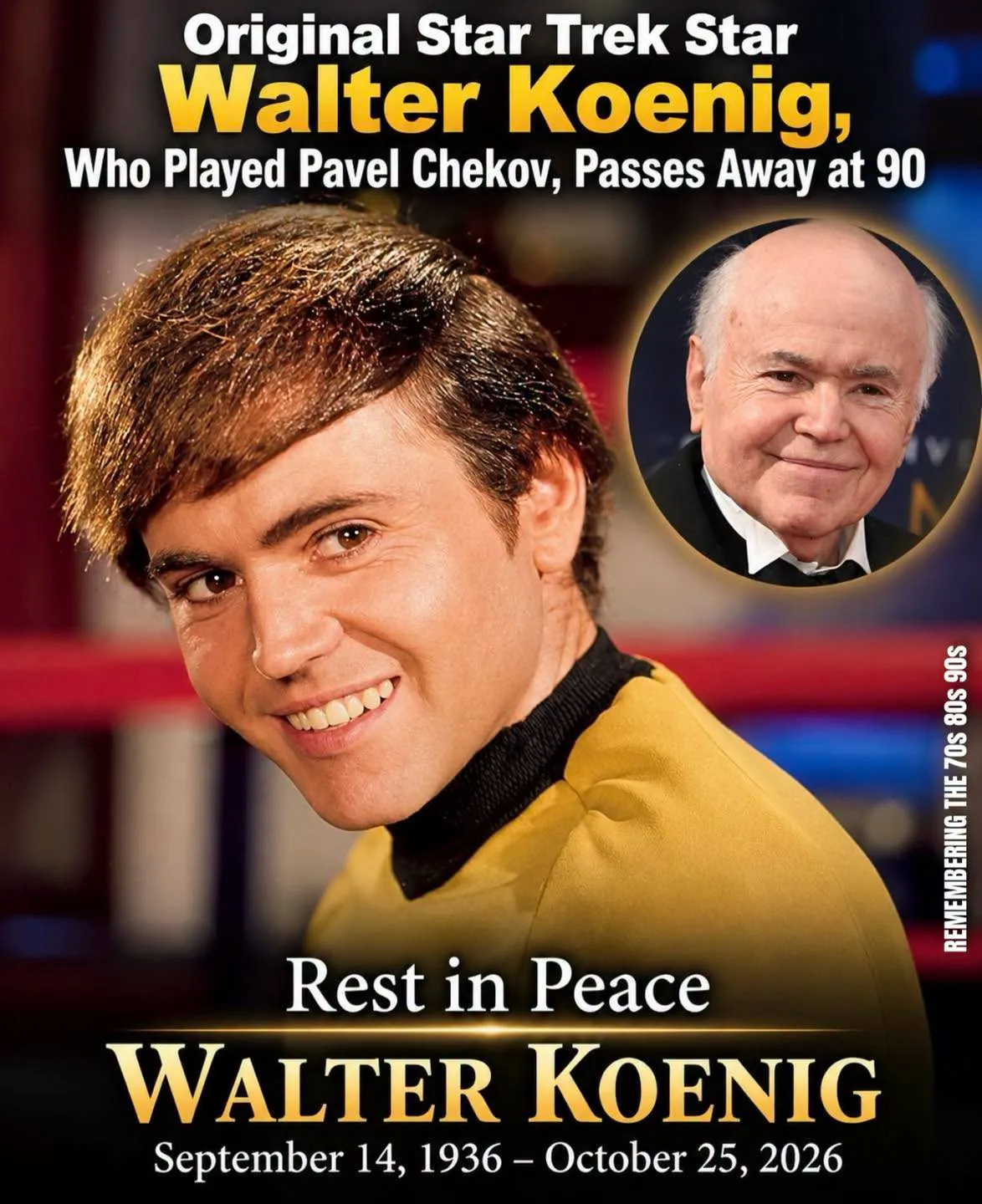
Thank you, Walter
I knew Chekov at the navigation console, Chekov screaming with an eel in his ear and Chekov asking a stranger for the nuclear wessels. I knew him from a television set in the 1960s and from a model Enterprise with lights in it, under a Christmas tree.
He stood for what Star Trek promised, and he did it with a smile and that accent. Rest in peace, Mr. Koenig. Thank you for shining so brilliantly.
- Walter Koenig, Who Played Star Trek's Chekov, Dead at 90, TVLine
- Walter Koenig, Chekov in Original Star Trek Series, Dies at 90, Forbes
- Walter Koenig, actor who played Chekov on original Star Trek series, dies at age 90, CBS News
- Walter Koenig, Wikipedia
- Mind War, Wikipedia
- J. Michael Straczynski, Facebook tribute to Walter Koenig, October 26, 2026
- Star Trek IV: The Voyage Home's Infamous Extra Story, Looper
