Latest
You Don’t Own Anything AnymoreThe Budget Decided How My Department Was ShapedWhy Your Competitor’s Book Is Working and Yours Would NotWhy Are These Guys Smiling? A Business Book That Became a Wrestling MemoirPangram Wants to Decide Who Gets PublishedWhat You Have Enough Material For Right NowWhen a Book Is the Wrong ToolThe Woke VirusGalactic InvasionChatGPT Turns Four: From a Free Research Preview to GPT-6What’s New at The Writing King: Week of November 1, 2026Diwali: The Festival of Lights and the Story Behind the LampsHow Much Water and Power Does Heavy AI Use Take? I Ran My Own NumbersBad Boys: Ride or Die (2024)Anti-Communism Week: Remembering the Writers Communism SilencedVesuvius Day: The Teenager Who Wrote Down Pompeii’s Last DayVoyager 1 One Light-Day: Fifty Years to Travel One Day of LightVellum Added an Optional AI Feature. A Pile-On Killed It in a Day.Are AI Subscriptions Losing Money? The Gym Membership Math Says NoAI Terms Every Writer Should Know, and Why Each One MattersWorking While Sick: What 24/7 On Call Cost MeHe Banned AI From His Writing Group. His Own Cover Got Called AI Slop.Who Writes the Fake Fan Mail Authors Get? Inside the Scam CompoundsSMS Appointment RemindersJoe Rockey: Ghostwriting His BookFree BooksDarrell Stern: Stop Being Invisible, Become UnmissableHow to Turn Your Expertise Into a Book People Want to Read | The Expert MethodWhat’s New at The Writing King: Week of October 25, 2026Challenger Remembrance Day: The Engineer Who Wouldn’t SignJoel Salomon: The Truth About MoneyReddit Is Putting Up a Login Wall. Wikipedia Won’t Be Far Behind.Victoria Chemko: The Body Is the First TechnologySir Patrick Stewart: A TributeA Year in the Bank: ADHD, Face Blindness and the Freedom to Walk Out | The Impossible Puzzles Show, Episode 326A Yale Economist Says We Won’t Be Missed. He Forgot the Bread Line.Walter Koenig: A TributeAI Has Paid Off Outside Tech. Apollo Is Reading the Wrong Scoreboard.I Don’t Post Bad ARC Reviews. I Send the Author a Note.The Little Red Book of Stuff That Works!Your Kids Are Your Own FaultGrow a PairYou’re Broke Because You Want to BeIt’s Called Work for a Reason!No Time for TactShut Up, Stop Whining, and Get a LifeWilliam Bessette: AI Enablement and Child Welfare TechnologyFree Book Planning ToolsWhat’s New at The Writing King: Week of October 18, 2026Ghostwriting by the Numbers: Timelines, Word Counts and the First Call

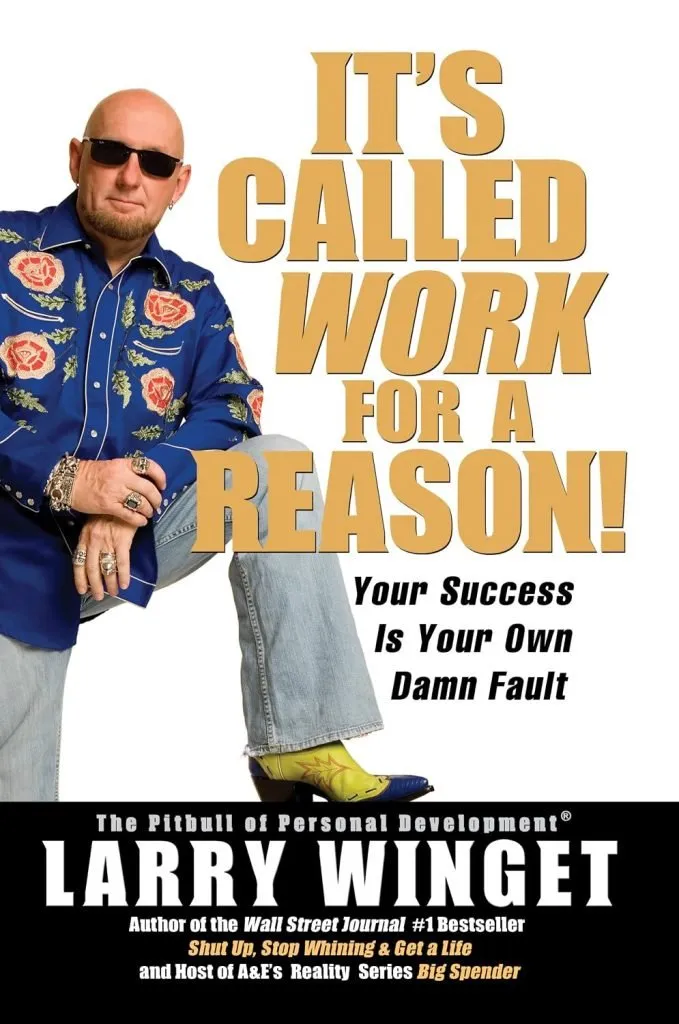
It’s Called Work for a Reason!

It’s Called Work for a Reason!

Your Success Is Your Own Damn Fault

Author:Larry Winget
Publisher:Avery, Gotham
Published:December 28, 2006
Pages:239
ISBN:9781101218198
Language:English
Share:

Description:

TL;DR

Larry Winget’s book about the job. His case: success at work is simple, results are everything, and your career is your own damn fault. He takes on employees, managers and business owners alike, and tells all of them to be worth more than they cost.

It’s Called Work for a Reason! takes the accountability argument from Shut Up, Stop Whining, and Get a Life and points it at the workplace. Gotham Books published the hardcover in late December 2006, Winget read the audiobook himself, and the Avery paperback followed a year later. It became a New York Times and Wall Street Journal bestseller.

Winget writes it for people who are frustrated at work, feel underappreciated, have no luck in business, or aren’t getting the career they want. His answer to all of them is in the subtitle.

The fifty percent problem

The book starts from a claim about effort. The publisher’s description cites studies saying people work only about half the time they are on the job, and one summary of the first chapter describes Winget putting the average American at about a 50 percent level of total output. His question follows from it: if you’re giving half, whose fault is it when the results don’t come?

Publishers Weekly reviewed it in October 2006 and called it a full-throttle rant covering careers, the relationship between employer and employee, management, productivity and pay. The review singled out his black-and-white view of ethics and his reminder that a company exists to make a profit, with keeping employees happy beside the point. It quotes his line “No work, no pay. No work, no job.”

What the book argues

The publisher lists the provocations the book is known for: success is simple, teamwork doesn’t work (one of the chapter titles), many co-workers are really only “co-goers,” results are everything, and you don’t have to love your job, though it helps. Winget also drops the usual business-book furniture: no jargon, no parables, no praise sandwiches.

Reviewers pull out the practical side. One describes Winget replacing the to-do list with a list of things that have to get done, and telling readers to manage priorities instead of time. Another summarizes a dozen rules for employees: be known for getting things done, keep promises, be on time, don’t gossip, brag or complain, don’t put up with an abusive or unethical employer, find the most important part of your job and do it, and serve the customer, remembering that someone else decides what you do.

The closing advice is old-fashioned. Remember the work ethic of your parents and grandparents, and make yourself worth more than you cost.

The book is not written only for employees. Winget addresses people who punch a clock, people who own a business and people who manage others, and he is just as blunt with bosses who tolerate poor performance as with the people who deliver it.

Keep reading

The same blunt accountability, aimed at the rest of life: People Are Idiots and I Can Prove It!

Who should read It’s Called Work for a Reason!?

It suits anyone who feels stuck at work and suspects the problem might be closer to home than the boss’s office. Managers will find language for conversations about performance, and owners will find a hard look at what they tolerate. Readers who want sympathy about a bad job won’t find it; Winget warns early that there will be parts of the book they won’t like.

Where this book fits in Winget’s work

It is the work volume in a run of books that each apply one idea to one area of life: Shut Up, Stop Whining, and Get a Life for life in general, this one for the job, You’re Broke Because You Want to Be for money and Your Kids Are Your Own Fault for parenting.

Explore the hub

The Leadership Hub: twenty years of running teams, and what works when the job gets hard.

Frequently Asked Questions

What is It’s Called Work for a Reason! about?
It is Larry Winget’s argument that success at work is your own responsibility. He says success is simple, results are everything, and the way to get ahead is to make yourself worth more than you cost, with no secret shortcut.
Why does Larry Winget say teamwork doesn’t work?
Teamwork Doesn’t Work is one of the book’s chapters and one of its best-known provocations. Winget argues that results come from individuals taking responsibility for their own work, and he uses the claim to puncture comfortable workplace slogans.
What did Publishers Weekly say about It’s Called Work for a Reason!?
Its October 2006 review called the book a full-throttle rant on careers, management, productivity and pay, and noted Winget’s black-and-white ethics and his point that a company exists to make a profit, with keeping employees happy beside the point.
Who is It’s Called Work for a Reason! written for?
Employees, managers and business owners. Winget says his advice applies whether you punch a clock, run your own company or manage other people, and he is equally blunt with all three.
When was It’s Called Work for a Reason! published?
Gotham Books published the hardcover in December 2006, with an audiobook read by Winget at the same time. The Avery paperback followed in December 2007. It became a New York Times and Wall Street Journal bestseller.
Categories and tags
CategoriesPersonal Growth

About the author

Larry Winget

Larry Winget is an American business speaker, television personality, and bestselling author of personal development and small business books, widely known by his trademark nickname the Pitbull of Personal Development. His style is bluntly direct, anti-self-help, and built on personal accountability, and his books have sold in the millions across multiple bestsellers. His best-known titles include Shut Up, Stop Whining,…

More about Larry Winget

Back