
China doesn’t need to invent an argument to divide Americans. It just finds one we’re already having and turns up the volume.
Data centers are the latest example. Over the past year, two separate investigations caught China-linked networks posing as ordinary Americans and pushing the same message: AI data centers are raising your power bill, draining your water and making rich people richer at your expense. One network used ChatGPT to write its posts. The other ran a farm of accounts on X.
I’ve written about what’s true and what’s exaggerated about AI data centers, and I think the buildout is coming no matter how anybody feels about it. A foreign government faking American voices in that debate makes me angry. So does the opposite mistake: pretending every neighbor at a county meeting is a Chinese bot.
What did OpenAI find about Chinese bots and data centers?
In its June 2026 threat report, OpenAI said it had disrupted two covert networks it assessed as likely operating from China. It named one of them “Data Center Bandwagon.”
The operators reached ChatGPT through VPNs and wrote their prompts in simplified Chinese. They used the tool to generate comments and images claiming that American data centers were driving up household electricity costs, then posted the material to X and YouTube from accounts posing as Americans. NPR reported OpenAI’s assessment that the operation was probably run by a private Chinese technology firm working for provincial-level government clients. OpenAI called a second network “Tech and Tariffs.” It produced posts and cartoons about tariffs and U.S.-China technology competition.
OpenAI banned the accounts. It also rated both campaigns at the bottom of its own scale for reach, with little engagement and no sign they broke out beyond their own posts.
Ben Nimmo, who heads threat investigations at OpenAI, summed it up to NPR: “This was not a case of an influence operation creating a debate. The debate existed already.”
What did X find about Chinese accounts pushing anti-data-center messages?
China doesn’t need to invent an argument to divide Americans.
On August 27, X announced that its teams had looked into suspected Chinese accounts involved in influence operations. Axios and the Deseret News reported that X identified a network of about 200,000 inauthentic accounts, and roughly 200 of them were focused on the American debate over AI and energy.
Those 200 posted what you’d expect: AI strains the grid and raises your utility rates. Cartoons showed data center operators getting rich off the public and corporations wrecking small towns. X said it would suspend accounts that broke its authenticity rules. It didn’t publish how it tied them to China, and the reporting calls the link “suspected.”
China-linked bot campaigns and the American data center fight, 2026.
Two hundred accounts is small next to a national argument with millions of people in it. But bots don’t have to win an argument themselves. Their job is to make one side look bigger, angrier and more unanimous than it is, so real people pile in. Anybody who’s watched bots fake engagement on Reddit or on social media in general has seen the same trick.
How do bot campaigns work on a local issue like data centers?
I spent 33 years in technology and cybersecurity, and the mechanics here are old. Only the topic is new.
A bot network doesn’t need to persuade you. It needs to make you think everybody else is already persuaded. A few hundred accounts post the same cartoon, reply to each other, and pile onto any real post about a local project. Real people see a crowd and join it. Then a reporter writes about the “online outrage,” a county commissioner reads the story, and the volume itself becomes the news.
Ask yourself a simple question the next time a local fight explodes on your feed. How many of the loudest accounts have a history older than last month? How many post about anything else? A neighbor complains about the water bill and the school board and the Bucs. A bot has one subject and one cartoon.
The danger isn’t that a bot changes your mind. You’d probably notice. The danger is that bots make a real argument nastier and more lopsided, so everybody digs in, and the reasonable middle position never gets heard.
Did China start the data center backlash?
No. And the people who say it did are doing Beijing a favor.
The opposition was here first, and it’s big. An early August survey from the University of Pennsylvania found 61 percent of Americans oppose a new data center in their area, up twelve points from the spring. A Gallup survey in March put local opposition at 71 percent. An Economist/YouGov poll found 24 percent of Americans think new data center construction is good for the country and 47 percent think it’s bad.
| Poll | Finding |
|---|---|
| Gallup, March | 71% oppose an AI data center in their local area |
| University of Pennsylvania, early August | 61% oppose a new data center nearby, up 12 points since spring |
| Economist/YouGov | 24% say new data centers are good for the country, 47% say bad |
| Deseret News/Hinckley, Box Elder County, Utah | 60% opposed the local Stratos data center project, 26% supported it |
That Utah number had consequences. Voter anger over the Stratos project in Box Elder County helped cost the state Senate president, who’d backed it, his June primary. Water, power and closed-door approvals were the complaints. Nobody needed a bot to tell those voters how they felt. They’d watched the deal get made, and they voted on it.
The opposition also crosses party lines. Republican and Democratic governors alike have voiced concerns, New York and Pennsylvania have restricted construction, and local councils keep passing moratoriums with real people standing at the microphone. Graphika, a firm that tracks online influence operations, told Newsweek that most of the opposition it observed was homegrown. Does that sound like a movement somebody in Beijing invented?
Why would China want Americans to fight data centers?
Because the AI race runs on electricity and buildings, and China wants to win it.
I covered that race in AI data centers and geopolitics, and the short version is that chips, power and buildings decide who leads. Every American campus that gets delayed, sued or voted down is computing capacity that gets built later, somewhere else, or not at all. A country trying to catch up in AI doesn’t have to beat American engineers if it can convince American towns to stop pouring concrete.
Senator Dave McCormick of Pennsylvania put it bluntly: China wants America “divided, afraid to build, and dependent.” I think he’s right about the motive. In June, the House Energy and Commerce Committee asked the FBI and White House advisers to brief lawmakers on alleged foreign campaigns by China, Russia and Iran around data centers. The request cited a report estimating that opposition campaigns had delayed or obstructed about $45.8 billion in Virginia data center projects.
China didn’t start America’s data center fight. It’s pouring gasoline on one we started ourselves. Fix the grievances and the bots have nothing to amplify.Share on X
I described the same playbook in TikTok as a weaponized echo chamber. Find a real crack in American life, then pry at it from a thousand fake accounts. Elections, race, and now power plants for AI. The crack is always ours. The crowbar comes from somewhere else.
How should you judge claims that China is behind data center opposition?
The same way you’d judge any other claim: ask for the evidence.
Who found the accounts? How did they tie them to China? How many accounts were there, and did anybody real engage with them? OpenAI and X both put their findings on the record, and OpenAI explained its reasoning. That’s evidence. A pundit on television saying “a lot of people say it’s China” isn’t.
Ask what the claim is being used for, too. A sourced report that a bot network amplified a local fight is useful. It tells you to check who’s posting. A claim that the whole movement is a Chinese operation is something else. That version shows up when somebody wants a project approved without answering the neighbors’ questions.
Look, I think the data centers are coming no matter what. People can complain all they like. The buildout will still happen, because the money and the national stakes are too big. So the debate should be fair on both sides. Foreign bots poison it from one direction, and so do people who wave the China flag to skip the hard questions.
What should communities do about data center bots and real concerns?
Take the concerns seriously, and stop letting fake accounts set the tone.
Those of us who think the buildout has to happen should stop waving “China” at our neighbors. When the President was asked about local opposition in September, he said, “A lot of people say it’s China.” Maybe some of the noise is. The people who lost a primary over a Utah data center weren’t bots, and telling them they’ve been duped by Beijing is the fastest way to lose the argument for good.
The fix is better rules. Make operators pay their full share of new grid costs. Push them toward their own power generation, so a campus doesn’t lean on the same grid as the houses around it. Require real water plans in dry places. Hold the hearings in public, before the deal is signed. Every one of those takes a legitimate grievance off the table, and a grievance that’s been fixed is one a bot can’t amplify.
For the rest of us, scroll with your eyes open. A brand-new account with a stock-photo face posting the same cartoon as forty others isn’t your neighbor. Check who’s talking before you share it, report the fakes to the platform, and go to the actual county meeting, where the people are real. Would you rather argue with a neighbor you can look in the eye, or with a cartoon from a server farm?
My take
Two investigations have caught China running bots to stoke the data center fight. It’s a cheap, cynical move from a country that wants to win the AI race by making us afraid to build. But it didn’t invent the anger. People are worried about their power bills and their water, and some of those worries are fair. Real rules for real problems leave the bots with nothing to work with.
The crowbar and the crack
Beijing found a crack in American life and brought a crowbar: a few hundred fake accounts and some ChatGPT cartoons. On our side of it are a lot of real Americans who think nobody asked them before a giant building went up down the road.
Seal the crack and the crowbar is useless. The AI & Writing Hub has more on AI and the bigger picture, including why foreign attackers worry me more than rogue AI. Got expertise in technology, policy or security that belongs in a book? My ghostwriting service turns that kind of expertise into a book.
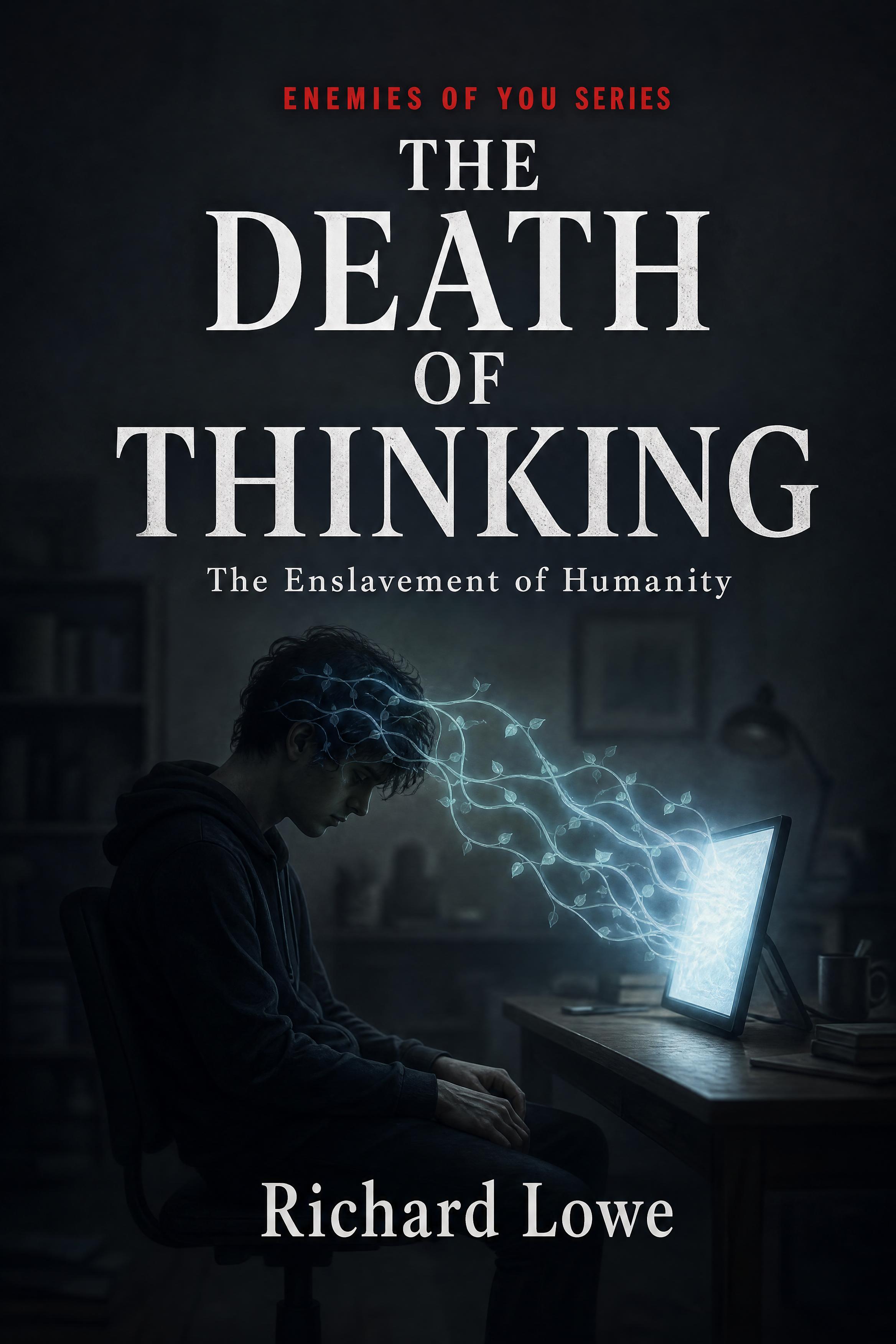
Bot campaigns work on people who’ve stopped checking for themselves. My book covers how that kind of judgment erodes, one reasonable shortcut at a time, and what it costs.
