TL;DR
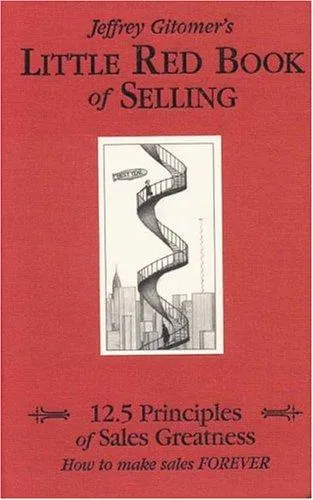
7/10. Twelve and a half principles delivered at volume in short bursts, built on one line that does most of the work: people don’t like to be sold, but they love to buy. Abrasive, repetitive, and more useful than its packaging suggests.
The format is a deliberate choice. Red cover, short sections, bold type, exclamation marks, and a tone somewhere between a sales trainer and a man shouting at you in a car park.
The half principle is a joke that’s also the point: he numbers it 12.5 because the last one is short and because the whole book is refusing to be solemn about a subject most people find excruciating.
The principles cover getting off your own back, preparing to win, personal branding, humor, creativity, referrals, and persistence, and the through line is that the seller is the variable and not the pitch.
I don’t enjoy a book shouting at me, and I still keep this one around. The volume is exhausting, and the central idea is so good that I’ll forgive a lot of exclamation marks to get it.
What is the central idea of The Little Red Book of Selling?
People don’t like to be sold, but they love to buy.
That single line reframes the entire job. It moves the work from persuasion, which is adversarial and which everybody can feel happening to them, to removal of obstacles. That’s collaborative. The consequence is a completely different set of actions. If you’re persuading, you build arguments and handle objections. If you’re removing obstacles, you find out what’s standing between somebody and a thing they already want, and you address that.
This reframe is the reason I’d put up with any amount of shouting. Too much sales training teaches people to wrestle prospects into submission, and everyone on the receiving end can feel it happening. Gitomer’s version treats the buyer like an adult who already wants something.
For a ghostwriter this is directly applicable and it’s why I keep the book. Nobody has ever been talked into a book. They arrive having wanted one for five years or twenty, and the conversation is about what is in the way: money, time, fear of exposure, uncertainty about whether the story is worth telling, or a previous bad experience with a writer.
Every one of those is an obstacle and a pitch answers none of them.
Watch: The Little Red Book of Selling by Jeffrey Gitomer | Audiobook Summary, Busniess Books Summaries and Stories
What does The Little Red Book of Selling say about referrals?
The strongest section after the reframe, and the least exciting. That’s usually how it goes.
His position is that referrals come from having done work worth talking about and then asking, and that most people do neither and blame the market. The doing is the harder half. Work that’s merely satisfactory produces no referrals, because nobody mentions adequate. A referral requires that somebody had an experience they want to describe. That means the work has to exceed the transaction in some specific and memorable way. This chapter is uncomfortable to read. It’s easy to blame the market when referrals dry up, and much harder to admit the work was merely fine. Gitomer won’t let you off that hook, and he’s right not to.
The asking is the part people skip out of discomfort. Gitomer is blunt that a satisfied client won’t think to refer you unless prompted, that the prompt should be specific and not general, and that asking who else has this problem is a better question than asking whether they know anybody.
He’s also right that the moment to ask is at the point of delivered value and not at the point of invoice. That’s a small distinction that changes the answer.
That timing point is small and smart. A referral request stapled to an invoice feels like a toll booth, and the same request at the moment someone’s delighted feels like a natural conversation.
What is the personal branding material worth?
Less than it was, and it’s the most dated part of the book.
Written in 2004, the specifics are about newsletters, speaking at chamber events, and getting into the local business press. Those aren’t wrong and they’re a description of a media environment that’s changed considerably. The principle underneath survives. His argument is that people buy from people they know about before the conversation starts, and that the work of becoming known is done in advance and can’t be compressed into a meeting.
Translate the tactics and the principle applies exactly. A prospect who has read three of your articles arrives as a different person from one who found you in a directory, and the difference isn’t in what you say to them.
I think the principle matters even more now than it did in 2004. People look you up before the first conversation, and whatever they find has already done half the talking.
Who should avoid The Little Red Book of Selling?
Anybody who dislikes being shouted at. That’s a major proportion of readers and a reasonable position.
It’s loud. It repeats itself deliberately, on the theory that repetition is how sales training works. It uses the word greatness without embarrassment. There are exclamation marks on most spreads. If that tone makes you close a book, close it. The ideas are available elsewhere in a quieter form, and reading something you’re fighting the whole way produces nothing.
What the volume buys is memorability, and Gitomer knows exactly what he’s doing. Six months later you’ll remember the line about being sold and loving to buy. That’s more than most quieter books manage.
Verdict
Read it for the reframe and the referral chapter, skim the rest, and forgive the volume.
It’s a book for people who dislike selling, and its central move, turning persuasion into removal of obstacles, is the thing that makes selling survivable for that kind of person. I’d put up with twice the volume for that one idea.
Explore further
The Publishing and Marketing Hub: getting a book found, sold, and talked about.
Frequently Asked Questions
Other Books From – Business and Economics