TL;DR
8/10. The claim that the Peter Principle understates it, and that organizations promote the least competent directly into management to limit the damage they can do. Built considerably from reader mail describing real workplaces. That’s why it works.
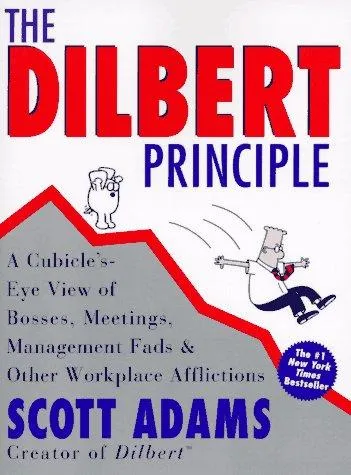
Adams was working at Pacific Bell when the comic strip started, drawing it before work, and the book came out of what happened afterward.
He put his email address in the strip, which almost nobody was doing in the early nineties, and received thousands of messages from people describing things their own employers had done. The satire is considerably assembled from those. That’s the reason it stays credible even when it seems impossible.
The reader-mail origin is why this book affects me so much. Adams didn’t have to invent the absurdity.
Thousands of working people sent it to him, and he arranged it. When satire is built from complaints real employees mailed in, every laugh carries a small sting of recognition, and I think that sting is the reason the book still works.
The stated principle is that the Peter Principle, where people rise to their level of incompetence, was too optimistic. Companies now route the least effective people straight into management, where the theory goes that they can do the least harm to actual production.
Why does the principle hold?
Because it describes a real incentive and not a conspiracy. A competent engineer is expensive to lose from engineering. Promoting them costs the organization its best technical work. Promoting somebody who was struggling costs nothing anybody will miss, and it solves a personnel problem without a dismissal. Nobody sits in a room and decides this. It emerges from a set of individually reasonable decisions. That’s how most organizational pathology emerges, and that’s what makes it durable.
This is the section I’d make every new executive read before their first reorg. Nobody in these stories is a villain, and that’s what makes it so maddening. Each decision looks sensible on the day someone makes it, and the pile of them produces an org chart that punishes competence.
Adams also identifies why it persists once established. A manager promoted this way selects for people like themselves, because the alternative is hiring somebody who will make the gap visible.
Watch: The Dilbert Principle: How Does Scott Adams’ Manifesto Hold Up 30 Years Later?, Jordan Owen
What does The Dilbert Principle get right about corporate life?
The mechanisms, and thirty years on the specific fads have changed and the mechanisms haven’t.
Mission statements assembled from interchangeable words, which he shows by generating them randomly and daring the reader to spot the difference. Reorganizations announced as strategy when they’re frequently a way of moving a problem. Consultants selling back to management what the employees told them in the first week.
Metrics that reward the measurement instead of the outcome. That’s the single most reliable source of organizational absurdity and which he covers repeatedly. Once a number is a target it stops being a measurement, and people optimize the number.
Metric worship is the corporate habit that makes me angriest, and Adams skewers it better than any management book I know. A target that replaces the outcome turns smart employees into accountants of their own busywork, and the organization ends up paying them to look productive.
I spent decades inside large organizations and I recognized nearly all of it. The chapter on meetings is the closest thing to documentary in the book, especially the observation that the purpose of most meetings is to distribute responsibility for a decision somebody has already made.
Is there a serious argument underneath The Dilbert Principle?
Yes, and it’s about incentives instead of individual stupidity.
Adams’s people are responding sensibly to a system that rewards appearing productive over being productive, and the comedy comes from the gap between the two. An employee who spends the afternoon on a status report nobody reads is behaving rationally, because the report is what gets seen. That’s a more generous reading than the cover suggests and it’s why the book is useful and not merely funny. If the behavior is rational given the incentives, then complaining about the people is the wrong response and redesigning the incentives is the right one. I think this is the most useful idea in the book, and it’s easy to miss because Adams hides it inside jokes. It’s easy to blame the people, and it feels good. A redesign of the incentive is harder work, and it’s the only move that fixes anything. He also makes a point that’s aged well about employees as the only people who know how the work is done and the last people consulted about changing it.
What has dated in The Dilbert Principle?
The technology, entirely, and some of the tone. The references are to fax machines, mainframes, and an office culture that no longer exists in that form. The jokes about email being a new burden read strangely now.
Some of the humor is of its period in ways that a reader will notice, especially around gender in the workplace, and it’s more dated than offensive.
The gender jokes embarrassed me, and a modern reader will cringe in the same places. I’d still hand the book to a young manager, because the cringe costs a page and the point about incentives lasts a career.
What hasn’t dated is the structure of the complaints. Remote work, agile transformations, and AI adoption have produced exactly the same pathologies with new vocabulary, and a reader could update the examples without touching the argument.
Verdict
Very funny and better analysis than it pretends to be. Anybody who manages people should read it. The failures it describes are all failures of incentive design, and the reader mail is the evidence.
The specific technology is dated. Nothing else in it is, and that should unsettle anyone who’s sat through an agile transformation. It galls me that a book full of fax machines still describes the modern office better than most leadership titles published this decade, and I’d put it on every manager’s desk before they hire another consultant.
Explore further
The Leadership Hub: running things, and the failures that repeat.
Frequently Asked Questions
Other Books From – Business and Economics