TL;DR
General Ann Dunwoody, the first woman in U.S. military history to reach four-star rank, turns a 37-year Army career into a leadership book built on principles. She lives in Tampa.
Ann Dunwoody joined the Army in 1975 planning to stay two years. She left 37 years later as the first woman in American military history to wear four stars.
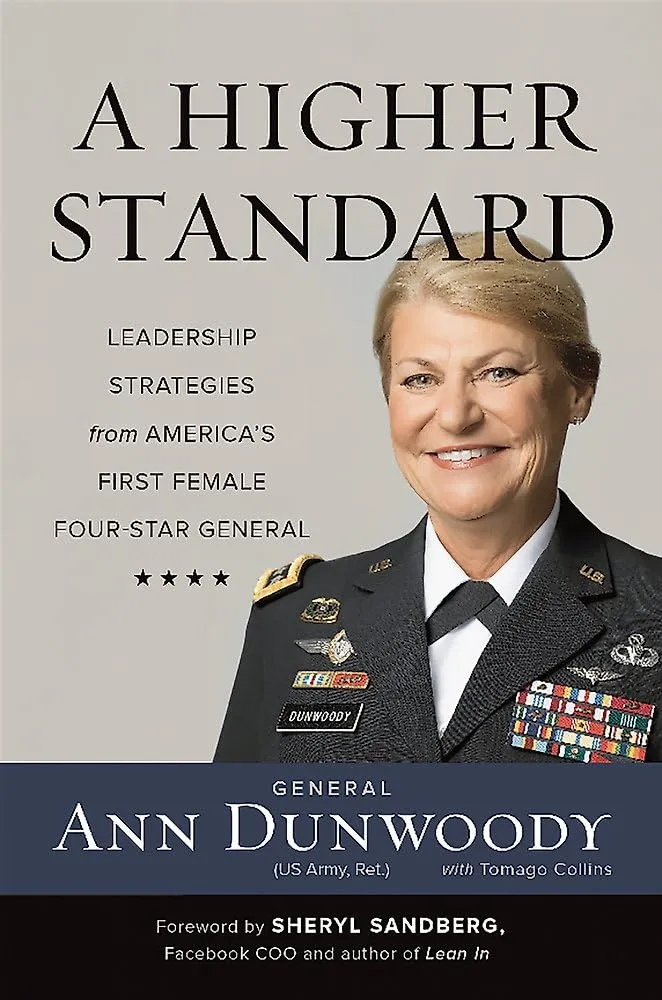
A Higher Standard is the book she wrote about how that happened, and what she learned leading along the way. Da Capo Press published it in April 2015, written with Tomago Collins and with a foreword by Sheryl Sandberg.
What is A Higher Standard about?
It’s a leadership book first and a memoir second. Dunwoody built it around principles drawn from her childhood, college athletics, the Army and the corporate boards she joined after retiring.
She opens as a young lieutenant reporting to Fort Sill and ends at the head of Army Materiel Command, an enterprise of about 69,000 people that ran the Army’s global supply chain during the wars in Iraq and Afghanistan. She counts eleven principles in all. Several of her principles come straight from sports, like forming a winning team and building a bench. Others are her own, like never walking past a mistake. A leader who ignores one has just set a new, lower standard.
The title comes from there.
Who is Ann Dunwoody?
Dunwoody was the first woman to command a battalion in the 82nd Airborne Division and the first female general officer at Fort Bragg. She became the Army’s top logistician in 2005 and was promoted to four-star general in November 2008. She commanded Army Materiel Command until she retired in 2012, after 37 years, and went on to advise companies and serve on corporate boards. Along the way she earned a place in the Army Women’s Foundation Hall of Fame and, in 2019, the Sylvanus Thayer Award from West Point’s alumni.
She came out of SUNY Cortland and joined through a direct commission in 1975, while the Women’s Army Corps still existed.
She’s candid about being a woman in the Army. She writes that she never faced direct sexual harassment in uniform, and she credits the Army with breaking the brass ceiling.
She lives in Tampa.
Stanley McChrystal, Walter Isaacson and Frances Hesselbein all praised the book, and the Tampa Bay Times reviewed it twice in 2015.
How do you turn a military career into leadership principles?
Dunwoody’s book shows one way. She didn’t tell her career in order. She pulled out the lessons she kept relearning, gave each one a name and then went back through the career for the stories that proved it.
Any long career can be mined the same way. The raw material is the stories a leader already tells. The work is noticing which lesson each story keeps teaching, and grouping them so a reader can find the one they need.
Why does A Higher Standard belong on this shelf?
It shows a career turned into a book of principles instead of a chronology. A reader in a corporate job can open any chapter and use it.
Readers outside the military use it the same way.
And the credit line is honest. Dunwoody wrote it with Tomago Collins, and the book carries both names. A four-star general with a busy board career and a working collaborator is a very common way leadership books get written.
Keep reading
Hiring a ghostwriter for a retired general’s or admiral’s leadership book: how senior military leaders turn a career into a book, and what has to stay out.
Frequently Asked Questions
Other Books From – Business and Economics