
Stuck in the Middle
Wars, Weapons, and the Next Thirty Years
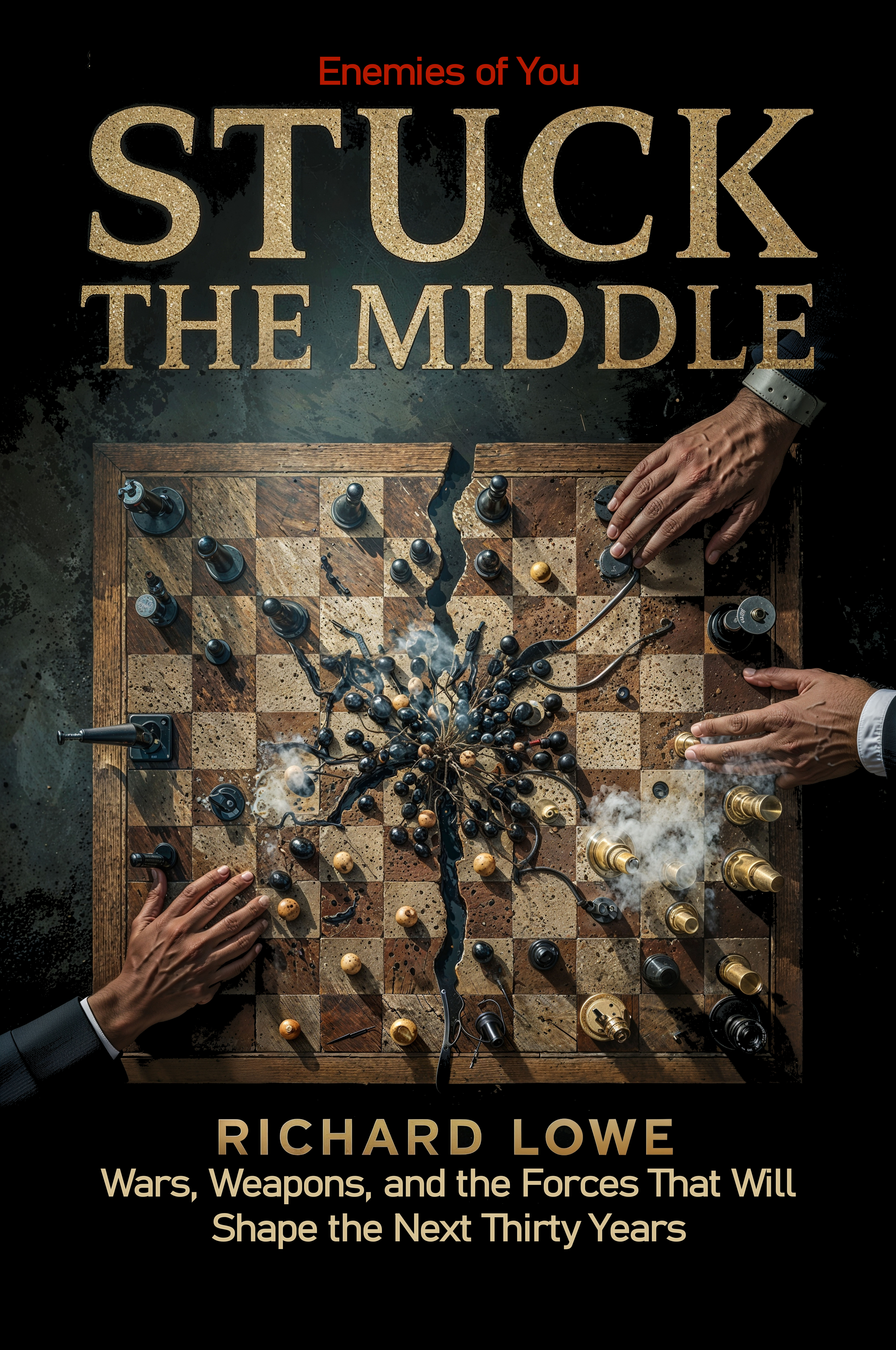 |
The Iran war isn’t the subject. It’s the entry point. BUY FROM INGRAMSPARKAMAZONKOBOREAD THE INTRODUCTIONTABLE OF CONTENTS 362 pages · Paperback ISBN 978-1-972810-03-3 · ebook ISBN 978-1-972810-04-0 |
| 362Pages | 45Chapters | $120Oil, within a week | 30Years this looks ahead |
The Iran war is not the subject. It is the entry point.
On 28 February 2026 the United States and Israel launched coordinated strikes against Iran. Within a week the Strait of Hormuz was effectively closed, oil went past 120 dollars a barrel, American warships were burning through missile stockpiles faster than industry could replace them, and a war most Americans opposed was consuming the assets the country needs for a threat everyone agrees matters.
By the time the shooting stopped in April the Supreme Leader was dead, his son had been installed by the Revolutionary Guard, and the Gulf states were calling Beijing instead of Washington.
That alone would be enough for a book. But it’s the symptom instead of the disease.
The disease is structural. The United States built the most powerful military in history and hollowed out the industrial base that sustains it. It built the greatest innovation engine and defunded the research that feeds it. It built an alliance system and withdrew from it so gradually that nobody noticed until it started breaking.
What is inside Stuck in the Middle?
|
The entry point
|
The structural problem
|
|
The competitors
|
The next thirty years
|
Who should read Stuck in the Middle?
|
Read it if
|
Not for you if
|
Why did I write Stuck in the Middle?
Richard Lowe, the Writing King
Thirty-three years running technology operations inside a large organization, which is training in what happens when a system’s supporting capacity is quietly allowed to decay while the visible part still looks fine. That’s the argument of this book applied to a country.
► Behind the Book: Stuck in the Middle
How this one got written, what went wrong, and what got cut.
► I Raised the Alarm on Pandemic Preparation. I Got Laughed Out of the Room.
One story from behind this book.
What do people ask about Stuck in the Middle?
Further reading
Ghost Wars by Steve Coll is the definitive account of a country used as a board by larger powers, covering twenty-two years of covert operations in Afghanistan and ending on 10 September 2001.
Also in Enemies of You
|
The Enshittification of America How Good Businesses Were Taken Apart |
What Outsourcing Judgment Costs |
|
The Birth of the Augmented Human What Goes Right When You Use AI Properly |
Including the Man Who Wrote This |
|
What Bezmenov Described and Nobody Acted On |
Why the Story We Tell Ourselves Matters |
|
Turn Off the TV, Get Off Your Ass, and Do Something Getting Your Time Back From the Screens |
The war was the symptom
The structure underneath it’s the thing that decides the next thirty years.
BUY FROM INGRAMSPARKAMAZONKOBOREAD THE INTRODUCTIONTABLE OF CONTENTS
Paperback and ebook.
Introduction
Stuck in the Middle
On February 28, 2026, the United States and Israel launched coordinated strikes against Iran. What was supposed to be a short, sharp demonstration of overwhelming force turned into the first sustained naval conflict the US had fought since World War II. Iran fired back. Not with the kind of pinprick attacks the Pentagon had war-gamed against, but with everything it had.
In the first five days, Iran launched over 500 ballistic and naval missiles and nearly 2,000 drones. Not at American ships directly, because Iran couldn’t reliably find them. At American bases across the Middle East, at Gulf state allies, at Israel, at anything associated with the coalition. The sky over the Persian Gulf, the Arabian Sea, and the eastern Mediterranean filled with incoming threats around the clock.
The ships did their job. Aegis cruisers and destroyers tracked incoming missiles and knocked them down. THAAD batteries ashore swatted ballistic missiles at high altitude. Patriot batteries caught what leaked through lower down. The layered defense system worked exactly as designed.
Then the numbers started telling a different story. Each THAAD interceptor costs roughly twelve million dollars. Each SM-6 runs four to five million. Iran was building the ballistic missiles those interceptors were designed to kill for a few hundred thousand dollars apiece. And Iran could build about ninety missiles a month. The US could manufacture six or seven interceptors in the same period.
Read those numbers again. Ninety versus seven. That’s not a production gap. That’s a production chasm.
Four days into the war, at least one Gulf ally was already running low on interceptors. Four days. Not four months. The United States burned through approximately a quarter of its entire stockpile of THAAD interceptors defending Israel during the opening phase. A system that took years to manufacture was being consumed in days.
The Houthis had been sending this same message for two years and nobody listened. American destroyers in the Red Sea had been firing million-dollar SM-2 missiles to shoot down drones that cost twenty thousand dollars. Do that math enough times and you go bankrupt. The Iran war was the Houthi problem at industrial scale, and nobody had done anything about it in the two years between the warning and the test.
The missile math shows the deeper problem. The US military doesn’t have a wartime industrial base. It’s a peacetime industrial base that panics during wars.
Table of contents
Stuck in the Middle
- Preface
- Introduction: The Shape of the Trap
- Part One: The Guns Don’t Work
- Chapter 1: Where Are All the Guns?
- Chapter 2: The Missile Math
- Chapter 3: The Incredible Shrinking Navy
- Chapter 4: The Carrier Question
- Part Two: Wars Without Reasons
- Chapter 5: What Are We Doing Here?
- Chapter 6: The Tail Wags the Dog
- Chapter 7: The Lesson Every Country Learns
- Chapter 8: The War Nobody Can End
- Part Three: The Long Retreat
- Chapter 9: The Invoice Nobody Wants to Pay
- Chapter 10: Somebody Else’s Strait
- Chapter 11: The War That’s Already Here
- Part Four: The Four Horsemen
- Chapter 12: The Empty Cradle
- Chapter 13: The Continent That Can’t Connect
- Chapter 14: The Last Barrel and the Empty Plate
- Chapter 15: The Burning Map
- Chapter 16: The Next Plague
- Part Five: The Quiet Empire
- Chapter 17: The Matador’s Cape
- Chapter 18: Railroads, Not Rifles
- Chapter 19: The Grand Bargain
- Part Six: The Hollowed-Out Country and the Tools to Rebuild It
- Chapter 20: The Enshittification of Strategic Capacity
- Chapter 21: The Deskilled Nation
- Chapter 22: The Nuclear Answer
- Chapter 23: The AI Multiplier
- Chapter 24: The Long Life
- Chapter 25: The Rewritten Code
- Chapter 26: Ghost in the Shell
- Chapter 27: The Innovation Thesis
- Chapter 28: The High Ground
- Part Seven: Stuck in the Middle
- Chapter 29: Two Hemispheres, Stress-Tested
- Chapter 30: The India Question
- Chapter 31: The Better Overlord
- Chapter 32: The Migration Century
- Chapter 33: Clowns to the Left, Jokers to the Right
- Conclusion: The View from Here
- Recommended Reading
- About This Series
- Enemies of You Series
- Index