
Everybody’s Prejudiced
Including the Man Who Wrote This
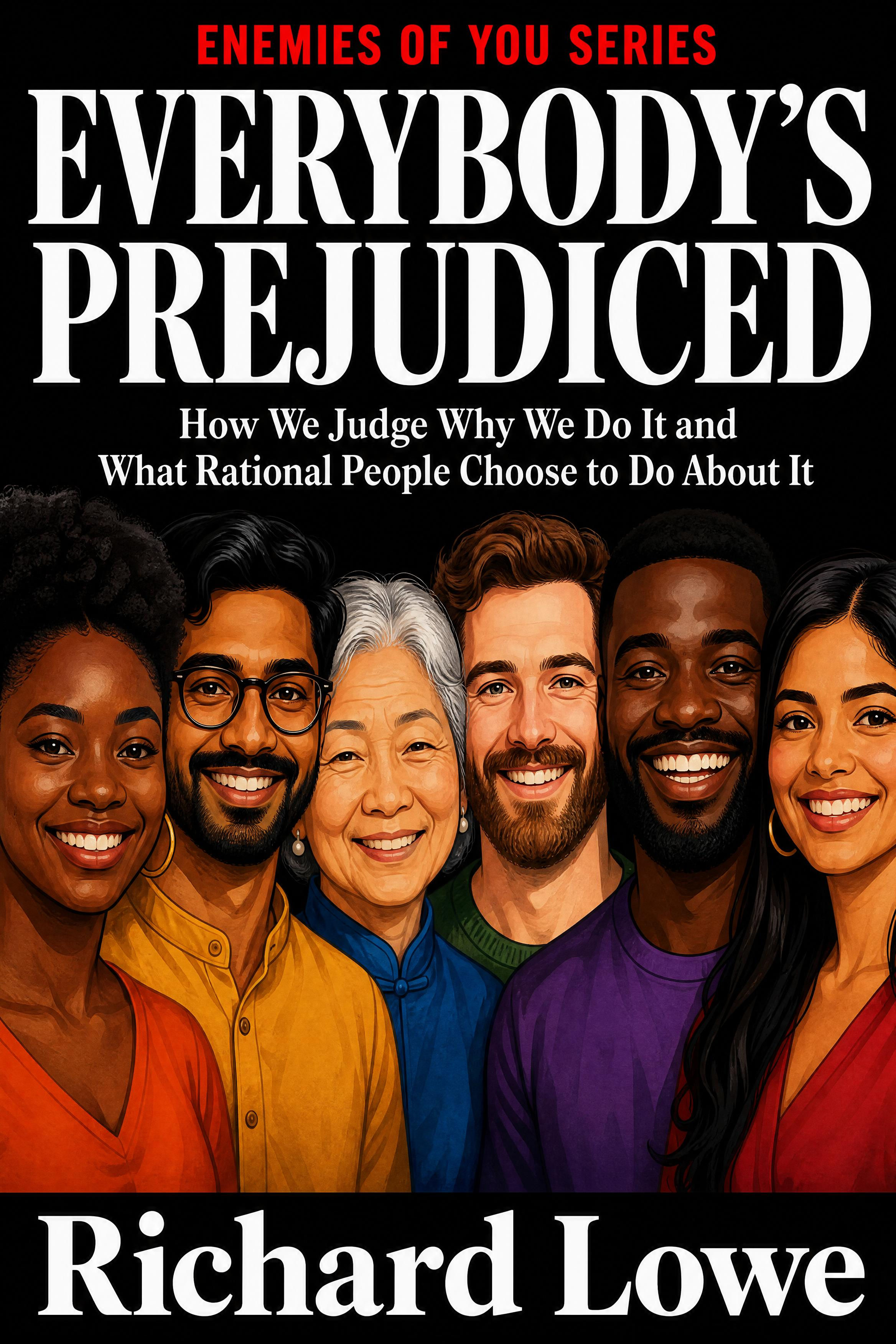 |
I’ll put mine on the table before I ask about yours BUY FROM INGRAMSPARKAMAZONKOBOREAD THE INTRODUCTIONTABLE OF CONTENTS 411 pages · Paperback ISBN 978-1-972810-71-2 · ebook ISBN 978-1-972810-72-9 |
| 411Pages | 33Chapters | 1Author who goes first | 0Comfortable conclusions |
I will put mine on the table before I ask about yours
That’s the deal. The only way this book earns the right to say what it’s going to say is if the person writing it goes first.
I prefer women doctors. Women bankers. Women in customer service. Given equivalent credentials I lean toward the woman almost every time, and I’ve done this for most of my adult life. I’ve justified it ways: more thorough, more attentive, more patient with difficult people.
Maybe that holds as a pattern across my own experience. What I have never done is examine whether my experience proves what I think it proves, or whether I’m giving a flattering name to something that works the same way any other bias works. The name I give it’s informed preference. The accurate name is prejudice. I own it.
I start there because it’s the most flattering thing I’m about to tell you, and flattering is a good place to start. The rest is less comfortable.
What is inside Everybody’s Prejudiced?
|
Going first
|
How it forms
|
|
Where it operates
|
What to do
|
Who should read Everybody’s Prejudiced?
|
Read it if
|
Not for you if
|
Why did I write Everybody’s Prejudiced?
Richard Lowe, the Writing King
I go first in this book, at some cost, because a book on this subject written by somebody claiming to stand outside it would be worthless. Thirty-three years in corporate America gave me plenty to examine, in hiring rooms and elsewhere.
► Behind the Book: Everybody’s Prejudiced
How this one got written, what went wrong, and what got cut.
► The Only Open Seat Was Next to a Black Kid. His Name Was Sam.
One story from behind this book.
What do people ask about Everybody’s Prejudiced?
Also in Enemies of You
|
The Enshittification of America How Good Businesses Were Taken Apart |
What Outsourcing Judgment Costs |
|
The Birth of the Augmented Human What Goes Right When You Use AI Properly |
What Bezmenov Described and Nobody Acted On |
|
Why the Story We Tell Ourselves Matters |
Wars, Weapons, and the Next Thirty Years |
|
Turn Off the TV, Get Off Your Ass, and Do Something Getting Your Time Back From the Screens |
Everybody’s prejudiced
The useful question is which of yours you have never looked at.
BUY FROM INGRAMSPARKAMAZONKOBOREAD THE INTRODUCTIONTABLE OF CONTENTS
Paperback and ebook.
Introduction
Everybody’s Prejudiced
Let me save you the trouble of wondering where I’m coming from. I’m going to put my own prejudices on the table before I ask you to examine yours. That’s the deal. The only way this book earns the right to say what it’s going to say is if the person writing it goes first.
This book was written by a Christian white man. I want to address that directly, because prejudice is often portrayed as something white people observe in others, study from a distance, or experience only as the people who hold it instead of the people it’s aimed at. That framing is wrong, and it’s part of what this book is arguing against.
White people experience prejudice. Men experience prejudice. Christians experience prejudice. Working-class people experience prejudice. Old people experience prejudice. People with disabilities experience prejudice. Veterans experience prejudice. The same process works in every direction. Pretending otherwise doesn’t make it untrue. It just makes it invisible to the people who most need to see it.
I’m writing this book because I’ve experienced prejudice from multiple directions, held prejudice in multiple directions, and spent decades watching the same mechanism produce harm regardless of which way it was pointed. I wanted to write an honest book about that, agenda-free, applying the same standard no matter who held the bias or who it was aimed at. That required someone willing to go first with their own prejudices before asking anyone else to examine theirs. I qualified on every count.
One more thing. I’m not a sociologist, a psychologist, a researcher, or an academic of any kind. I’m a person. I have the same brain producing the same automatic judgments that every other person has. I’ve lived inside the same mess everyone else is living inside. The research in this book is real, and I’ve tried to represent it accurately. But the engine of the book isn’t research. It’s observation, sixty-plus years of watching how this works in actual rooms with actual people.
That’s the only qualification I’m claiming. It turns out to be enough.
I want to address that directly, because prejudice is often portrayed as something white people observe in others, study from a distance, or experience only as the people who hold it instead of the people it’s aimed at. That framing is wrong, and it’s part of what this book is arguing against.
White people experience prejudice. Men experience prejudice. Christians experience prejudice. Working-class people experience prejudice. Old people experience prejudice. People with disabilities experience prejudice. Veterans experience prejudice. The same process operates in every direction.
Table of contents
Everybody’s Prejudiced
- A Note on the Author
- Introduction: I’ll Go First
- Part One: How It Gets In
- Chapter 1: Installed Before You Can Question It
- Chapter 2: The Wiring – Tribalism, the Brain, and Why This Never Goes Away
- Chapter 3: Small Cruelties
- Chapter 4: Culture, Religion, and the Air You Breathe
- Chapter 5: The Stories We Were Handed
- Part Two: What It Looks Like
- Chapter 6: Race
- Chapter 7: Gender
- Chapter 8: Religion
- Chapter 9: Class
- Chapter 10: Age
- Chapter 11: Disability
- Part Three: How It Survives
- Chapter 12: How Prejudice Survives
- Chapter 13: DEI, Good Intentions, and What Actually Works
- Part Four: The Full Count
- Chapter 14: Sexual Orientation and Gender Identity
- Chapter 15: The Body
- Chapter 16: The Prejudices Nobody Names
- Chapter 17: From the Inside, and From the Side
- Chapter 18: What Trauma Builds
- Chapter 19: When the Mechanism Runs Free
- Part Five: What Rational People Do
- Chapter 20: Contact
- Chapter 21: The Veterans – Holding the Line
- Chapter 22: The Only Prejudice I Can Defend
- Chapter 23: Claudia
- Epilogue: The Only Prejudice That Makes Sense
- Notes and Sources
- About This Series
- Enemies of You Series
- Index