
The Villainization of America
Why the Story We Tell Ourselves Matters
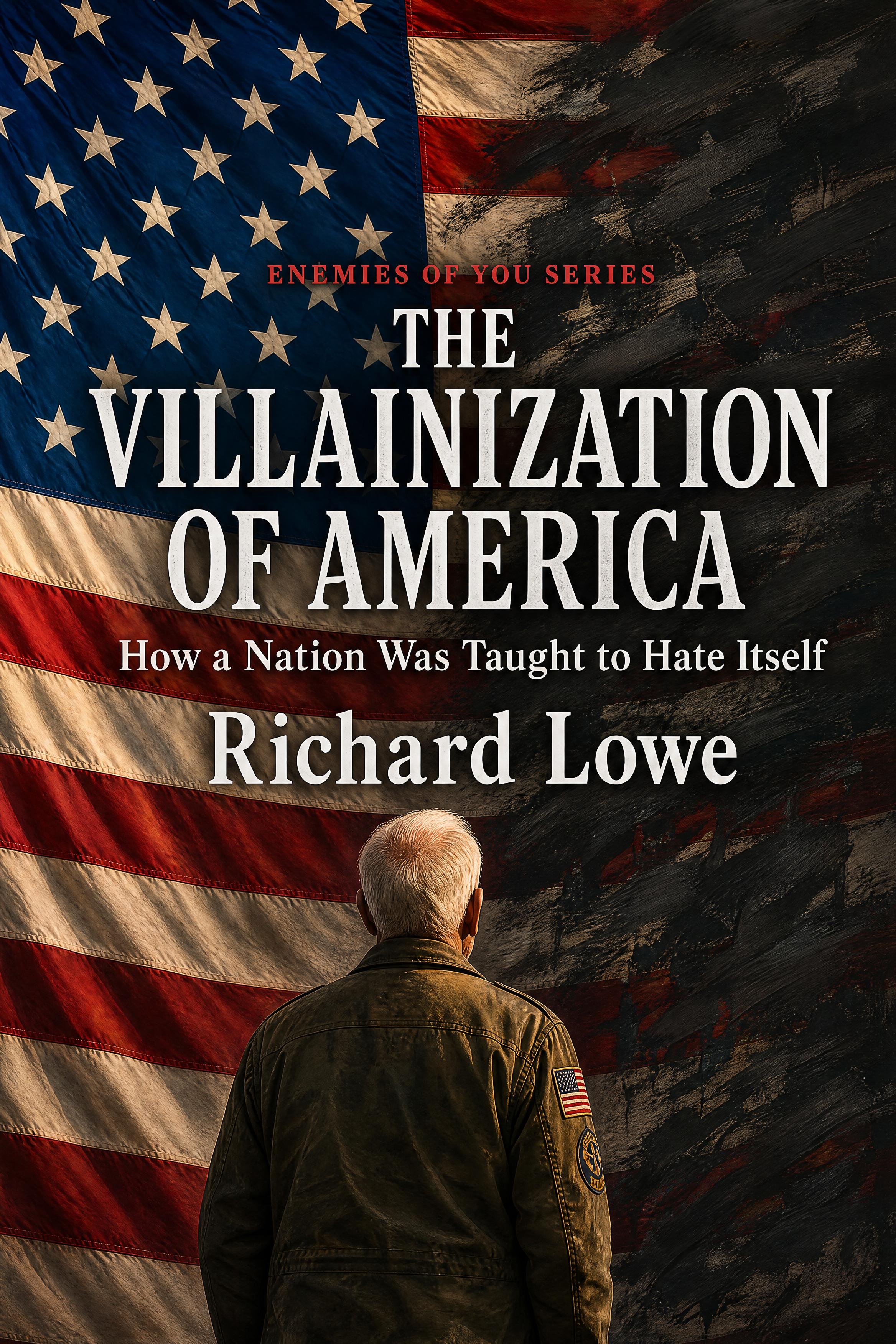 |
My grandfather spent three and a half years in a Japanese prison camp BUY FROM INGRAMSPARKAMAZONKOBOREAD THE INTRODUCTIONTABLE OF CONTENTS 216 pages · Paperback ISBN 978-1-972810-08-8 · ebook ISBN 978-1-972810-10-1 |
| 216Pages | 34Chapters | 3.5Years his grandfather was held | 1Memoir behind this one |
My grandfather spent three and a half years in a Japanese prison camp
He was Navy. He survived things I won’t describe here because he described them himself, in his own words, in a memoir I helped him publish called Behind the Wire. When I ask why I wrote this book, that memoir is part of the answer.
He’d talk about what happened. That was never the problem. The problem was that nobody wanted to listen, and not because they didn’t care about him. They cared. The story made them uncomfortable, and after a while people tire of being uncomfortable.
So a man who survived three and a half years in a camp sat with his stories mostly in silence, and I was the one who listened, and eventually I was the one who helped get the words onto a page where they couldn’t be ignored.
What he survived, he survived for a concrete reason. He believed the country he was fighting for was worth it. That belief wasn’t naive. He’d grown up in it and understood its failures and its contradictions. He knew it wasn’t perfect. He believed it was the best thing going.
What is inside The Villainization of America?
|
Where this comes from
|
The shift
|
|
Getting it right
|
Forward
|
Who should read The Villainization of America?
|
Read it if
|
Not for you if
|
Why did I write The Villainization of America?
Richard Lowe, the Writing King
My grandfather was Frank Hoeffer II, Navy, three and a half years a prisoner of war. I listened to him when others found it uncomfortable and eventually helped him publish the memoir. This book comes out of that, and out of thirty-three years working inside American institutions and seeing both what they get wrong and what they hold up.
► Behind the Book: The Villainization of America
How this one got written, what went wrong, and what got cut.
► I Grew Up in California. I No Longer Live There.
One story from behind this book.
What do people ask about The Villainization of America?
Also in Enemies of You
|
The Enshittification of America How Good Businesses Were Taken Apart |
What Outsourcing Judgment Costs |
|
The Birth of the Augmented Human What Goes Right When You Use AI Properly |
Including the Man Who Wrote This |
|
What Bezmenov Described and Nobody Acted On |
Wars, Weapons, and the Next Thirty Years |
|
Turn Off the TV, Get Off Your Ass, and Do Something Getting Your Time Back From the Screens |
He believed it was the best thing going
He also knew exactly what was wrong with it. Both, at once, is the whole point.
BUY FROM INGRAMSPARKAMAZONKOBOREAD THE INTRODUCTIONTABLE OF CONTENTS
Paperback and ebook.
Introduction
The Villainization of America
My grandfather spent three and a half years in a Japanese prisoner of war camp. He was Navy. He survived things that I won’t describe here because he described them himself, in his own words, in a memoir I helped him publish called Behind the Wire. When I ask myself why I wrote this book, that memoir is part of the answer.
He’d talk about what happened to him. That wasn’t the problem. The problem was that nobody wanted to listen. Not because they didn’t care about him. They cared. The problem was that the story made them uncomfortable, and after a while people get tired of being uncomfortable, and so the man who had survived three and a half years in a camp sat with his stories mostly in silence, and I was the one who listened, and eventually I was the one who helped him get the words onto a page where they couldn’t be ignored.
What he survived, he survived for a specific reason. Not an abstract one. A concrete one. He believed the country he was fighting for was worth fighting for. That belief wasn’t naive. He knew what America was. He’d grown up in it and understood its failures and its contradictions. He wasn’t blind. He knew the country he was fighting for wasn’t perfect. He believed it was the best thing going on this earth, and that what it represented was worth his life if it came to that.
None of that changed his conclusion about whether it was worth three and a half years in a camp. He came home, he lived his life, and he died believing the same thing he believed when he shipped out.
I grew up in California. I no longer live there. Those two sentences tell you something about the last thirty years. The California I grew up in and the California that exists now aren’t the same place in any way that matters beyond the geography. What happened to it isn’t a mystery. It is, in fact, the subject of this book. The most populated state in the country became, over the course of my lifetime, one of the clearest examples of what happens when the institutions responsible for transmitting a national story stop believing the story is worth transmitting.
I’ve watched this process from different angles across several decades. I watched it as a young man in California when it was mostly confined to universities and certain neighborhoods in certain cities. I watched it accelerate in the 1990s when the academic structure started showing up in newspapers and television. I watched the brief interruption of September 11, 2001, when the country remembered for a moment what it was and what it was capable of, and then I watched the memory of that day fade and the process resume with more momentum than before. In the last ten years, with social media providing both a distribution system and a measurement tool, the process has become impossible to look away from.
Every day the news is full of stories about America being a bad country. Stories about its founding, its history, its military, its symbols, its institutions. Some of those stories contain real facts about real failures. Some of them are doing something else entirely. This book is about how to tell the difference, who built the machinery that makes the difference hard to see, and what it costs when a country loses the capacity to tell its own story.
My grandfather’s story is honest. It includes things that are hard to read. It doesn’t conclude that the country he served wasn’t worth serving. He came home and built a life here and he believed, until the end, that this place was worth what he paid for it.
I’m angry about what is being done to that story. Not sad. Angry. There’s a difference. Sad is what you feel when something is over. Anger is what you feel when something is still happening and you can still do something about it.
Table of contents
The Villainization of America
- A Note to the Reader
- Preface
- Introduction: The Story That Replaces the Country
- Part One: The Targets
- Chapter 1: The Founding
- Chapter 2: The Military and Veterans
- Chapter 3: Religion
- Chapter 4: Capitalism and Achievement
- Chapter 5: The Symbols
- Chapter 6: The Land – What the Bison Story Gets Wrong
- Part Two: The Internal Architects
- Chapter 7: The Academy
- Chapter 8: The K-12 Pipeline
- Chapter 9: The Media
- Chapter 10: The Culture Machine
- Chapter 11: The Political Apparatus
- Chapter 12: The Legal Enforcement Apparatus
- Chapter 13: The Corporate and NGO Machine
- Part Three: The External Accelerators
- Chapter 14: Russia
- Chapter 15: China
- Chapter 16: The Convergence
- Part Four: The Cost
- Chapter 17: The Data
- Interlude: Eight People
- Chapter 18: Who Benefits
- Part Five: The Couter-Narrative
- Chapter 19: Nations That Held
- Chapter 20: The Larger Catastrophe: What the Selective Structure Conceals
- Chapter 21: Americans Who Refused
- Chapter 22: Reckoning vs. Villainization
- Conclusion: The Story Worth Defending
- Appendix: The Documentation
- About This Series
- Enemies of You Series
- Index