
The Death of Thinking
What Outsourcing Judgment Costs
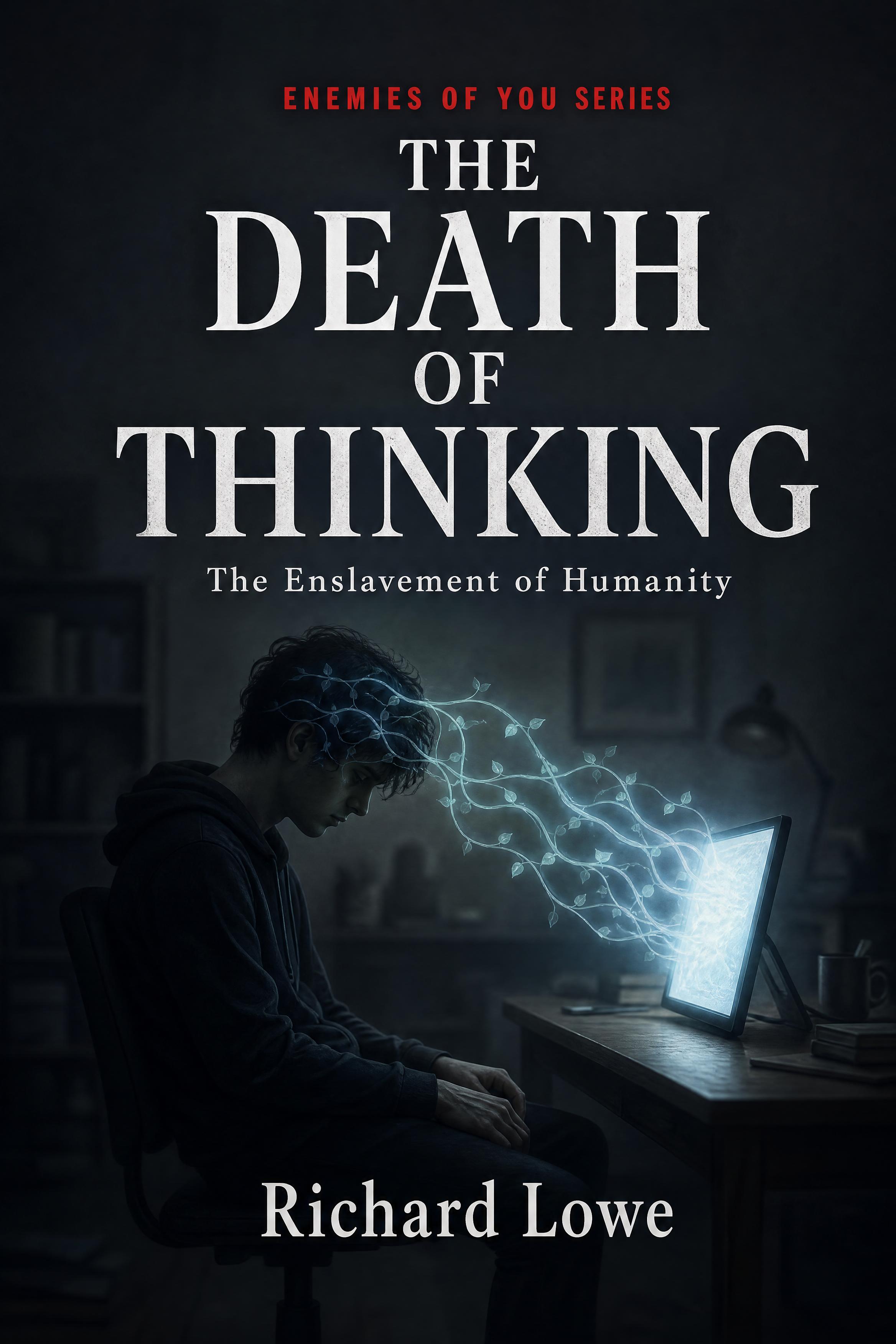 |
You don’t feel a slow loss going BUY FROM INGRAMSPARKAMAZONKOBOREAD THE INTRODUCTIONTABLE OF CONTENTS 314 pages · Paperback ISBN 978-1-946458-97-1 · ebook ISBN 978-1-972810-00-2 |
| 314Pages | 29Chapters | 1Companion volume | 0Single bad decisions |
You do not feel a slow loss going
You feel its absence when something requires it and it’s not there. The writer who opens a document and finds the blank page harder than it used to be. The programmer who can’t fully explain in an interview why the system was built the way it was. The analyst who discovers that the structural error in the report was there from the beginning, baked into the framing, invisible because he’d stopped standing outside the structure.
None of these people decided to lose anything. They made a series of reasonable decisions, each defensible on its own, that accumulated into a pattern with consequences nobody anticipated.
The writer stopped staring at the blank page because there was no longer any need. The programmer accepted the architectural suggestion because it was good enough and faster than thinking it through. The analyst let the initial framing happen elsewhere because the deadline was real.
Each decision was reasonable. The pattern isn’t. This book is about the pattern.
What is inside The Death of Thinking?
|
The mechanism
|
By discipline
|
|
The evidence
|
Recovery
|
Who should read The Death of Thinking?
|
Read it if
|
Not for you if
|
Why did I write The Death of Thinking?
Richard Lowe, the Writing King
Thirty-three years in enterprise technology and 113+ books written under my own name. I use these tools daily and I’m not writing against them. The companion volume covers what goes right. This one covers what goes wrong. That’s a different book and needed to be.
► Behind the Book: The Death of Thinking
How this one got written, what went wrong, and what got cut.
► Do What I Did Before I had the Tools, Then Do What I Do With Them
One story from behind this book.
What do people ask about The Death of Thinking?
Also in Enemies of You
|
The Enshittification of America How Good Businesses Were Taken Apart |
The Birth of the Augmented Human What Goes Right When You Use AI Properly |
|
Including the Man Who Wrote This |
What Bezmenov Described and Nobody Acted On |
|
Why the Story We Tell Ourselves Matters |
Wars, Weapons, and the Next Thirty Years |
|
Turn Off the TV, Get Off Your Ass, and Do Something Getting Your Time Back From the Screens |
Each decision was reasonable. The pattern is not.
That’s the whole difficulty of noticing it in time.
BUY FROM INGRAMSPARKAMAZONKOBOREAD THE INTRODUCTIONTABLE OF CONTENTS
Paperback and ebook.
Introduction
The Death of Thinking
The thing about a slow loss is that you don’t feel it going. You feel its absence when something requires it and it’s not there. The writer who opens a document and finds the blank page harder than it used to be. The programmer who sits in an interview and can’t fully explain why the system was built the way it was. The analyst who publishes a report and later discovers that the structural error in it was present from the beginning, baked into the AI’s framing, invisible because the analyst had stopped standing outside the structure and examining it.
None of these people decided to lose anything. They made a series of reasonable decisions, each one defensible in isolation, that accumulated into a pattern with consequences they didn’t anticipate. The writer decided to stop staring at the blank page because the AI eliminated the need. The programmer decided to accept the AI’s architectural suggestions because they were good enough and faster than thinking through the architecture independently. The analyst decided to let the AI do the initial framing because it was efficient and the deadline was real.
This book is about the pattern: what happens to a practitioner’s cognitive capacity when they consistently outsource the parts of their work that require the most real thinking. Not in one session, not in one project, but over months and years of a daily practice that removes the cognitive demands that were building something.
The building that was happening isn’t obvious when it’s happening. It’s only obvious in retrospect, or under specific conditions of pressure that reveal what is and isn’t there. The blank page anxiety is the retrospective signal. The interview question is the pressure test. The structural error in the report is the failure that makes visible what the practice had been producing: a practitioner who had been getting faster at producing outputs and slower at the underlying cognitive work those outputs were supposed to represent.
Part One of this book, The Diagnosis, describes this process in detail. It follows individual practitioners through moments where the pattern is visible, and it traces the mechanisms: the convenience trap, the illusion of understanding, the death of the wrong answer as a concept, the epistemic authority transfer. These aren’t metaphors. They’re cognitive and behavioral changes that AI dependency produces, with consequences that are identifiable before the pressure test arrives, if anyone is looking for them.
Part Two, The Autopsy, examines the structural forces that produce and accelerate the pattern. The history of cognitive erosion that preceded AI and primed the population for it. The commercial design of AI tools that optimizes for dependency. The education system that met AI halfway. The governance structures that concentrate control of cognitive infrastructure in a small number of private hands with minimal accountability. The cage with the friendly interface. These forces aren’t inevitable. They’re the product of decisions by identifiable actors with interests of their own, and understanding them is the prerequisite for addressing them.
Part Three, The Body Count, traces the consequences at every scale from the individual practitioner to the democracy and the civilization. The individual who has lost the capacity they didn’t know they were losing. The generation developing without the baseline. The professions hollowing from the inside. The democracy that requires a kind of citizen the current trajectory isn’t producing. The existential threats that the cognitive erosion makes harder to address.
Part Four, The Prescription, describes what people can do. Not at the scale of the problem, because the problem is structural and the structural responses are slow and contested. At the scale where individual choice is effective: the specific daily practices that maintain cognitive capacity in an environment designed to replace it. The note before the prompt. The hypothesis before the paste. The position before the framing. These aren’t difficult. They’re against the grain of every co
Table of contents
The Death of Thinking
- Preface
- Introduction: What Was Lost Before Anyone Noticed
- Part One: The Diagnosis
- Chapter One: The Question Nobody’s Asking
- Chapter Two: The Convenience Trap
- Chapter Three: The Illusion of Understanding
- Chapter Four: The Death of the Wrong Answer
- Chapter Five: The Epistemic Authority Transfer
- Part Two: The Autopsy
- Chapter Six: The Long Erosion
- Chapter Seven: The Optimization of Helpfulness
- Chapter Eight: The Education System Met AI Halfway
- Chapter Nine: Who Pulls the Levers
- Chapter Ten: The Cage with a Friendly Interface
- Part Three: The Body Count
- Chapter Eleven: The Individual Mind
- Chapter Twelve: The Next Generation
- Chapter Thirteen: The Professions
- Chapter Fourteen: Democracy and Discourse
- Chapter Fifteen: The Culture of Certainty
- Chapter Sixteen: The Existential Ledger
- Part Four: The Prescription
- Chapter Seventeen: Reclaiming the Friction
- Chapter Eighteen: The Education Nobody Provided
- Chapter Nineteen: Using the Tool Without Being Used By It
- Chapter Twenty: Your Environment
- Conclusion: The Question
- Sources
- About This Series
- Enemies of You Series
- Index