
Almost everything anybody knows about the day Vesuvius erupted comes from one writer.
He was seventeen when it happened. He watched from across the Bay of Naples while his uncle sailed into the disaster and didn’t come back. About twenty-five years later, a historian asked him what he’d seen, and he wrote it down in two letters. Those letters are the first eyewitness account of a volcanic eruption that survives from the ancient world, and they’re the reason a whole class of eruptions carries his family’s name.
I’ve loved geology for most of my life, and Vesuvius is the eruption that hooked a lot of us. But on Vesuvius Day the writer stays on my mind as much as the volcano.
What is Vesuvius Day?
Vesuvius Day is an unofficial observance on August 24, the traditional date of the eruption of Mount Vesuvius in 79 AD. That eruption buried the Roman towns of Pompeii and Herculaneum, along with Stabiae and the villas around the bay, and killed thousands of people.
Nobody declared it. It shows up on the observance calendars, in museums and in classrooms, the way plenty of history days do. It’s a reason to remember the people of those towns, and the oddest gift a disaster ever left behind: whole cities, sealed at a single moment and found again centuries later.
Did Vesuvius really erupt on August 24?
Maybe not.
Would anyone have guessed that a scribble on a wall could move a famous date by two months?
The August 24 date comes from the surviving manuscripts of Pliny’s letter, and for centuries nobody argued with it. But archaeologists kept finding things in Pompeii that didn’t fit a summer day: autumn fruit, braziers that looked like they’d been in use, wine that seemed to be sealed for the season.
In 2018 they found a charcoal scrawl on a wall in Pompeii that gave a date corresponding to October 17. Charcoal doesn’t last long on a wall, so it was almost certainly written in the last days before the eruption. Italian officials suggested October 24 as the likely date. Medieval copyists could easily have garbled a date in Pliny’s text.
So Vesuvius Day falls on the date tradition gave us, and the real anniversary is probably two months later. I like that about it. The day itself shows how a written record gets copied wrong for a thousand years and nobody notices.
From the eruption in 79 AD to AI reading Herculaneum's scrolls, nearly two thousand years later.
Who wrote the eyewitness account of Pompeii’s last day?
Pliny the Younger. His uncle, Pliny the Elder, was a naturalist and the commander of the Roman fleet at Misenum, across the bay. When the eruption began, the uncle saw a strange cloud rising over the mountain and set out to take a closer look. Then the pleas for rescue came, and he turned the warships toward the coast to evacuate people.
He died on the beach at Stabiae.
His nephew stayed behind at Misenum with his mother.
Years later the historian Tacitus asked Pliny the Younger for an account of his uncle’s death, and Pliny sent two letters. The first tells his uncle’s story. The second tells his own, the earthquakes, the panic, the ash falling so thick that he and his mother had to keep standing up and shaking it off so they wouldn’t be buried, and a darkness he said was worse than any moonless night, like a room with the lamps put out.
A teenager who picked up a book while the mountain was erupting wrote the record everybody still uses.
He describes the eruption cloud as shaped like an umbrella pine, a tall trunk spreading out into branches at the top. Volcanologists still call that kind of eruption Plinian, after the two of them.
And there’s one detail that makes him real to me. While the ground was shaking at Misenum, the seventeen-year-old asked for a volume of Livy and sat reading it. He admits he doesn’t know whether to call that courage or foolishness. A teenager who picked up a book while the mountain was erupting wrote the record everybody still uses.
Why does Pliny’s account matter to writers?
Because it’s the reason we know anything.
Think of how close we came to having nothing at all.
Thousands of people lived through that day, and most of them left nothing. The ones who died left their bodies and the shapes of their last moments. The ones who survived scattered. What we have of the eruption as a human experience is mostly two letters, written by one man a quarter century later, because someone asked him to put it on paper.
I wrote about the same thing when Krakatoa started erupting again. In 1883 a Dutch geologist named Rogier Verbeek went out and collected eyewitness accounts while people still remembered, and his report is why the timeline of that eruption is so precise. Pliny did the same job seventeen centuries earlier with nothing but a pen and his memory.
Thousands lived through the eruption of Vesuvius. We know what it was like because one of them wrote it down. – Richard LoweShare on X
If you’ve lived through something, write it down. You don’t have to do it the week it happens. Pliny waited twenty-five years. But somebody has to, or the event survives as rock and ash and nothing else.
What happened to the people of Pompeii and Herculaneum?
Most of Pompeii’s people got out during the first hours, when pumice was falling. The ones who stayed, or couldn’t leave, were killed when the eruption column collapsed and surges of superheated gas and ash rolled down the mountain the next morning.
Their bodies decayed inside the hardened ash and left hollows behind. In 1863 the archaeologist Giuseppe Fiorelli worked out that he could pour plaster into those voids, and the casts came out in the exact shape of people in their last moments. Some are covering their faces. Some are holding each other. They’re the most painful things in Pompeii, and you don’t forget them.
Herculaneum went differently. It sat closer to the mountain and was buried far deeper, under material that hardened like rock. In the boathouses by the old shoreline, excavators found hundreds of skeletons of people who had run to the water hoping for boats that never came.
How is AI reading the burned scrolls of Herculaneum?
This next part sounds made up.
It isn’t.
In the 1750s, workers digging at Herculaneum broke into a luxurious villa and found its library: hundreds of papyrus scrolls, carbonized by the heat into black lumps that look like burned logs. Most attempts to unroll them destroyed them. For more than two hundred and fifty years, nobody could read most of what was inside.
Then researchers scanned the rolled scrolls with X-rays at a particle accelerator in England and trained machine learning models to find the ink inside.
In 2023 a contest called the Vesuvius Challenge offered prizes to anyone who could read them, and early on contestants recovered a word meaning purple. In February 2024, a team of three, Youssef Nader, Luke Farritor and Julian Schilliger, won the $700,000 grand prize for reading more than 2,000 characters from one scroll, about 5 percent of it. The text is thought to be by Philodemus, a philosopher who lived around Herculaneum. Since then, researchers have read the title of another still-rolled scroll, “On Vices,” without ever opening it.
The same eruption that killed the people of Herculaneum kept their library, and two thousand years later a tool built this decade is reading it back to us. I write about AI on this site constantly. I can’t think of a better use for it.
My take
Vesuvius gets remembered for the bodies, and I understand why. The part I can’t get past is that we’d know almost nothing about that day if one teenager hadn’t written it down for a historian years later. Pompeii’s people left casts, and Herculaneum left a library. Pliny left the story. If you’ve lived through something, put it on paper, because the record outlasts everything else.
How to mark Vesuvius Day
Read Pliny’s two letters to Tacitus. They’re short, they’re free in translation and they read like a dispatch from someone who couldn’t quite believe what he’d seen. Then read what happened to Rome ten years earlier, in the year of the four emperors, because Tacitus wrote about that too.
If volcanoes are your thing, as they are mine, I’ve written about Krakatoa erupting again and about the Toba supereruption that nearly ended our species, and there’s more on why I love the subject in my geology page. And if someone in your family has lived through something worth keeping, my memoir process is how I help people get it on paper while there’s still someone who remembers.
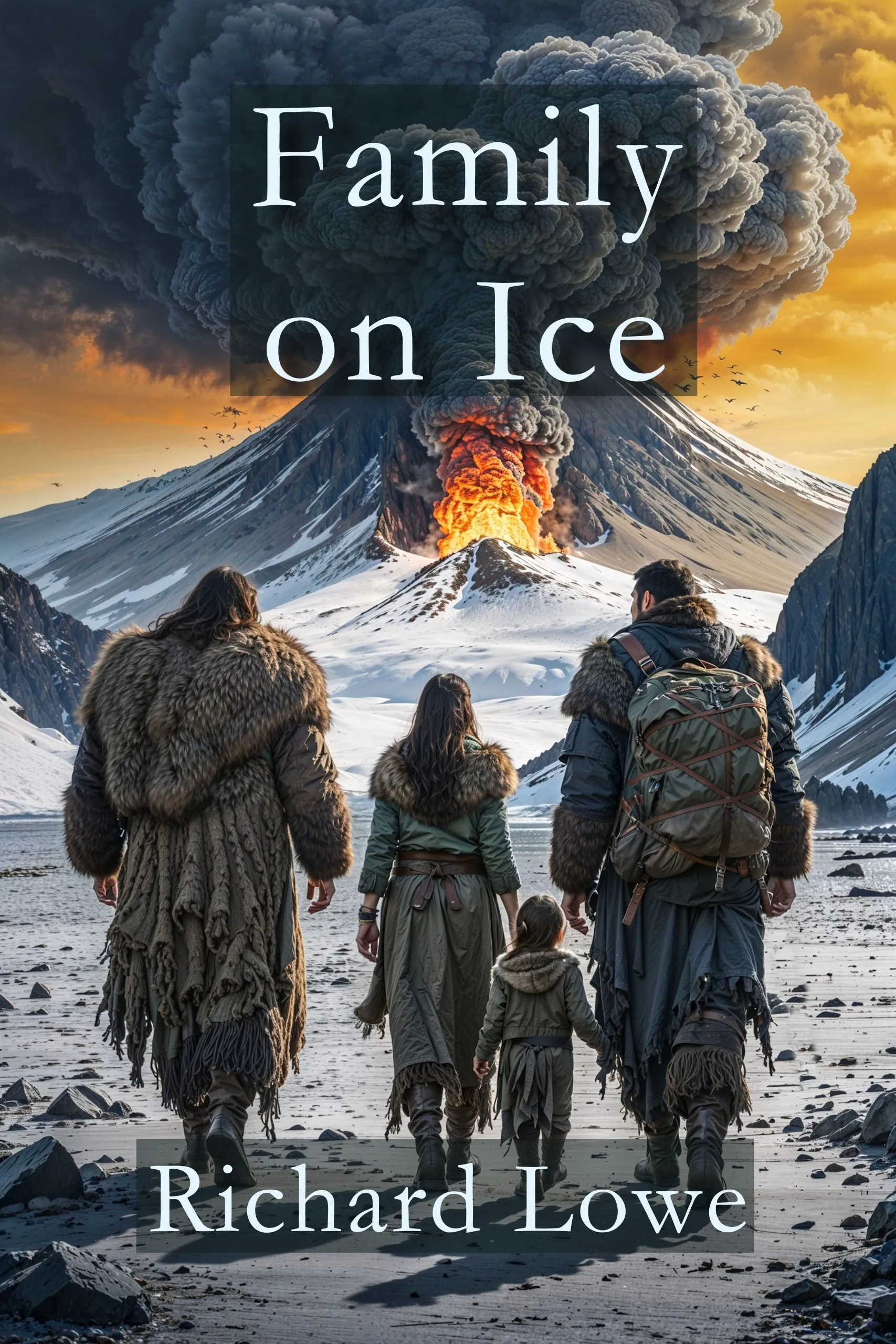
Seventy-four thousand years ago Toba threw roughly 2,800 cubic kilometers of material skyward. My novel follows one family through the volcanic winter that came after.
Frequently Asked Questions
- New Thoughts on Pompeii's Last Day, Archaeology
- Scroll charred in Mount Vesuvius eruption partially deciphered, earning researchers $700,000 prize, Live Science
- Researchers just deciphered a title for the first time, Smithsonian
- National Vesuvius Day, Holiday Insights