
The Enshittification of America
How Good Businesses Were Taken Apart
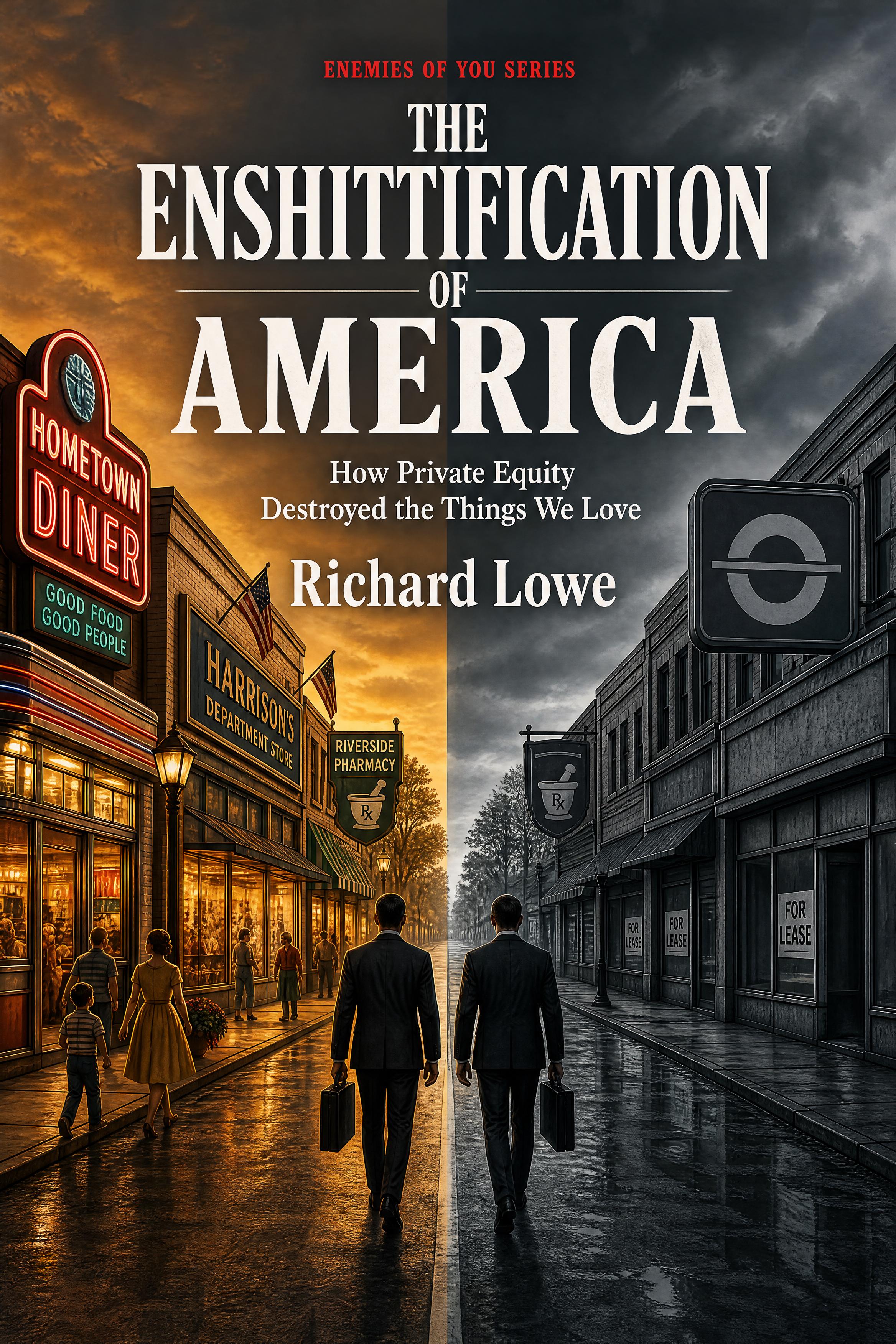 |
I never set out to write about the decline of American business BUY FROM INGRAMSPARKAMAZONKOBOREAD THE INTRODUCTIONTABLE OF CONTENTS 314 pages · Paperback ISBN 978-1-972810-11-8 · ebook ISBN 978-1-946458-62-9 |
| 314Pages | 13Industries examined | 3Parts | 2023The conversation that started it |
I never set out to write about the decline of American business
I was perfectly happy ghostwriting memoirs and helping executives tell their success stories. Then, after twenty years managing technology at Trader Joe’s and a decade listening to business leaders tell me what really happened, I started noticing patterns that kept me awake.
The same private equity playbook dismantling one industry after another. The same optimization algorithms that could have improved customer service being repurposed to maximize fee extraction. The same executives who built good businesses explaining how they were pressured to take apart the thing that made them good.
Companies I’d shopped at my whole life turned into hollow versions of themselves. Airlines that made flying feel like something now treat passengers as freight. Department stores that anchored communities became real estate plays. Local papers that held mayors to account got strip-mined by funds that wouldn’t know journalism if it sued them.
The turning point was a client conversation in 2023, where a Fortune 50 executive explained how his company had optimized customer interactions by removing the humans.
What is inside The Enshittification of America?
|
The mechanism
|
The algorithmic layer
|
|
Thirteen industries
|
The resistance
|
Who should read The Enshittification of America?
|
Read it if
|
Not for you if
|
Why did I write The Enshittification of America?
Richard Lowe, the Writing King
Twenty years managing technology at Trader Joe’s, then a decade ghostwriting for executives who told me privately what they were pressured to do. That’s an unusual vantage point: inside a company that resisted this, then hearing from the people inside the ones that didn’t.
► Behind the Book: The Enshittification of America
How this one got written, what went wrong, and what got cut.
► The Same Private Equity Playbook, One Industry After Another
One story from behind this book.
What do people ask about The Enshittification of America?
Also in Enemies of You
|
What Outsourcing Judgment Costs |
The Birth of the Augmented Human What Goes Right When You Use AI Properly |
|
Including the Man Who Wrote This |
What Bezmenov Described and Nobody Acted On |
|
Why the Story We Tell Ourselves Matters |
Wars, Weapons, and the Next Thirty Years |
|
Turn Off the TV, Get Off Your Ass, and Do Something Getting Your Time Back From the Screens |
It does not have to be this way
Which is a claim the book has to earn, and spends a whole part doing.
BUY FROM INGRAMSPARKAMAZONKOBOREAD THE INTRODUCTIONTABLE OF CONTENTS
Paperback and ebook.
Introduction
The Enshittification of America
I never set out to write a book about the decline of American business. I was perfectly happy ghostwriting memoirs and helping executives tell their success stories. But after twenty years managing technology at Trader Joe’s and then a decade listening to business leaders share their real stories, I started noticing patterns that kept me awake at night. The same private equity playbook destroying one industry after another. The same optimization algorithms that could improve customer service getting repurposed to maximize fee extraction.
The same executives who built great businesses explaining how they were pressured to dismantle what made those businesses great. I watched companies I’d shopped at my whole life turn into hollow shells of themselves. Airlines that once made flying feel special now treat passengers like cattle. Department stores that anchored communities became real estate plays. Local newspapers that held mayors accountable got strip-mined by hedge funds that wouldn’t know journalism if it sued them for libel.
The turning point came during a client conversation in 2023. A Fortune 50 executive was explaining how his company had “optimized customer interactions” by replacing human service representatives with chatbots designed to frustrate callers into giving up. He said it with the detached professionalism of someone describing weather patterns. No malice, no awareness of what he was describing. Just systems working exactly as designed. That’s when I realized we weren’t just witnessing random business failures. We were watching the systematic transformation of American commerce from a
8 system designed to serve customers into one designed to extract maximum value from them. The same balance- sheet techniques, the same consulting playbooks, the same private equity strategies, deployed across industry after industry. This isn’t a book about individual bad actors or isolated corporate greed. It’s about a system that consistently produces outcomes we call failures but which are working exactly as intended. When you optimize for extraction, not service, you get extraction. When you reward quarterly performance over long-term value creation, you get short-term thinking.
When you structure businesses to maximize cash flow to investors, not value to customers, you get enshittification. The most frustrating part is how preventable this all was. The businesses that escaped this fate prove it every day. They’re not miraculous outliers or lucky accidents. They’re companies that made different choices about ownership, optimization, and what success means. I wrote this book because pretending that widespread business degradation is just how markets work is an evasion.
It’s not. It’s how these particular markets work, structured by these particular incentives, optimized for these particular outcomes. We built these systems. That means we can rebuild them. The stories in this book come from two decades of watching systems work and a decade of listening to the people who run them. Some details have been changed to protect client confidentiality, but the patterns are real, the data is documented, and the outcomes speak for themselves. A note on ghostwriting: my professional work involves helping business leaders write books they have the
9 knowledge and experience to write but not always the time or inclination to write alone. That collaboration is as old as publishing. What this book criticizes isn’t expertise assisted by craft, but institutions hollowed out so that the people with genuine expertise are replaced entirely by cheaper substitutes. The distinction matters, and I’d rather name it than leave it for someone else to point out. We can do better. We just have to decide we want to.
10 A Note on Sources The financial figures, employment statistics, fee disclosures, and corporate chronologies in this book are drawn from public sources: SEC filings, bankruptcy court documents, congressional testimony, regulatory agency reports, and named journalism f
Table of contents
The Enshittification of America
- Preface
- A Note on Sources
- Introduction: The Great Degradation
- Take a Drive with Me
- Part I: The Mechanism of Decay
- The Private Equity Playbook
- The Puppet Masters
- From Ownership to Extraction
- The Strongest Case for Private Equity
- The Algorithmic Layer
- Part II: Thirteen Industries in Decline
- Airlines – From Glamour to Cattle Cars
- Restaurants – Gray Boxes Replace Character
- Department Stores – Palaces to Warehouses
- Obsolescence
- Banking – Relationships to Fee Extraction
- Healthcare – Care to Bureaucratic Maze
- Telecommunications – Innovation to Rent-Seeking
- Corporate Mills
- Everything
- Warehouses
- Everything
- Movies – From Dreams to Algorithms
- Part III: The Resistance
- What Protects Against Enshittification
- the Vultures Came Home to Roost
- It Doesn’t Have to Be This Way
- Policy Solutions
- Consumer and Community Action
- How Reforms Get Won
- Conclusion: I Drove It Again
- Afterword: Is This Evil?
- About the Author
- About This Series
- Enemies of You Series
- Books by Richard Lowe
- Index