
You Don’t Own Anything Anymore
And You Thank Them for It
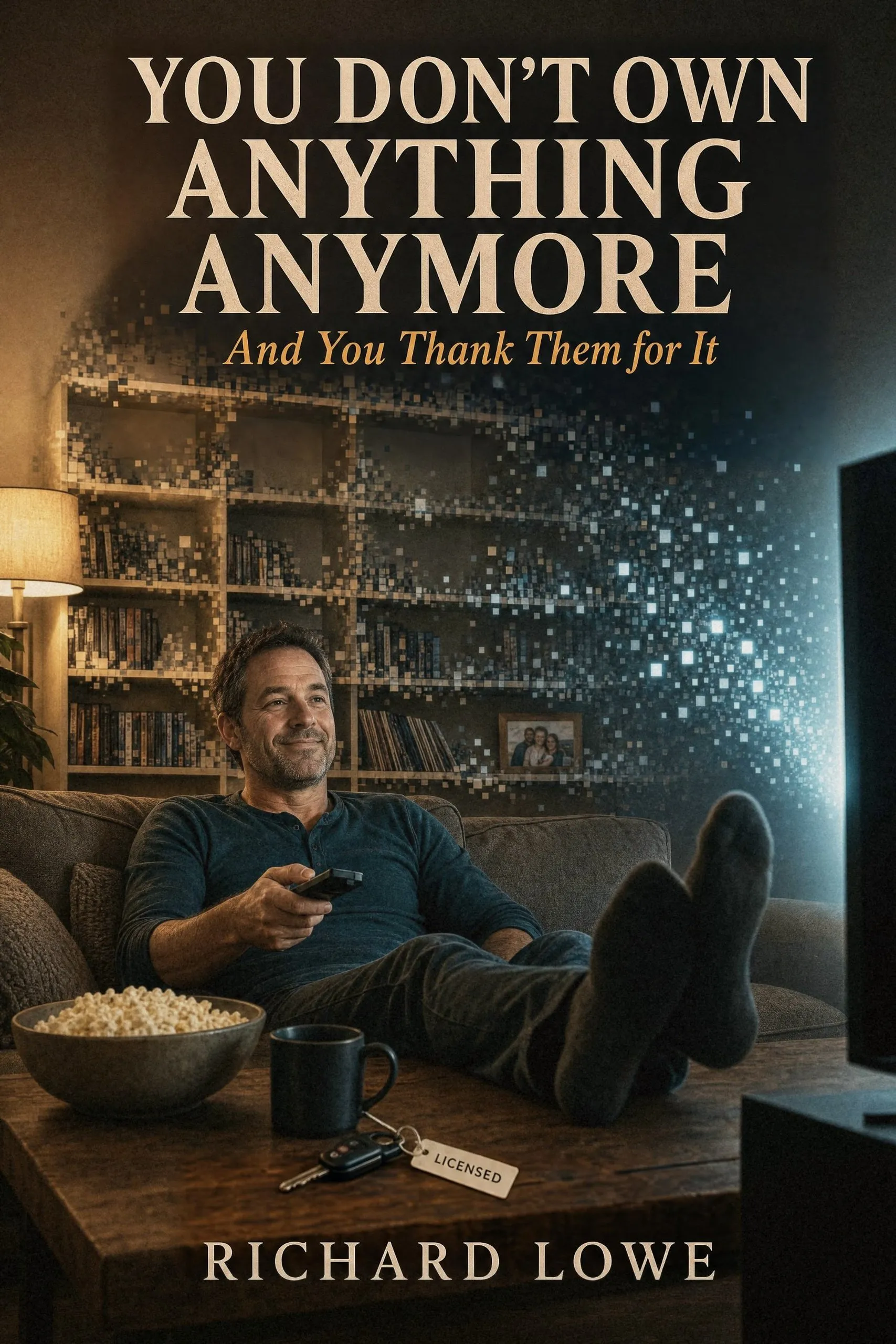 |
You never owned the movie. Nobody could reach the tape. Then they could. Nonfiction · 247 pages · Technology and society Coming soon in paperback and ebook. |
| 247Pages | 34Chapters | 99¢Refund for 1984 | 256Looney Tunes shorts pulled |
Nobody’s fighting it. How do you organize resistance against a convenience?
from the book
On the morning of July 17, 2009, a seventeen-year-old in Michigan turned on his Kindle and the book he was annotating for summer homework was gone. Amazon had reached across a wireless network and taken it back. The book was 1984. He got his ninety-nine cents back.
You never owned the movie either. A videotape in 1985 was a copy and a license, the same as a film you buy today. What made it feel like property was that it sat in your house and nobody could reach it. Technology closed that gap, and this book follows what came through it: software sold as a license, a racing game switched off by its publisher, heated seats by the month, printers that reject a cartridge without the maker’s chip, televisions that report what you watch, and a retinal implant its maker could not fix.
I went looking for a conspiracy and I’ll tell you up front I didn’t find one. What I found was an evolution: executives making decisions that looked sensible inside their own quarter, all pointing the same direction. It’s partly us, too, because streaming really is more convenient, and one chapter gives the floor to the best case against the book.
| Element | Detail |
|---|---|
| The argument | Buying a thing used to mean the seller could never reach it again. That physical fact was the only limit on corporate power that needed no law, and it is gone. |
| Where it starts | A 1908 Supreme Court case about a department store selling a novel for eighty-nine cents |
| The people | A student whose 1984 vanished, a reseller locked out of his shop, a farmer who planted a soybean, a woman whose retinal implant stopped on a subway staircase |
| Into the house | Deleted libraries, the car as a subscription, the refrigerator with advertising, the clause in the paperwork |
| The fair hearing | Chapter Fourteen gives the best case against the book, at full strength |
| The practical part | A one-hour inventory of your own house and three questions to ask of anything you pay for |
| Format | Nine parts, 34 chapters, 247 pages, with sources and an index |
For readers who keep a shelf of discs, anyone who has watched a purchase vanish from an account, and people who want the history and the law behind the subscription economy told through the people it happened to.
How does You Don’t Own Anything Anymore open?
Chapter 1: The Rented Life
On the morning of July 17, 2009, a seventeen-year-old in Shelby Township, Michigan, turned on his Kindle and the book was gone.
Justin Gawronski was a student at Eisenhower High School and the book was summer work for an advanced placement course. The assignment was to read it and turn in reflections on every hundred pages, which meant he had been reading it the way teachers want and almost nobody does, highlighting as he went and typing notes against the passages.
The notes were still there. They had been stored in a separate file and the deletion left them untouched, which made them worse than useless, because a note that says something sharp about page 143 is nothing at all when page 143 is no longer on the device.
Amazon refunded the ninety-nine cents.
Under two thousand other people lost the same book that morning. The publisher of that particular edition had not held the rights, Amazon discovered this, and Amazon reached across a wireless network into two thousand private homes and took it back.
The book was 1984.
* * *
Everybody made the joke. The joke is the least interesting thing about it.
What actually happened that morning is that a company demonstrated, by doing it, that the objects in your house were not the kind of thing you had assumed they were. There was no policy announcement and no press release anybody read. Just a Friday, a book gone, and a refund. Antoine Bruguier, an engineer in Milpitas who lost the same title, wrote a sentence in the lawsuit that followed which is the sentence this entire book is about.
I thought that once purchased, the books were mine.
He wasn’t confused. He was describing what buying something had meant for the whole of human history, right up to about the moment he bought it.
Gawronski sued on July 30 with Bruguier alongside him, in federal court in Seattle. Amazon settled, paid a hundred and fifty thousand dollars that went to lawyers and then to charity, and signed a binding commitment not to do it again. Jeff Bezos had already posted an apology to the customer forum under his own name, calling the company’s conduct stupid and signing off with a deep apology.
Amazon has kept that promise for seventeen years. It’s the only company here of which that can be said, and the reason it made the promise is that it got caught doing something visible.
Almost nothing since has been visible.
* * *
Orwell imagined the wrong mechanism.
He was right about the memory hole and right about the telescreen and wrong, understandably, about who would be operating them and what it would feel like from the inside. He assumed it would take a state. He assumed there would be a Ministry, and a war, and a boot, and that you would know.
Winston Smith is watched by a screen he can’t switch off, installed in his apartment by a government he fears. You are watched by a screen you picked out in a store, after comparing it against three others, because it had the better picture at the better price. No one installed it. You carried it to the car.
That is the same thing in a more complete form.
Torture, in Orwell, is what the Party needs when persuasion has failed. It is the failure case, expensive, inefficient, and reserved for the handful who won’t comply on their own. A system that needs the Ministry of Love has already lost most of the argument. That isn’t strength.
A system where compliance is purchased, at a discount, by people who would be annoyed if you took the thing away from them, requires no ministry at all. There is no enforcement cost because there is nothing to enforce. Nobody coerced you into it. You went out and got it, you would go and get it again tomorrow, and on most days it is better than what it replaced.
Nobody’s fighting it. How do you organize resistance against a convenience?
The chapter keeps going.
Who should read You Don’t Own Anything Anymore?
|
Read it if
|
Not for you if
|
What do people ask about You Don’t Own Anything Anymore?
Also in Digital Self-Defense
|
Protecting the people who live in your house |
What the platforms did to us |
|
Ridiculous Things People Actually Believe A tour of the indefensible |
Check your own house
Of everything you own, what can you sell, lend, keep or hand to your child without asking anybody’s permission?
READ A CHAPTERTABLE OF CONTENTS
Coming soon in paperback and ebook.
Chapter 2: What Ownership Used to Mean
You Don’t Own Anything Anymore
Isidor Straus had a pile of books he had paid for and a price he wanted to charge.
He and his brother Nathan ran R. H. Macy and Company, and they’d bought a novel called The Castaway in large lots at wholesale, around forty percent below retail, the way any merchant buys anything. Then they put it on the counter at eighty-nine cents.
The publisher wanted a dollar and had printed a line inside every copy saying so. Straus didn’t care.
Straus knew about the line. He had signed nothing, agreed to nothing, and nobody had asked him. He had books, they were his, and he sold them.
In 1912 he drowned on the Titanic. His wife Ida was offered a place in a lifeboat and refused it, on the grounds that she had been with her husband for forty years and was not going to start being somewhere else now. They were last seen on deck together.
None of that has anything to do with the law. I put it in because the people described here were people, and that’s easy to forget once a man turns into a case name.
* * *
The line Straus ignored sat on the page after the title page, under the copyright notice, in a forgettable 1904 novel by a Kentucky writer named Hallie Erminie Rives.
The price of this book at retail is one dollar net. No dealer is licensed to sell it at a less price, and a sale at a less price will be treated as an infringement of the copyright.
Look at the middle clause. No dealer is licensed. Not no dealer may. Not we request. Not our terms require.
Licensed.
By 1904 a publisher had already worked out that the way to keep hold of a thing after selling it is to announce you never really sold it. The vocabulary is a hundred and twenty years old. Everything since has been the industry working out what it takes to make that one word stick.
* * *
Bobbs-Merrill sued in federal court in New York and asked for an order stopping Macy from selling the novel under a dollar.
The circuit court threw it out. The Court of Appeals affirmed. The publisher took it all the way up, and on June 1, 1908, the Supreme Court ruled against it unanimously, Justice William R. Day writing.
The statute gave a copyright holder the sole liberty of vending his work. The Court read that as exactly what it says. A right to control the first sale, and nothing past it. Once a copy is sold, the publisher’s interest in that particular copy is finished, and what the buyer does next is the buyer’s business.
One detail in the opinion is the crack that everything eventually gets driven through. The Court noted there was no contract between the publisher and the purchaser, and no privity between the publisher and anybody further down the line. It did not say a contract could never create such an obligation. It said a notice printed in a book, addressed to nobody and agreed to by nobody, was not one.
That is a narrow ruling and it reads today like an instruction manual. If you want control after the sale, do not print a notice. Get a signature. Seventy years later an industry read that sentence, understood exactly what it was being told, and stopped printing notices.
When money changes hands for a thing, the thing goes with it. That’s all first sale has ever meant.
* * *
That one ruling built things almost nobody thinks of as a legal arrangement at all.
It’s why used bookstores are legal. Why the record store can buy your collection and sell it to a stranger. Why libraries look like libraries, why you could lend a paperback without a lawyer present, why GameStop built a national chain out of a counter where teenagers traded in last year’s games, why a garage sale isn’t a criminal enterprise.
Each is an entire economy that exists only because a copy belongs to whoever bought it. Far from being a leak in the real market, for most of the last century the used market was where a working person got access to culture at all. A kid with four dollars couldn’t buy a new hardcover and could buy six used paperbacks, and no publisher had any say in the matter.
None of it needed anybody’s permission and none of it generated a cent for the people who made the work. It also produced the audience that eventually paid them, which is the part publishers keep forgetting.
It was the disposal mechanism. A collection could be turned back into money when somebody needed money. That is the difference between an asset and a hobby. A license can’t do that.
That is what was there.
* * *
A hundred and five years after Straus, a student at Cornell noticed that his textbooks cost more in Ithaca than the same books cost in Bangkok.
Supap Kirtsaeng was a Thai mathematics student on a scholarship, doing arithmetic. His family started shipping him copies from home, lawfully printed abroad by the publisher’s own foreign subsidiary, and he resold them in America and paid for his education out of the difference.
John Wiley and Sons sued him. The publisher argued that first sale reaches only copies manufactured in the United States, which would have meant anything printed overseas could never be lawfully resold here by anyone, ever.
The scope of that is hard to overstate. Libraries hold millions of foreign-printed volumes and would’ve needed permission to lend them. Museums would have needed permission to display foreign-made works they owned outright. A used car has copyrighted software in it and most of it is built abroad.
On March 19, 2013, the Supreme Court ruled six to three for Kirtsaeng. First sale attaches to any copy lawfully made under the Copyright Act, wherever it was printed.
So the doctrine isn’t dying of old age. Put it in front of judges and it still holds, in 1908 and in 2013, against publishers with better lawyers than the people they were suing. A department store owner won. A foreign student on a scholarship won.
Hold on to the date, because eight weeks later the same nine judges decided a case about a soybean and went the other way, and the farmer who lost is in Chapter Seven. Same Court, same spring, same doctrine of exhaustion, opposite outcomes. Understanding why is most of what this book is for.
* * *
Which raises the question this whole book exists to answer. If the rule’s intact, and it is, how did an economy of licensees get built on top of it inside thirty years?
Not by repeal. Nobody repealed it. Congress did not vote, no court overturned Straus, and if you sue tomorrow over a paperback you will win.
It was done by going around. First by inventing a category of thing that is sold but not sold, which is Chapter Three. Then by making it unlawful to open the box, which is Chapter Six. Then by removing the box.
Straus won because a publisher tried to control him with a printed line addressed to nobody. The industries described here learned what that opinion actually taught, which was that they had used the wrong instrument, and that a contract might work where a notice had failed.
It took them seventy years to find one. When they did, it was attached to a floppy disk.
Table of contents
You Don’t Own Anything Anymore
- Preface
- Introduction
- Part I: The Crime Scene
- Chapter 1: The Rented Life
- Chapter 2: What Ownership Used to Mean
- Part II: The Playbook
- Chapter 3: Patient Zero
- Chapter 4: The Audit
- Chapter 5: The Wall
- Chapter 6: The Lock
- Chapter 7: The Second Planting
- Part III: The Test Markets
- Chapter 8: The Test Market
- Chapter 9: The Main Event
- Chapter 10: When the Money Stops
- Chapter 11: Theft with a Footnote
- Chapter 12: The Crew
- Chapter 13: No Object at All
- Chapter 14: The Best Case Against This Book
- Part IV: Into the House
- Chapter 15: The Deletion
- Chapter 16: Your Car Is a Subscription
- Chapter 17: The Kitchen Is Next
- Chapter 18: The Paper Clause
- Part V: What They Learn
- Chapter 19: The Second Sale
- Chapter 20: Nowhere to Stand
- Chapter 21: A Hundred Billion a Day
- Chapter 22: The Measured Audience
- Chapter 23: The Babysitter
- Part VI: Beyond the Living Room
- Chapter 24: Twenty-Six Times
- Chapter 25: What a Used Copy Was Worth
- Part VII: The Far End
- Chapter 26: When the Landlord Fails
- Chapter 27: The Lock on the Book
- Chapter 28: Explant
- Part VIII: The Conspiracy Question
- Chapter 29: What They Wrote Down
- Chapter 30: Nobody Had to Meet in a Room
- Chapter 31: Two Dollars and a Coupon
- Chapter 32: A Tuesday in 2041
- Part IX: Taking It Back
- Chapter 33: People Who Kept Copies
- Chapter 34: What Ownership Is Worth
- Conclusion
- Appendix A: A Reader’s Inventory