Latest
The Money Appeared the Week After the DisasterHow a Stranger Decides You Are Credible in Nine SecondsWhat You Have to Decide Before Anybody WritesWriting It Before You Need ItCross Training Covered Everything Except the Role That Mattered MostBehind the Book: The Woke VirusBehind the Book: Galactic InvasionBehind the Book: You Don’t Own Anything AnymoreWhat’s New at The Writing King: Week of November 8, 2026Alexander Zhidkov: Decision MakingJessi Szurek: Expand Your RangeYou Don’t Own Anything AnymoreThe Budget Decided How My Department Was ShapedWhy Your Competitor’s Book Is Working and Yours Would NotWhy Are These Guys Smiling? A Business Book That Became a Wrestling MemoirPangram Wants to Decide Who Gets PublishedWhat You Have Enough Material For Right NowWhen a Book Is the Wrong ToolThe Woke VirusGalactic InvasionChatGPT Turns Four: From a Free Research Preview to GPT-6What’s New at The Writing King: Week of November 1, 2026Diwali: The Festival of Lights and the Story Behind the LampsHow Much Water and Power Does Heavy AI Use Take? I Ran My Own NumbersBad Boys: Ride or Die (2024)Vesuvius Day: The Teenager Who Wrote Down Pompeii’s Last DayAnti-Communism Week: Remembering the Writers Communism SilencedVoyager 1 One Light-Day: Fifty Years to Travel One Day of LightVellum Added an Optional AI Feature. A Pile-On Killed It in a Day.Are AI Subscriptions Losing Money? The Gym Membership Math Says NoAI Terms Every Writer Should Know, and Why Each One MattersWorking While Sick: What 24/7 On Call Cost MeHe Banned AI From His Writing Group. His Own Cover Got Called AI Slop.Who Writes the Fake Fan Mail Authors Get? Inside the Scam CompoundsSMS Appointment RemindersFree BooksDarrell Stern: Stop Being Invisible, Become UnmissableJoe Rockey: Ghostwriting His BookHow to Turn Your Expertise Into a Book People Want to Read | The Expert MethodWhat’s New at The Writing King: Week of October 25, 2026Challenger Remembrance Day: The Engineer Who Wouldn’t SignJoel Salomon: The Truth About MoneyReddit Is Putting Up a Login Wall. Wikipedia Won’t Be Far Behind.Victoria Chemko: The Body Is the First TechnologySir Patrick Stewart: A TributeA Year in the Bank: ADHD, Face Blindness and the Freedom to Walk Out | The Impossible Puzzles Show, Episode 326A Yale Economist Says We Won’t Be Missed. He Forgot the Bread Line.Walter Koenig: A TributeI Don’t Post Bad ARC Reviews. I Send the Author a Note.AI Has Paid Off Outside Tech. Apollo Is Reading the Wrong Scoreboard.
The Writing King Your Ethical Ghostwriter. Your Story, Done Right.

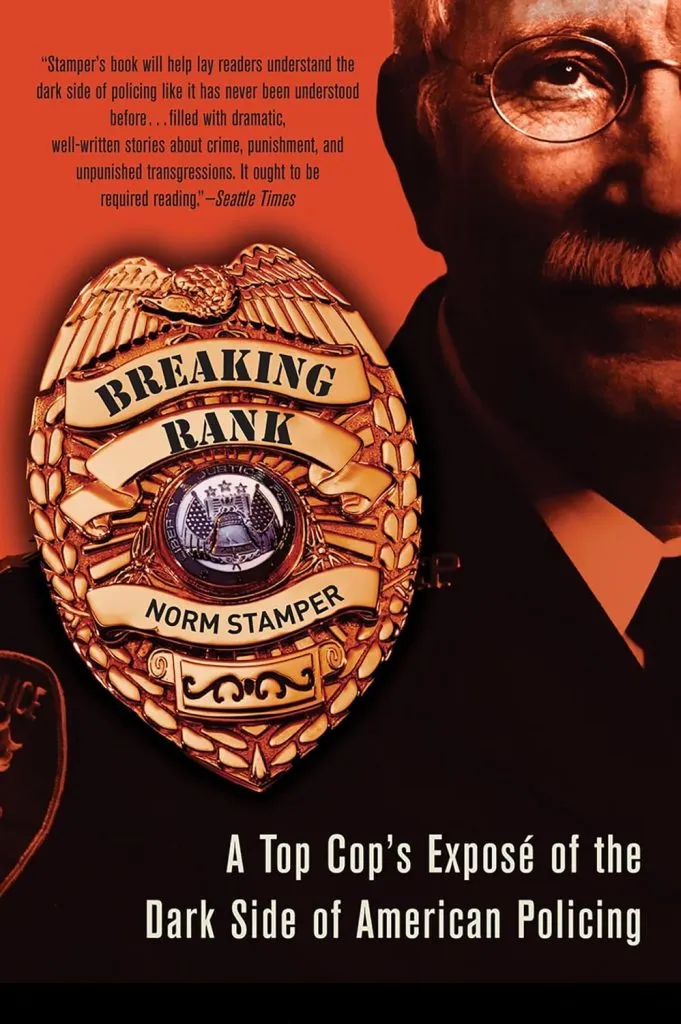
Breaking Rank: A Top Cop’s Exposé of the Dark Side of American Policing

Breaking Rank: A Top Cop’s Exposé of the Dark Side of American Policing

A Top Cop's Exposé of the Dark Side of American Policing

Author:Norm Stamper
Publisher:Nation Books
ISBN:1560256931
Pages:397
ISBN:9781560256939
Language:English
Share:

Buy Now

Description:

TL;DR

Former Seattle Police Chief Norm Stamper’s insider critique of American police culture, drawn from 34 years in San Diego and Seattle. It’s confessional, combative and still argued over.

In 1972, a young San Diego officer named Norm Stamper shot and killed a man who appeared to be holding a gun to his two-year-old son’s head. The man turned out to be unarmed. The shooting was ruled justified. Twenty-one years later, that little boy, now a grown man threatening to jump from a bridge, blamed the officer who had killed his father for much of what had gone wrong in his life.

Stamper tells that story in Breaking Rank: A Top Cop’s Exposé of the Dark Side of American Policing. It sets the tone for the book. Nation Books published it in 2005.

What is Breaking Rank about?

It’s a critique of police culture from someone who spent 34 years inside it. The book opens with a letter to a Washington police chief who shot his estranged wife and then himself, and uses that case to examine domestic abuse inside police departments. From there it takes on racism, sexism and homophobia in the ranks, the code of silence, undercover work, police unions and what it means to take a life.

Stamper includes his own failings. He writes about his early racism and homophobia, undercover work he did against activists and gay men, and his own past as a verbally abusive husband. He also recounts a 1976 investigation he ran into a San Diego graveyard squad, where nearly every officer admitted to using racial slurs on duty.

Some of the chapter titles alone tell you what kind of book it is: “Why White Cops Kill Black Men,” “Sexual Predators in Uniform” and “Snookered in Seattle,” his account of the 1999 World Trade Organization protests that turned violent while he was chief.

What does Stamper argue for?

A great deal, and readers will disagree with much of it. He argues for demilitarized community policing and against the code of silence. He also takes positions on drug policy, prostitution law, guns and the death penalty that put him well outside the mainstream of his profession. He later said publicly that his decision to authorize tear gas in Seattle in 1999 was a mistake.

Who is Norm Stamper?

Stamper joined the San Diego Police Department in 1966 and rose into the department’s top command over 28 years. He was Seattle’s police chief from 1994 to 2000 and resigned after the WTO protests. He later wrote a second book on policing and retired to the San Juan Islands.

How was Breaking Rank received?

With praise from reviewers and anger from some officers. The Seattle Times, the Boston Globe and the San Diego Union-Tribune all gave it strong notices, and true crime writer Ann Rule endorsed it. Seattle Weekly called it blunt and surprisingly well written, while noting that a former aide disputed some of Stamper’s claims. Officers in both his old cities sent angry letters.

What happened in Stamper’s 1976 San Diego investigation?

It’s one of the book’s most uncomfortable chapters, and one of its most important. In 1976, San Diego’s police chief assigned Stamper to look into a graveyard-shift squad. Nearly every officer on it admitted using racial slurs on duty, and the squad had its own radio shorthand for calls involving Black residents that treated the victims as less than human.

Stamper uses the investigation to make a point he returns to throughout the book: the problems he describes weren’t a few bad officers. They were habits a whole squad shared and a department tolerated. He also writes about policing San Diego’s Logan Heights and Barrio Logan neighborhoods in the 1970s, where he saw firsthand how those habits shaped the way residents saw the police.

What Breaking Rank shows a leader planning a book

It’s a different kind of law enforcement book, one written to argue with the profession. A retired leader can use a book to say what he couldn’t say in uniform, and Stamper did. Whether a reader agrees with him or not, the book shows how far a police memoir can go when the author holds nothing back, starting with himself.

Another Seattle chief, Carmen Best, wrote her own account two decades later in Black in Blue.

Keep reading

Hiring a ghostwriter for a sheriff’s or police chief’s book: how law enforcement leaders turn a career into a book, and what has to stay out.

Sources

Frequently Asked Questions

What is Breaking Rank by Norm Stamper about?
It’s a 2005 critique of American police culture by Norm Stamper, former Seattle police chief, drawing on 34 years in San Diego and Seattle. It covers racism, sexism, domestic abuse by officers, the code of silence and police shootings, along with Stamper’s frank account of his own past failings. Chapters cover police shootings, sexual misconduct by officers and the 1999 WTO protests.
Who is former Seattle police chief Norm Stamper?
He joined the San Diego Police Department in 1966 and spent 28 years there, rising into its top command. He was Seattle’s police chief from 1994 to 2000 and resigned after the 1999 World Trade Organization protests. He later wrote a second book on policing. He spent 34 years in policing in all and became one of the profession’s most outspoken internal critics.
What does Breaking Rank say about the 1999 WTO protests?
Stamper gives his account in a chapter titled Snookered in Seattle. The protests turned violent while he was chief, and he later said publicly that authorizing tear gas against largely nonviolent protesters was a mistake he regretted. He has also said he would revise the chapter if he wrote it again, placing more of the blame on the police response.
Who published Breaking Rank?
Nation Books published it in 2005, with a paperback edition in 2006 of about 416 pages. Its full title is Breaking Rank: A Top Cop’s Exposé of the Dark Side of American Policing. Nation Books was an independent publisher known for political and investigative nonfiction.
Was Breaking Rank controversial?
Yes. Reviewers in Seattle, Boston and San Diego praised it, and true crime writer Ann Rule endorsed it, but some officers objected. Some officers in both of Stamper’s former departments objected strongly and wrote angry letters, and a former aide disputed some of its claims. Two decades later it’s still cited in debates about police culture.
Is Breaking Rank a memoir?
It’s part memoir and part argument. Stamper uses stories from his own career, including a 1972 shooting and a 1976 internal investigation, to make the case for changing police culture, and he’s as hard on himself as on the profession. Readers who disagree with his conclusions still tend to find the personal stories hard to set aside.
Categories and tags
CategoriesMemoirs

About the author

Back