TL;DR
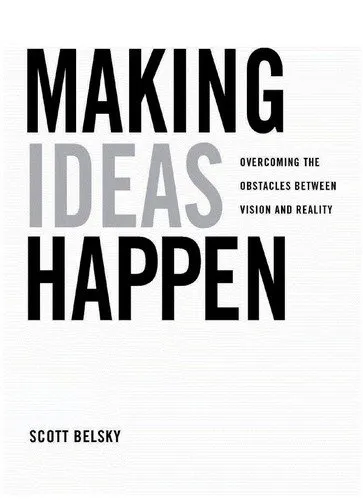
8/10. Edison’s line about one percent inspiration, taken seriously and turned into a method. Belsky founded Behance, spent six years watching which creative people finish things, and reports what they do differently. The answer is unglamorous and correct.
The premise is that everyone has ideas and almost nobody ships them, and that the gap has nothing to do with talent. Execution is a skill built out of organizational habits, accountability, and the willingness to keep going after the excitement wears off.
Belsky interviewed hundreds of productive creatives at Apple, IDEO, Disney, and Google, plus a great many individual designers and small studios, and looked for what the finishers had in common. He founded Behance and later sold it to Adobe, and the book is the distilled version of six years of that observation.
This book made me uncomfortable, which is the best compliment I can pay a productivity title. Most of them flatter the reader’s ideas. Belsky insists ideas are cheap and finishing is what counts. He’s right, and I needed to hear it said that bluntly.
What is the Action Method?
This is the transferable core and it’s worth the price on its own.
Every meeting, every burst of thinking, and every conversation gets broken into three categories. Action steps. They’re specific physical tasks with a single owner. References. They’re the notes and links and background you might want later. And backburner items. They’re the ideas you’re not doing now and aren’t willing to lose.
The discipline is in the wording. An action step has to start with a verb and describe something a person can physically do, so a step reading think about the cover doesn’t qualify, and one reading email three designers with the brief does. That sounds pedantic until you audit your own list and discover most of it is wishes.
I’d make every writer memorize the verb rule. Work on the book is a wish. Write the scene where the brother leaves the house is a task, and that difference decides whether anything gets done on an ordinary Tuesday.
The backburner category is the underrated part. Most systems make you either act on an idea or discard it, and creative people will do neither, so the idea sits in the active list forever generating guilt. Giving it a named place to wait removes it from your attention without losing it.
The backburner matches how I write my own novels. I don’t usually outline first.
I write the first chapter, then outline, then write whichever chapters interest me and connect them afterward, a habit I call the ink blot method. The chapters that don’t interest me yet need somewhere to wait without nagging, and a named backburner is exactly that place.
Watch: TEDxPugetSound - Scott Belsky - Making Ideas Happen, TEDx Talks
What advice in Making Ideas Happen stings?
Generate ideas in moderation and kill ideas liberally.
That one is aimed straight at people who mistake idea generation for progress. That’s most creative people including me. Every new idea is a small dopamine hit and a large tax on the projects already open, and a person with fifteen live projects has fifteen ways to avoid finishing any of them.
Prioritize through nagging is the second, and it sounds petty until you’ve watched a project die because everyone was too polite to keep asking. Belsky is explicit that the person who follows up repeatedly is doing the most valuable job in the room and is usually the least liked. Encourage fighting within your team is the third, and it’s right for the same reason. Consensus produces work nobody argues with and nobody remembers, and a team that never disagrees is either homogeneous or frightened.
The fighting principle is the one I’d push hardest on anybody running a team. A room full of nodding heads feels pleasant and produces mush, and Belsky has the nerve to say so in a book aimed at the people doing the nodding.
How does Making Ideas Happen apply to writing a book?
Directly, and this is why I keep it near the desk.
A manuscript is a long project with no external deadline, no client chasing you, and a middle stretch where the initial excitement is gone and the end isn’t visible. That’s the condition Belsky is writing about, and it’s the condition in which almost every abandoned book gets abandoned.
The action step discipline works on a chapter. Fix chapter seven is a wish. Cut the second scene and rewrite the ending of chapter seven so it ends on the argument is something a person can sit down and do at eight in the morning without deciding anything first.
The accountability material matters more for writers than for the design teams he studied, because a writer has none by default. Belsky’s answer is a deliberate community, meaning people who expect to see the work, and it’s the single most reliable predictor I’ve seen of who finishes.
That accountability point is the one writers resist hardest. They like to think discipline is a private virtue, and then they abandon their books in private too. The ones who finish usually have somebody waiting for the next chapter, and that person is worth more than any app or planner on the market.
What is wrong with Making Ideas Happen?
It functions partly as an advertisement for Behance, and readers who notice this find it hard to unnotice. The company appears throughout as the exemplar, the products are mentioned, and the 99U conference gets its share. That was fair enough in 2010 when the company was the evidence for the argument, and it dates the book now that Behance is an Adobe property and the physical Action Method products are gone.
The Behance plugging is self-serving, and it’s the main reason this sits at an eight. A book arguing for discipline should have had the discipline to leave its own brand out of the examples. The case studies also skew toward design and technology, so the examples are studios and startups. A novelist or an academic will have to translate, and the translation is easy but it’s work the book doesn’t do for you.
Verdict
The best book I know on the gap between having ideas and finishing things. That’s the gap most writers live in.
Read it for the Action Method and for the three uncomfortable principles, and skip the case studies if the branding grates. The structure survives its packaging.
I’d hand this to a writer stalled in the middle of a manuscript before I’d hand them a craft book. A stalled book usually has a habit problem far larger than its sentence problem, and Belsky fixes the habit.
Explore further
The Psychology of Writing Hub: what drives creative work and what stops it.
Frequently Asked Questions
Other Books From – Business and Economics