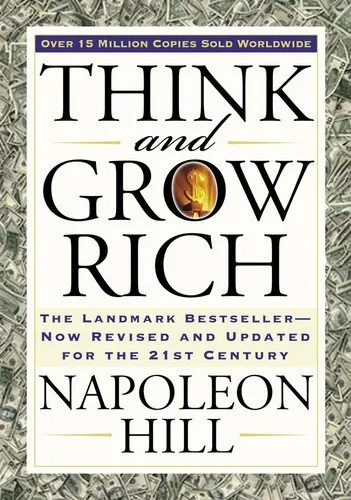
TL;DR
5/10. The book almost every success and self-help title since 1937 is descended from. It contains one principle worth keeping and a foundational claim about its own research that doesn’t survive examination. Both facts belong in the same review.
Hill’s frame is thirteen principles derived, he says, from twenty years studying more than five hundred successful men, beginning with a commission from Andrew Carnegie.
Desire, faith, autosuggestion, specialized knowledge, imagination, organized planning, decision, persistence, the Master Mind, the mystery of sex transmutation, the subconscious mind, the brain, and the sixth sense. The list ranges from the sensible to the outright occult, and the book doesn’t flag the transition. I’ve got a complicated relationship with this book. It gave the success genre its shape, and one of its principles is as good as anything in the field. It also rests on a story nobody can verify, and it galls me every time I see it sold as research.
It’s sold in the tens of millions and remains in print after almost ninety years. Almost everything in the genre traces back here or to the New Thought writers working alongside him.
What is definiteness of purpose?
The principle worth keeping, and the one I’d hand to a client. Hill’s insistence is that a vague wish produces nothing and a specific written aim behaves completely differently. His version has four parts: the exact thing you intend to obtain, what you intend to give in return, a definite date, and a written plan you begin acting on immediately whether or not you feel ready.
He then instructs you to read it aloud twice a day. That part is autosuggestion and I’m less sure about it.
The core is correct for reasons that have nothing to do with the metaphysics he attaches.
A specific goal is checkable. It tells you what to do this week and it tells you when you’ve failed. A vague one does neither. That’s exactly why people prefer them: a wish that can’t fail is more comfortable than a plan that can.
The stated price is the underrated half. Naming what you’ll give up converts an aspiration into a transaction, and a great many aspirations don’t survive that conversion. That’s useful information.
This is the part I’d defend to anyone. The named price is the step every dreamer skips, and it’s the one that tells you whether you want the thing or merely like thinking about it.
Watch: Think And Grow Rich! (1937 - 1st Edition) by Napoleon Hill, Master Key Society
What is the Master Mind?
A deliberate group of people working in harmony on each other’s problems, meeting regularly, with a shared purpose. Hill wraps it in language about a third mind emerging from the combination. That isn’t necessary. Strip that away and what remains is a mastermind group in the modern sense, and it’s now standard advice under other names: peer advisory boards, writing groups, founder circles.
It wasn’t obvious in 1937 and Hill deserves credit for isolating it. The conditions he names are the part people skip: regular meetings, genuine harmony meaning no unresolved friction, and a definite purpose the group is organized around. A group missing any of those is a social occasion. That’s fine and isn’t what he described. I’ve got real respect for Hill here. He spotted something in 1937 that business culture took decades to formalize, and the conditions he names are exactly what’s missing from most of the groups that call themselves masterminds today.
Is the Carnegie story true?
There’s no documentary evidence for it, and this matters more here than it would in most books.
Hill’s account is that Andrew Carnegie, in 1908, gave a young reporter a twenty-year unpaid commission to interview the most successful men in America and codify their methods. It’s the origin story of the entire book and of Hill’s career. Researchers have found no record of the meeting, no correspondence between them, and nothing in Carnegie’s extensive papers. Several of Hill’s other biographical claims haven’t held up either, including some concerning his education and his positions.
His career also included ventures that ended badly for the people involved, which biographers have documented and which doesn’t sit comfortably beside a book about integrity and definite purpose.
The reason this matters is structural. The entire authority of the book rests on the claim that Hill extracted these principles from studying people who succeeded. Remove the study and you’re left with one man’s assertions. They may still be useful, and they’re no longer evidence. That does more damage than any single bad chapter, because readers were told for generations that they were getting research.
Which parts of Think and Grow Rich should you skip?
The later chapters. The chapter on sex transmutation argues that sexual energy can be redirected into creative and commercial achievement, and it’s a period piece dressed as a principle. The chapter on the sixth sense describes an imaginary council of historical figures Hill convened in his mind for advice, and reports that they became real to him.
The subconscious mind and the brain chapters are New Thought material of the kind Joseph Murphy would publish more clearly twenty-five years later.
None of that is dangerous and all of it is padding a reader can skip without loss. The useful book is the first half. I’d skip them without guilt. I find the sex transmutation chapter embarrassing, and the imaginary council reads like a man mistaking daydreams for data.
Why has Think and Grow Rich lasted?
Because it was the first to package it, and because the format is close to perfect for the purpose.
Thirteen numbered principles. A promise in the title. Anecdotes about named wealthy men. An instruction to act immediately. That structure is now so standard that it reads as generic, and Hill is one of the people who made it standard.
It also arrived in 1937, at the end of the Depression, into an audience that badly wanted to believe that outcome was controllable. Timing doesn’t make an argument true and it does explain reach.
Verdict
Historically essential and unreliable on the facts. Read it to understand the genre, keep definiteness of purpose and the Master Mind, and treat the research provenance as unproven, because it is.
The parts that work don’t need the parts that don’t, and the first half is where they live. So I’m torn, and I think a reader should be too. Keep the two ideas that work, and don’t let the book’s reputation talk you into trusting the rest. A founding story with no documents behind it is a shaky base for anyone’s plans.
Explore further
The Leadership Hub: running things, and the failures that repeat.
Frequently Asked Questions
Other Books From – Business and Economics