
Every household disaster falls into one of a few shapes, and none of them is the one the market sells. The utilities stop. The water becomes unsafe or stops arriving. The road out is closed. Somebody in the house is injured or sick and professional help is delayed. The money stops. And occasionally, rarely, you have to leave immediately with what you can carry.
That list covers almost everything that will ever happen to almost anyone. It’s worth noticing what’s absent from it.
The survival industry has it backwards. It spends its marketing budget on the end of the world and leaves ordinary families unready for a three-day outage, and the people who pay for that mistake are the old and the isolated, who never bought the bunker gear in the first place.
What emergencies do people face?
The frequency ordering is roughly the inverse of the attention ordering.
Power outages are by far the most common and the most consequential in aggregate. Most are hours. Some are days. In a heatwave or a hard freeze they kill people, and the deaths are mostly among the old, the sick, and those living alone. Almost none of them involve any drama.
Water interruptions are next, usually a main break or a boil notice. The failure mode isn’t thirst but the discovery that a household needs water for a great deal more than drinking and has stored none of it.
Being cut off is regional and seasonal. Snow, flooding, a bridge closure. The house is fine, the road isn’t, and it lasts days.
Medical delay. Ambulance response stretched, hospital full, storm in progress. The gap between the event and professional care is where preparation matters, and it’s measured in minutes.
Income loss. The one that reaches the most households and appears in almost no preparedness discussion at all, because it doesn’t fit the genre.
Preparedness lists that leave out income loss are negligent. It’s the disaster most likely to land on a family, and the genre ignores it because you can’t sell a lost paycheck in a camouflage bag. A household with a few months of savings is better prepared for real life than one with a basement full of freeze-dried meals.
Why does the prepper industry oversell disaster scenarios?
Because it sells a product, and the product needs a story.
Fear moves inventory. A grid-down scenario, civil collapse, a decade of stored food, and a plan involving a remote property sells equipment at high margins to people who will never use it. The realistic version, which is a week of tinned food, some water, a torch, and a neighbor’s phone number, sells almost nothing.
There’s a second problem underneath the commercial one. Preparing for the extreme scenario is emotionally easier than preparing for the likely one, because the extreme scenario is fiction and the likely one is an admission. Buying a five-year food supply is a purchase. Accepting that you might lose your income and can’t cover three months is a fact about your life.
So the market and the customer collaborate on the wrong problem, and it’s a comfortable arrangement for both.
What preparation works in a disaster?
Short answer: depth in ordinary things over specialist equipment.
Water. The standard planning figure is about a gallon per person per day, and three days is a reasonable floor with a week better. This is the cheapest and most neglected item on any list. Tap water in clean containers costs nothing.
Food you already eat. Not survival rations. A deeper shelf of the tinned and dry food your household normally consumes, rotated normally. This means it gets used instead of expiring, and it means an emergency doesn’t also involve eating unfamiliar food during a stressful week.
Light and power. Torches with charged batteries, and a battery bank for phones. A phone with no charge is the single most common failure in a short outage, because it removes information and contact at the same time.
Heat or cooling. Region dependent and the one that kills. In cold climates, the ability to keep one room warm without the grid. In hot ones, a plan for where to go, because a house without air conditioning in a heatwave becomes dangerous faster than people expect.
Medication. The item most likely to matter and least likely to be stocked. A prescription buffer is worth more than everything else on this list combined to the person who needs it.
I’d put this one at the top of every list if I could. A prescription that runs out in the middle of a flood or a week without roads can do more harm than hunger, and plenty of the kits sold online don’t even mention it.
Cash. Card systems fail with the power. A small amount of physical money covers the gap.
Documents. Copies of what you’d need to prove who you are and what you own, stored somewhere that survives the house.
Money. An emergency fund is preparedness, and it addresses the most common household disaster there is.
What is the seventy-two hour bag for?
Leaving immediately, and only that. The idea is simple and gets overloaded until it stops working. It’s what you take when you have minutes to go and no idea when you return: fire, flood, gas leak, evacuation order. Three days of self-sufficiency while you get somewhere.
A household with a few months of savings is better prepared for real life than one with a basement full of freeze-dried meals.
The universal failure is weight. A bag built by someone preparing for every scenario ends up too heavy to carry. That means it stays in the house. That means it doesn’t exist. A bag you can carry a mile without stopping is worth more than a complete one you can’t lift. I think the overpacked bag is the perfect symbol of the whole industry. It looks impressive laid out on a garage floor and fails the first time somebody has to run with it. A second failure is that the contents are unfamiliar. Equipment used for the first time in an emergency, at night, in bad weather, is equipment that doesn’t work. Anything in the bag should be something the owner has used before. Most evacuations end at a relative’s house or a hotel. The bag is a bridge to that, and its most valuable contents are usually medication, documents, chargers, and a change of clothes.
What matters more than supplies in a disaster?
Knowing people, and this is consistently the finding after real disasters. The households that come through are the ones embedded in something: neighbors who check on them, family within driving distance, a community that notices an absence. After heatwaves, the pattern in the mortality data is that the people who die are disproportionately isolated. Not poorest, not oldest, though those correlate. Alone, with nobody whose job it was to knock. That points somewhere the market can’t follow, because there’s nothing to sell. Knowing the names of the people on your street is the highest-return preparedness activity available and it costs nothing but the discomfort of introducing yourself.
The corollary follows directly. Someone whose plan is to withdraw from other people and rely on stored equipment has picked the strategy that performs worst in every documented disaster, and it saddens me how many people are being sold exactly that plan.
Why write a book about everyday disaster preparedness?
I asked a member of my own team what he’d do if an earthquake started right then. He said, without hesitating, that he’d get under the window. The correct answer is a heavy table or a desk, because the point is protecting your body from falling objects. Getting under a window is close to the worst option available, since the glass comes down on top of you. He didn’t hesitate and he wasn’t stupid. Nobody had ever told him.
That answer is how Real World Survival started.
Being ready for disaster was my motto for twenty years because it was my job. I ran disaster recovery for a major national retailer, and my team designed and built a duplicate computer room intended to run an entire company if the machines at head office were damaged or destroyed.
In those years we were hit by a couple of medium-sized earthquakes and a fire that came close to the building. Few people around me had any idea how to respond to either. Computers are worthless without the people who run them, and the people who ran mine didn’t know what to do.
So I took CERT-LA, the seven-day Community Emergency Response Team course run by the Los Angeles Fire Department. It was among the best educational experiences of my life and I took it twice to get everything out of it.
The book is a revision of my bug out bag book, widened into a family survival guide and updated after a pandemic, two hurricanes I lived through, and ten years of watching modern infrastructure fail in new ways.
The subtitle is Preparing Without Becoming a Prepper, and the second half is the argument. The word describes an identity now instead of a practice, and that identity arrives bundled with assumptions about collapse and self-reliance that are neither necessary nor supported by what happens in real emergencies. Most people who would benefit from a week of water and a prescription buffer won’t go near any of it, because the available material asks them to adopt a worldview along with the water.
How do you write about disaster risk without selling fear?
The temptation in this material is constant, because fear is the most effective tool available and it works immediately.
Three rules keep it honest.
Frequency before severity. Discuss the outage before the catastrophe, proportionate to how often each occurs. A book that opens on societal collapse has already chosen entertainment over usefulness.
Name the cost. Every measure costs money, space, or attention, and pretending otherwise is how a reader ends up with a garage full of equipment and no emergency fund. Preparedness is a budget allocation and should be discussed as one.
Refuse the identity. The moment preparedness becomes who someone is instead of something they did on a Saturday, the sunk cost begins operating and the spending stops tracking the risk.
The tone that works is closer to insurance than adventure. Nobody feels heroic about their fire extinguisher. That’s the correct emotional relationship to have with all of it.
My take
Prepare for the boring disaster, because that’s the one coming for you. A power cut in a heatwave or a burst pipe is far likelier than collapse. Keep a small stock of ordinary things and know who you’d call. Take a CERT course if one runs near you. I took the Los Angeles one twice. Skip the prepper catalog and its fear. Usefulness doesn’t sell as well, and it works.
The real summary
Most emergencies are inconveniences that become dangerous through a small number of missing items and a lack of anyone nearby.
A week of water, a deeper food shelf, charged batteries, spare medication, some cash, copies of documents, a way to stay warm or cool, and the names of four neighbors will carry a household through the overwhelming majority of what will ever happen to it. Most of that costs under two hundred dollars and one afternoon.
The remaining scenarios, the ones the market is built on, are real and rare, and the preparation that helps with them is largely the same preparation, in slightly greater depth.
A family getting through a bad week needs a stocked shelf and a phone number, and a worldview adds nothing to either. An industry that convinces decent people that preparedness means paranoia does real harm, because the ones who believe it spend their money on gear and skip the neighbor who would have knocked on their door.
The book is Real World Survival: Preparing Without Becoming a Prepper, and the bag itself is covered in The Ultimate Bug Out Bag Guide. The writing side of it is in how the book came together.
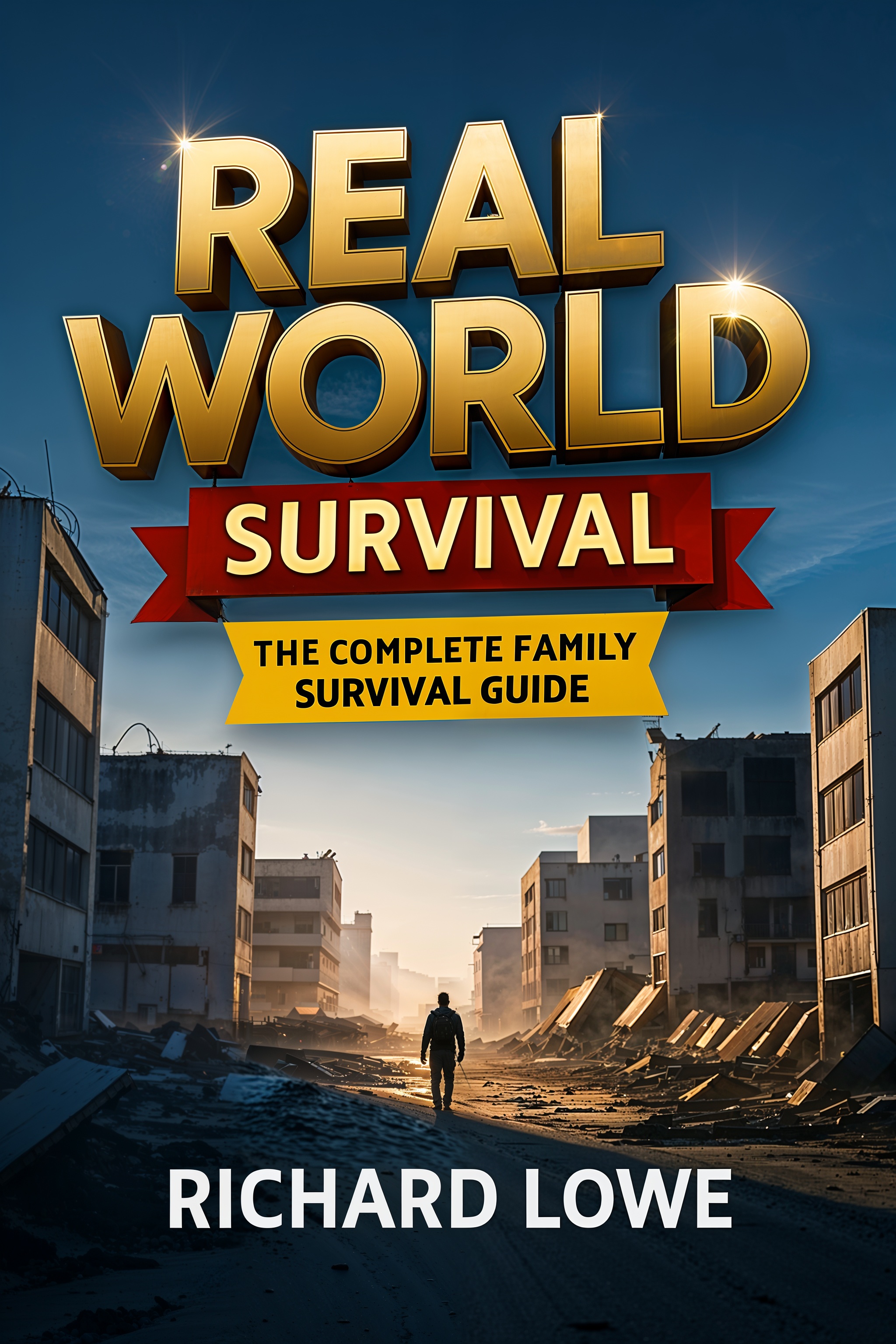
Ordinary disasters are the ones I prepare for. Real World Survival covers preparing for them without becoming a prepper, and it starts with a Christmas hike in 1986 that went wrong.
