
Every lock on the internet is made of math. The padlock in your browser bar, the green check in your banking app and the little line under a message that says it’s end-to-end encrypted are all the same idea: a lock anyone can close and only one person can open. Take that lock away and the internet turns into a building with no doors, where anybody can walk into any room. Would you do your banking in a building like that?
Global Encryption Day, every October 21, is the day set aside to remember that the lock exists and to argue for keeping it strong. It’s a young observance, only five years old, and it’s for everybody who has ever typed a password. I spent thirty-three years in IT, a good part of it worrying about who could get into what, and I’d put encryption near the top of the list of inventions that made modern life possible.
The RSA Conference marked the day this year by reminding people that the RSA algorithm, one of the foundations of all this, turns 50 in 2027. That’s a good excuse to look at where the lock came from, what it protects for a working writer, and what happens when someone turns it around and uses it against you.
What is Global Encryption Day?
Global Encryption Day is an annual observance on October 21, organized by the Global Encryption Coalition. The Internet Society, the Center for Democracy and Technology and Global Partners Digital launched that coalition in May 2020 as a “coalition of coalitions.” It brings together groups around the world that defend strong encryption, from digital rights organizations to technology companies.
The first Global Encryption Day was held on October 21, 2021. More than 70 events ran worldwide that day, over half of them hosted by Internet Society chapters, and 168 organizations signed the Global Encryption Day statement.
Advocacy matters as much as celebration here. Governments keep proposing ways to read encrypted data, and the coalition exists to push back.
How did RSA make modern encryption possible?
The same math that guards your manuscript can hold it hostage.
For most of history, encryption had a delivery problem. Two people who wanted to share secrets first had to share a key, and getting that key from one to the other safely was the hard part. Armies used couriers. Banks used armored cars. Nobody could do it over an open wire with strangers.
In 1976, Whitfield Diffie and Martin Hellman published the way around it: two keys instead of one. A year later, at MIT, Ron Rivest, Adi Shamir and Leonard Adleman turned the idea into a working system and named it after their initials. Martin Gardner described RSA in his Mathematical Games column in Scientific American in August 1977, and the world’s mathematicians went to work trying to break it.
Think of RSA as a padlock you hand out by the thousand. Anybody can take one, snap it shut on a box and mail the box to you. Only you have the key that opens it. The lock is public, the key stays private, and nobody needs a courier.
RSA was patented in the United States in 1983, and RSA Security released it to the public domain on September 6, 2000, two weeks before the patent ran out. There’s a footnote, too. A British mathematician named Clifford Cocks had described a nearly identical system inside GCHQ in 1973, and it stayed classified until 1997.
How long did it take to break Martin Gardner’s RSA puzzle?
Gardner’s column came with a dare. The MIT team published a message locked with a 129-digit number and offered $100 to anyone who could read it. Rivest estimated that factoring a number that size would take 40 quadrillion years with the best method and the fastest computers of 1977.
It took seventeen years.
In 1993 and 1994, more than 600 volunteers lent spare time on about 1,600 machines, two of them fax machines, and cracked it in roughly six months. Derek Atkins, Michael Graff, Arjen Lenstra and Paul Leyland coordinated the work. The hidden message read “The Magic Words are Squeamish Ossifrage,” and the winners donated the $100 to the Free Software Foundation.
Was RSA broken, then? No. The volunteers beat one small key with better math and a lot of borrowed computers, and everybody learned to use bigger keys. Every advance in factoring since then has been answered the same way. That’s how encryption survives: the locks keep getting thicker faster than the lockpicks get better.
What does encryption protect for a writer?
More than most writers realize.
Your unpublished manuscript lives in a cloud folder, an email attachment or a laptop bag. Encryption keeps it unreadable to anyone who intercepts it on the way or picks it up off a coffee shop table. Your publisher’s payment portal, your Amazon or IngramSpark dashboard and your bank all ride on it too. Every one of those logins travels across networks you don’t control, and only the lock stands between your password and whoever’s listening.
For a ghostwriter the stakes are higher. Confidentiality starts before any contract exists: a prospect’s ideas are covered from our first conversation, and the paperwork labels every page they hand over as theirs alone. Clients aren’t worried I’ll steal the idea. They worry somebody else will learn it before the book comes out. Every recorded interview and every chapter draft is a confidential business record, and I covered how they should be stored in what happens to your ghostwriting interview recordings.
My own setup is ordinary, and anyone can copy it. My passwords live in a password manager. My home Wi-Fi runs WPA3, with the smart gadgets on a separate subnet from the computer I write on. Backblaze backs everything up. None of it would mean anything without the encryption underneath.
Encryption is a padlock anyone can snap shut and only you can open. Every unpublished book, client interview and bank login depends on it. – Richard LoweShare on X
Where is encryption already working for you?
Almost everywhere, and you didn’t have to do anything to get most of it. You’ve used it a dozen times today without noticing.
The padlock beside a web address means your browser and that site agreed on a key before a single byte of your password crossed the wire. When you log into your bank, your email or your publishing dashboard, the page you see was locked on the server and unlocked on your screen. Anyone listening on the coffee shop Wi-Fi gets noise.
Your phone does it too. Set a passcode on a modern iPhone or Android phone and its storage is encrypted, so a thief who walks off with it gets a slab of glass and very little else. An app that advertises end-to-end encryption locks each message on your phone and unlocks it only on the other person’s. The company in the middle can’t read it either.
A password manager is a vault built the same way. It stores everything encrypted under one master password that the company never sees. Pick a long one and never reuse it.
Where do you still have to act? On the laptop, where disk encryption can be a switch you flip yourself, and on the backup drive in your desk drawer. That drive is wide open to anyone who picks it up unless you lock it.
What happens when encryption is used against you?
The lock doesn’t care whose hand is on the key.
Ransomware works by encrypting your files with a key the criminals keep. I opened Family Cybersecurity with a night I still remember. A friend’s phone call woke me in the small hours, and thirty years of her family photographs were disappearing behind that kind of lock while we talked. I brought my whole recovery kit, and by dawn we hadn’t saved one picture. She paid the five hundred dollars they demanded. They took the money and never sent the key.
The same math that guards your manuscript can hold it hostage. The defense is a copy the criminals can’t reach: a backup kept off the machine, ideally one that keeps old versions so you can roll back past the attack. A writer whose only copy of a novel sits on one laptop is one bad attachment away from losing it.
Why do governments keep arguing about encryption?
Because strong encryption locks out the police and spies along with the criminals. Every few years a government proposes some form of exceptional access, a way for investigators with a warrant to read encrypted messages, and Global Encryption Day exists largely to push back against those proposals.
The argument from the security side is that a spare key can’t tell who’s holding it. A door built for the good guys opens for anybody who finds it.
History has an example. For decades a Swiss company sold encryption machines to governments around the world, and the machines were secretly rigged so American and West German intelligence could read the traffic. I told that story in the history of Crypto AG’s rigged machines, and it’s the best case I know for being wary of anyone who wants a quiet copy of the key.
My take
Encryption is the most important security tool most writers never notice. It protects the book before publication, the client who trusted you with a secret, and the account the royalties land in. It also can’t save a file you only have one copy of. Turn it on for every device and account you own, and keep a backup the ransomware can’t touch. Neither one costs much.
Lock the doors
Use the day for a fifteen-minute check. Make sure your laptop’s disk encryption is on, BitLocker on Windows or FileVault on a Mac. Put a passcode on your phone, since modern phones encrypt their storage once one is set. Turn on two-factor authentication for email, cloud storage and anything that pays you, and move sensitive client conversations to an end-to-end encrypted app. Then confirm your backup ran this week.
The Digital Self-Defense hub covers the rest, and if you lead a security team and have a book in you, here’s how I write books with cybersecurity leaders.
Fifty years after three mathematicians figured out how to hand out padlocks to strangers, the internet still runs on that trick. Check that your own locks are closed. Your next book, and the clients who trusted you with theirs, are sitting behind them.
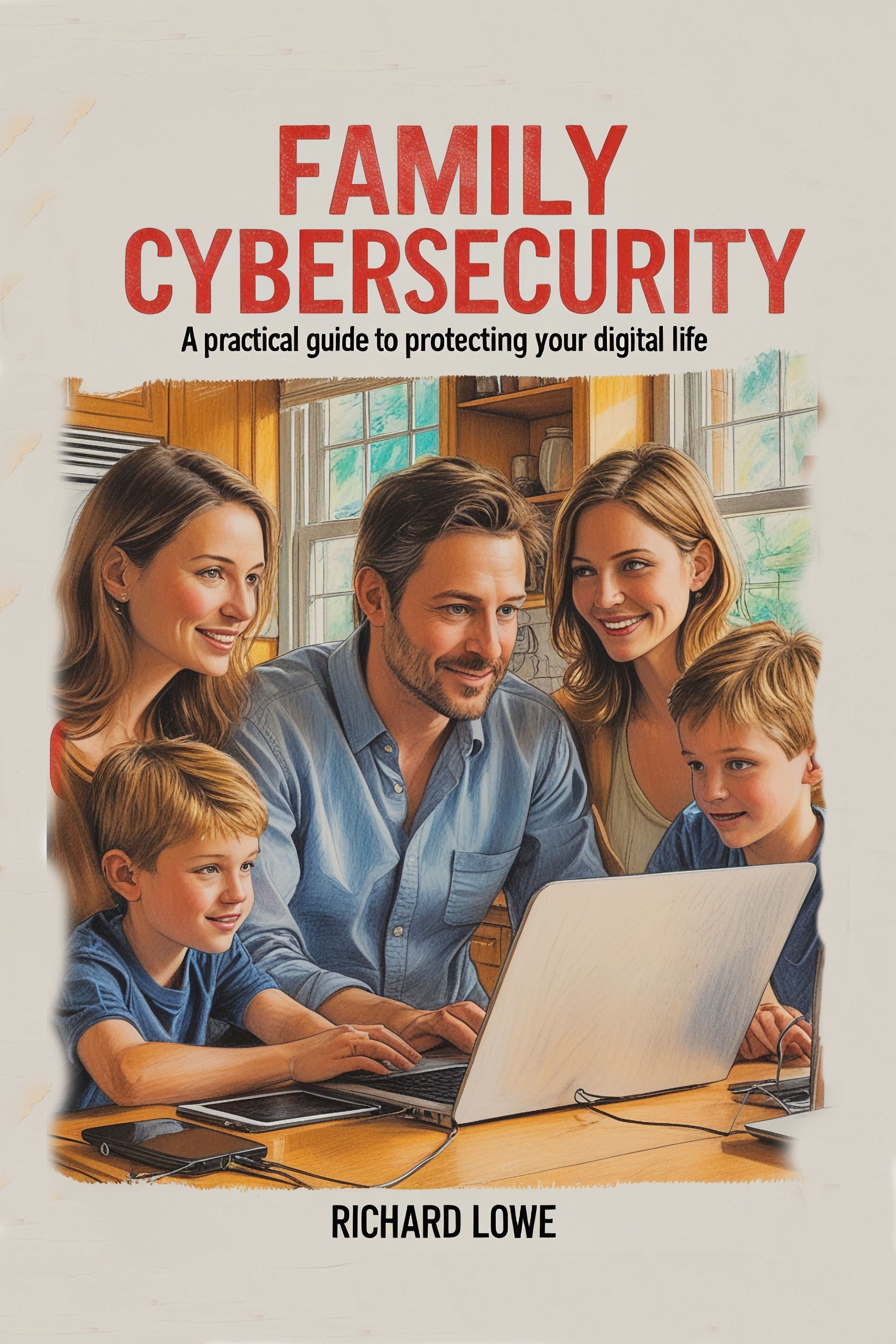
The home version of what I did for a living: ransomware, phishing, passwords and two-factor, backups that survive an attack, and the steps to take the moment an attack hits.