
I’ve watched platform after platform court writers, take their audiences and then change the deal. Substack is the latest, and the writers who moved their whole careers there are finding out what that costs. A journalist named Scott Carney posted a video called The Real Reason Substack is Collapsing. He’s an investigative reporter, six books, a Payne Award, formerly of Wired, and he runs a one-man operation out of Denver. He did something almost nobody does in this business. He put his actual numbers on screen. Substack is growing quickly and its valuation is climbing. What collapsed was the arrangement Carney signed up for, and the reason it collapsed is worth more than the headline.
Carney’s anger is fair, and I’d aim it squarely at the pitch.
Writers were told they could skip the gatekeepers and get paid directly by readers, and plenty of good ones walked away from steady work on the strength of that promise. The platform kept the audiences they carried over. The writers kept a dashboard. The cruelest part is that the people who pay for a broken promise are always the ones who believed it.
What Scott Carney showed
He pulled up two graphs. The first was his paid subscriber count, which sat flat for nine months between June 2025 and March 2026, then jumped when an investigation of his broke through. The second was his follower count over the same stretch. That went from twelve thousand to sixty-five thousand almost overnight.
One viral piece moved his paying readers by about a third. It moved his followers by a factor of six.
The cruelest part is that the people who pay for a broken promise are always the ones who believed it.
Those two lines describe two different businesses. Followers are eyeballs on a feed, and eyeballs on a feed are what a platform sells when it raises money. Paying readers are Carney’s rent. The graph that went vertical belonged to the platform.
His combined income for the year came to about eighty-four thousand dollars, roughly fifty-nine from YouTube advertising and the rest from subscriptions. He notes that this is close to what a beat reporter earns at a major newspaper, with no health insurance, no legal department, and no editor. A three-month investigation that cost a supplement company an estimated fifty million dollars in revenue paid him just over seven thousand.
What do Substack income numbers look like?
Buried in the middle of the video is a question about how many paying readers exist, and Carney moves past it quickly.
Say a writer needs a thousand paying subscribers at eight dollars a month to earn a living.
For the next writer to also earn a living, a thousand more paying readers have to arrive. Not a thousand more readers. A thousand more people willing to hand over eight dollars every month, on top of whatever they already pay.
He leaves it there as a thought experiment. It doesn’t have to be one, because Substack publishes enough numbers to do the sum.
The company has reported more than five million paid subscriptions. In April 2026 it said close to a hundred thousand publications were earning money, up from around fifty thousand a year earlier.
Put those two figures next to each other.
Five million subscriptions spread across a hundred thousand earning publications averages fifty paying subscribers each. Even if every subscription were distributed perfectly evenly, which no marketplace has ever done, five million subscriptions can support exactly five thousand writers at a thousand subscribers apiece. There are twenty times that many publications already collecting money.
And the distribution is nowhere near even. Sacra estimates gross writer revenue at about four hundred and fifty million dollars a year, while the top ten authors alone account for more than forty million of it.
Heather Cox Richardson is estimated at twelve million a year on her own. A handful of publications hold a tenth of everything paid out.
So the number of writers who can earn a living on Substack has nothing to do with talent or consistency or how well anyone works the feed. Division sets it, and I think every writer weighing a paid newsletter ought to do that sum before quitting anything.
Then there’s churn. Reported annual churn on new paid subscriptions runs near fifty percent. That means a writer holding a thousand subscribers is replacing roughly half of them every year while trying to grow. Ask yourself how many newsletters you pay for. Carney says his own ceiling is about five that he can keep up with, and his wallet is skeptical about that number. Now add streaming, a newspaper, a music service, and the software subscriptions that used to be one-time purchases. The pool doesn’t grow to match the writers. So writers don’t grow the market. They take subscribers from each other, and mostly they don’t even manage that, because a reader who cancels one newsletter usually doesn’t reassign that eight dollars. They just stop paying for newsletters.
This has nothing to do with Substack’s management. Ghost would hit it. Beehiiv would hit it. Patreon hit it years ago. It’s what a subscription economy does when the supply of things to subscribe to grows faster than the supply of money and attention.
The line that stopped me
Carney says, about the people paying him: “For most people, I’m not a commodity, I’m a charity.”
He means his readers are supporting a mission because they want it to continue.
That’s patronage, and patronage has been a legitimate way to fund creative work for about six centuries. It’s also emotionally different from selling something, and it behaves differently. Patronage is generous, loyal, and finite. It doesn’t scale, and it can’t be forecast.
The trouble is that the pitch was commerce. Build an audience, put up a paywall, sell your writing directly, and skip the gatekeepers. What arrived was a tip jar with excellent typography.
What happened when the platform added a feed
Substack launched Notes. It’s a feed of short posts. The stated reason was discovery, and discovery is what most newsletter platforms lack.
What a feed does, though, is change what the company is optimizing.
A newsletter platform makes money when readers pay writers. A feed makes money when people stay on the feed. Those two goals overlap for a while and then they stop overlapping, and when they stop, the feed wins, because the feed is the number the investors are watching.
The scale of that pressure is public. Substack raised a hundred million dollars in July 2025, led by BOND and The Chernin Group, at a valuation of one point one billion. Set that against Sacra’s estimate of roughly forty-five million in annual revenue for Substack itself, and the company is priced at about twenty-four times what it earns.
That kind of multiple is a bet on something much larger arriving later, and engagement is the metric that makes that story credible to the next investor. I hate how that shifts the risk without anyone noticing. The investors get their growth story, and the writer’s income becomes the thing that gives.
Carney’s follower graph is what that looks like from the writer’s chair. More people saw him than ever. Fewer of them paid. The fair objection is that Notes works. Sacra puts recommendations and the internal feed at roughly a quarter of all paid conversions on the platform. That’s a real number and cuts against the idea that discovery does nothing for writers.
Both things are true at once, and that’s the uncomfortable part. The feed does convert. It converts in proportion to attention, and on any feed the attention piles up at the top. Everybody else fights over scraps. A quarter of conversions flowing through a discovery mechanism helps most the writers who were already winning.
Cory Doctorow named this pattern. Platforms are good to users, then good to business customers, then good to shareholders, and the writers who brought their audiences over are business customers who have already handed over the thing that gave them a position.
Should writers leave Substack?
No, and the video’s title does the argument a disservice. Substack is a good distribution tool. It publishes cleanly, it handles email, it’s real discovery through Notes, its posts are indexed and get cited by AI answer engines, and it costs nothing until you charge. Judged as a way to reach people, it works better now than it did in 2023.
It also costs ten percent of subscription revenue, plus Stripe’s cut on top. That’s the reason several higher-earning writers have moved to Ghost or Beehiiv. That option existing matters, because it means the writers with the most to lose aren’t trapped. The ones who can’t leave are the ones whose audience came from the feed in the first place. What it stopped being is a salary. Those are two separate claims, and the collapse framing welds them together.
I publish on Substack. I’ve never expected it to pay me, because the money in my business comes from writing books for other people.
The newsletter exists so that people who might hire me can watch me think for six months before they call. Carney’s apocalypse, five times more people seeing his work for free, is the exact outcome I want from the platform.
The same feed that sinks one writer’s business carries another writer’s straight to the top. Nothing about the platform changed between those two sentences.
What should a writer do about platform income in 2026?
Spread it out. Treat every platform as a road, not a home, build income it can’t take away, like sponsorships, books and services, and keep your readers’ email addresses.
Carney answers this himself in the last four minutes, and the answer is the actual news in the video. He started taking sponsors. He’d turned down a hundred and fifty thousand dollars in offers over the previous year on principle. He now charges five and a half thousand for a read, has no trouble filling the slots, and that single line is worth two to three times his entire Substack income.
He’s honest about the cost. He publishes his rate card, refuses whole categories including supplements and crypto and gambling, and marks the ad breaks so viewers can skip them. He also admits the obvious risk, that the temptation to soften an investigation grows with the size of the offer, and that this has been his beat for years.
What he shows, without framing it this way, is that the reader-supported dream was the most fragile of his income streams and the one he defended longest.
The pattern under all of it
Every writer I know who has been doing this for more than a decade has lived through some version of the same story. I have traced what it did to writing in particular, and the shape doesn’t change. The traffic source that worked stopped working. Google changed. Facebook throttled pages. Medium introduced a paywall and then changed the split. Amazon changed the terms. Now it’s Substack, and in three years it’ll be something else.
The constant is that a business built on somebody else’s distribution has one input it doesn’t control, and that input is the whole business.
The same goes for the software you run a business on. If you’re choosing a CRM company, make sure it’s stable and do some research on it. Build everything on an all-in-one CRM platform and you’re totally sunk in. If it dies, so do you. All it takes is one sale of the company to get some bad management in there.
I wrote about this from the audience-building side, and the conclusion holds here. The follower count was never the asset. The asset is the work itself, the relationships it creates, and the record of it that lives somewhere you own.
What does a writer own that a platform cannot take?
Three things, and none of them are on a platform.
The first is a book. A book with an ISBN sits in library catalogs and distributor databases and gets cited for decades. Nobody deprecates it. There’s no algorithm change that removes it. This is the least glamorous answer and the most durable one, and it’s why I keep telling people the book is infrastructure.
The second is an email list you can export. Not subscribers on a platform, a file you can move. Substack lets you export yours. That’s to their credit and worth using while it remains true.
The third is a site you control, with your work on it, structured so machines can read it. That last part used to be optional. It’s not anymore.
SparkToro and Similarweb put zero-click at 68 percent of United States Google searches for the first four months of 2026, up from 60.45 percent in 2024, which they describe as the fastest two-year acceleration they’ve recorded. Only 276 searches in every thousand now reach the open web at all. When an AI Overview appears, the zero-click rate rises to around 83 percent.
People ask a question and get an answer assembled from sources. Being one of those sources is the current version of being findable, and it’s decided by what a machine can read on a page you own. Carney’s Substack posts will outlive his relationship with Substack only to the extent that they exist somewhere else too.
The bundle he mentions and abandons
One idea in the video deserved more than the ninety seconds it got. Carney suggests that twenty writers could pool into a single fifteen-dollar subscription and split the revenue. A reader who won’t buy twenty newsletters might buy one publication containing twenty writers. That idea already exists. It’s called a magazine.
He names the reason it fails: the writers would fight over the split, and then he says there’s no way to build it inside Substack and he doesn’t want to build it outside. Both of those are true, and they’re also the reason magazines had editors and business managers instead of being run by the contributors.
The subscription economy solved the distribution problem and then rediscovered, twenty years later, why publications existed.
My take
Substack isn’t the villain here. Any income that depends on a platform choosing to keep paying you is fragile, and the arithmetic of a thousand paying readers breaks once every writer arrives chasing the same pool. Own three things instead. A book with an ISBN, an email list you can export, and a site you control. Export your list now while the platform still lets you.
What I take from it
Carney made a video with real numbers in it. That’s rare and useful, and I respect him for it. He also gave it a title that argues something his own evidence doesn’t support.
Substack is still growing. A particular promise about Substack turned out to be smaller than it sounded, and a working journalist responded by diversifying instead of quitting.
If you write, take the arithmetic seriously and the headline lightly. Ask what happens to your income if the platform you depend on changes its priorities next quarter, because at some point it will, and the answer shouldn’t be that you lose the business.
Use the platforms for what they’re good at. That’s reach. Keep the things that compound somewhere you control. And if you’re going to build the durable asset, the publishing and marketing hub covers what moves books, and if the book is the thing you keep meaning to write, that’s the work I do.
Carney will be fine, because he saw the problem and moved his income somewhere the feed can’t touch. The writers I worry about are the ones who read his follower graph as good news and keep building on rented ground.
No platform has ever stayed loyal to the writers who built it, and I’d be a fool to expect Substack to be the first. Use it for reach and keep a home you control, because the day its interests split from yours, it’ll pick its shareholders over you every time and call it a product update.
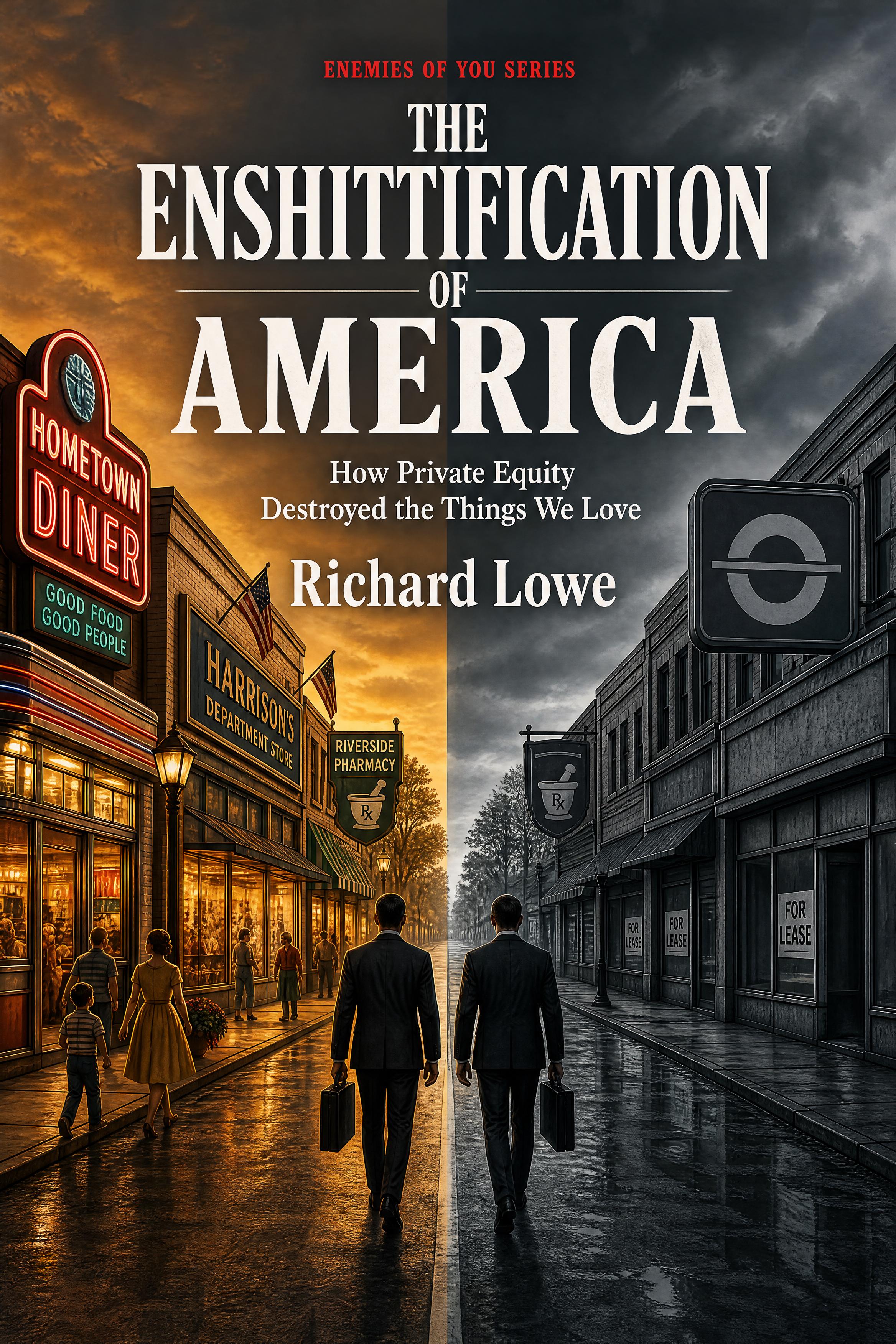
Good businesses get taken apart by the same playbook again and again. The Enshittification of America examines thirteen industries where it happened.
