Latest
Starting to Write Late Is a Head Start: What the Years Hand YouBjørn Larssen: Gods Who Don’t Know How to GodDan Shinder: Everyone Has a StoryWhat’s New at The Writing King: Week of November 15, 2026What My Old Rules of Friendship MissedWhen Helping a Friend Becomes EnablingThe Money Appeared the Week After the DisasterHow a Stranger Decides You Are Credible in Nine SecondsWhat You Have to Decide Before Anybody WritesWriting It Before You Need ItCross Training Covered Everything Except the Role That Mattered MostBehind the Book: Galactic InvasionBehind the Book: The Woke VirusBehind the Book: You Don’t Own Anything AnymoreWhat’s New at The Writing King: Week of November 8, 2026Alexander Zhidkov: Decision MakingJessi Szurek: Expand Your RangeYou Don’t Own Anything AnymoreThe Budget Decided How My Department Was ShapedWhy Your Competitor’s Book Is Working and Yours Would NotWhy Are These Guys Smiling? A Business Book That Became a Wrestling MemoirPangram Wants to Decide Who Gets PublishedWhat You Have Enough Material For Right NowWhen a Book Is the Wrong ToolGalactic InvasionThe Woke VirusChatGPT Turns Four: From a Free Research Preview to GPT-6What’s New at The Writing King: Week of November 1, 2026Diwali: The Festival of Lights and the Story Behind the LampsHow Much Water and Power Does Heavy AI Use Take? I Ran My Own NumbersBad Boys: Ride or Die (2024)Vesuvius Day: The Teenager Who Wrote Down Pompeii’s Last DayAnti-Communism Week: Remembering the Writers Communism SilencedVoyager 1 One Light-Day: Fifty Years to Travel One Day of LightVellum Added an Optional AI Feature. A Pile-On Killed It in a Day.Are AI Subscriptions Losing Money? The Gym Membership Math Says NoAI Terms Every Writer Should Know, and Why Each One MattersWorking While Sick: What 24/7 On Call Cost MeHe Banned AI From His Writing Group. His Own Cover Got Called AI Slop.Who Writes the Fake Fan Mail Authors Get? Inside the Scam CompoundsSMS Appointment RemindersJoe Rockey: Ghostwriting His BookFree BooksDarrell Stern: Stop Being Invisible, Become UnmissableHow to Turn Your Expertise Into a Book People Want to Read | The Expert MethodWhat’s New at The Writing King: Week of October 25, 2026Challenger Remembrance Day: The Engineer Who Wouldn’t SignJoel Salomon: The Truth About MoneyReddit Is Putting Up a Login Wall. Wikipedia Won’t Be Far Behind.

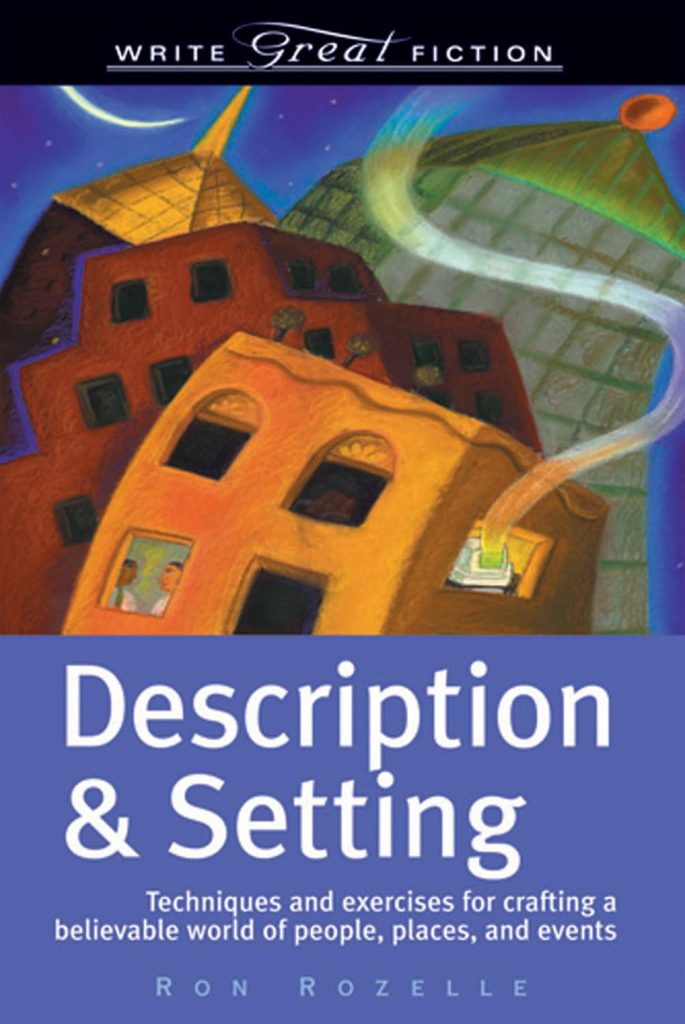
Description & Setting

Description & Setting

Techniques and Exercises for Crafting a Believable World of People, Places, and Events

Author:Ron Rozelle
Published:March 15, 2005
ISBN:158297327X
Pages:226
ISBN:978-1582973272
Language:English
Share:

Buy Now

Description:

TL;DR

8/10. One of the stronger Write Great Fiction volumes. It teaches that description and setting must do work instead of decorate. Mood, character, plot, grounding. And it favors the telling detail over exhaustive cataloging. Clear, practical guidance on the hardest judgment: how much is enough. Pitched at developing writers, and reliably useful for flat descriptions and empty-stage settings.

How much description is too much? When does setting stop serving the story and start stalling it? Description & Setting by Ron Rozelle answers those questions with the calm authority of a working writer and teacher, and it’s one of the stronger entries in Writer’s Digest’s Write Great Fiction series. Beginners handle these two elements badly in opposite directions. Too much inert description, or too little grounding. The book teaches the balance that makes a world feel real without drowning the story.

Description and setting are deceptively hard. Done well they’re nearly invisible, immersing the reader without their noticing; done badly they’re the paragraphs readers skim. Rozelle’s subject is how to land in the first category.

Description that does work

Rozelle’s central principle echoes the best craft thinking. Description should never be inert decoration. It should always be doing a job, establishing mood, revealing character through what they notice, advancing the story, or grounding the reader physically in a scene. He teaches how to choose the telling detail over exhaustive cataloging. One sharp image conveys more than a paragraph of inventory. He also teaches how to weave description into action and emotion instead of parking it in static blocks readers learn to skip.

The emphasis on selection, on the right detail instead of all the details, is the heart of good descriptive writing. Most beginners inventory a room like an insurance adjuster, and Rozelle is right to beat that habit out of them.

Keep reading

Imagery in writing: making description do real work: Rozelle’s telling-detail principle, in the fuller craft of vivid description.

Watch: World Building, Setting & Description in Your Novel | PREPTOBER 2023, Heart Breathings

Setting as more than backdrop

On setting, Rozelle makes the case that a well-rendered place is an active element, shaping mood, influencing character, and tying into plot, instead of a static stage the action happens in front of. He covers how to make a setting specific and alive, how setting and description interlock, and how much grounding a scene needs, the judgment about quantity that beginners most often get wrong.

Treating setting as a painted backdrop is one of the dumbest habits in fiction, and he takes it apart without lecturing. The balance he strikes, enough to immerse, not so much that it stalls, is the practical wisdom a developing writer needs, and he conveys it with clear examples instead of abstract rules.

Keep reading

Setting and world-building that pulls readers in: Rozelle’s active-setting principle, in the wider craft of building immersive places.

What are the limitations of Ron Rozelle’s Description & Setting?

The caveats are minor. As a fundamentals-series volume it’s pitched at developing instead of advanced writers, so a seasoned stylist may find its lessons familiar. Its subject overlaps with other books, dedicated setting guides cover some of the same ground, though Rozelle’s pairing of description and setting in one coherent treatment is a sensible combination. And like any craft book it teaches principles a writer must then practice; reading it doesn’t substitute for the work of applying it. None of that dents it for me. A seasoned stylist can skip it, and everyone else has work to do.

Is Description & Setting worth reading?

It’s one of the better Write Great Fiction volumes and a useful treatment of two elements writers commonly mishandle, with the right central principle, that description and setting must do work instead of decorate, and clear, practical guidance on the hardest judgment, how much is enough. It loses little, mainly for being pitched at developing writers and for subject overlap with other books.

For a writer whose descriptions feel flat or whose settings feel like empty stages, or who simply never knows how much is too much, it’s a clarifying, practical, and reliable guide. Rozelle answers the how-much question with more sense than most craft writers manage. That alone makes it a strong entry in a strong series.

Explore the hub

The Writing Hub: description, setting, and the rest of the craft, gathered in one place.

Frequently Asked Questions

What is Ron Rozelle’s Description & Setting about?
I found this book to be one of the stronger entries in Writer’s Digest’s Write Great Fiction series, teaching how description and setting should do work in a story and not just decorate it. Rozelle shows how these elements can establish mood, reveal character, advance the plot, and ground the reader in a scene. The book focuses on the hardest judgment call for developing writers, how much description and setting is enough without stalling the story. I think it succeeds because Rozelle favors the telling detail over exhaustive cataloging.
What is the central principle behind Ron Rozelle’s approach to description and setting?
Rozelle’s central principle is that description should never be inert decoration, it should always be doing a job. That job can be establishing mood, revealing character through what a character notices, advancing the story, or grounding the reader physically in a scene. He teaches writers to choose the telling detail over exhaustive cataloging, since one sharp image conveys more than a paragraph of inventory. I consider this emphasis on selection, the right detail instead of all the details, the heart of good descriptive writing.
How does Ron Rozelle treat setting as more than a backdrop?
Rozelle makes the case that a well-rendered place is an active element in a story, shaping mood, influencing character, and tying into plot, instead of a static stage the action happens in front of. He covers how to make a setting specific and alive, and how setting and description interlock with each other. He also addresses how much grounding a scene needs. That’s the judgment about quantity that beginners most often get wrong. I found his balance, enough to immerse the reader without stalling the story, conveyed through clear examples and not abstract rules.
What are the weaknesses of Ron Rozelle’s Description & Setting?
The caveats I found are minor. As a fundamentals-series volume, it’s pitched at developing and not advanced writers, so a seasoned stylist may find its lessons familiar. Its subject also overlaps with other books, since dedicated setting guides cover some of the same ground, though I think Rozelle’s pairing of description and setting in one coherent treatment is a sensible combination. Like any craft book, it teaches principles a writer must then practice, so reading it doesn’t substitute for the work of applying it.
Who is Ron Rozelle’s Description & Setting written for?
I’d recommend this book for a writer whose descriptions feel flat or whose settings feel like empty stages. It’s also useful for anyone who never quite knows how much description is too much. Rozelle pitches the material at developing writers and not advanced ones, and I found it a clarifying, practical, and reliable guide for that audience.
How does Description & Setting rank among the Write Great Fiction series?
I consider it one of the stronger volumes in Writer’s Digest’s Write Great Fiction series. It holds that standing because it addresses the central principle that description and setting must do work and not decorate, and it offers clear, practical guidance on the hardest judgment, how much is enough. It loses a little only because it’s pitched at developing writers and its subject overlaps with other craft books. Overall I’d call it a strong entry in a strong series.

About the author

Ron Rozelle

Ron Rozelle is an American novelist, memoirist, journalist, and longtime Texas creative writing teacher, best known for the Writer's Digest craft title Write Great Fiction: Description and Setting (2005), part of the widely used Write Great Fiction series. He was raised in Oakwood, Texas, where his father Lester served as school superintendent, earned his B.A. from Sam Houston State University,…

More about Ron Rozelle

Back