
Galactic Invasion started on YouTube. I’d been watching the HFY videos, the stories where humanity wins out in the end, and they’re a lot of fun. They’re kind of ridiculous, and they don’t pretend to be anything else. They don’t claim to be realistic. They’re just fun reads about humans being good and coming out on top.
I wanted to write something in the same vein, only as a full novel in my own style, which runs longer and slower than a ten-minute video. Humanity is good in this book, and it wins in the end, against a really, really big enemy.
It sits right alongside Collision With Andromeda and The Sphere in my science fiction. The Sphere is the one of those three where humanity doesn’t come out as well.
What kind of galaxy does Galactic Invasion start in?
The galaxy in this book is very old and very sure of itself. The Galactic Confederation has governed for four hundred million years from the Long Hall at Aurem, and it has one law every member shares, cut into a black stone in every script it has ever used: make nothing that thinks.
Then something comes in over the rim where the stars are thin. It holds still above a world in lines so regular they look drawn with a rule, and the lines come down. When it’s done, the clouds still move and the tides still run, and nothing under them is alive. Nothing even rots.
By the time the Assembly meets in emergency session, the Confederation has lost 231,000 worlds and 410,000 warships. A small man in a plain dark coat walks the nine kilometers of the Long Hall, says he’s from Earth, and offers to win.
The hall laughs. I wanted that laugh to hurt.
Why does the galaxy laugh at Earth?
Because it can. Earth sits in a scrap of the Orion Spur that the Confederation’s registry marks no routing, and the reason for the flag lapsed a million years ago. Nobody remembers why. The delegates see one small man from an unregistered world, and they laugh him off the floor.
He expects it. Before he walks in, he says the line the whole book turns on: people don’t come to you because you’re strong, they come to you because they were wrong about you in public.
That’s the subtitle, too. Never Underestimate Humans. The whole galaxy does, and humans turn out to be the most dangerous people in the story. That isn’t always comfortable for the ones who end up asking them for help.
The book on this: Galactic Invasion is military science fiction at galactic scale: an enemy that sterilizes worlds, a Confederation that can’t stop it, and a small man from Earth who offers to win the war if they hand him everything.
How do you write a war this big without losing the people in it?
You keep leaving the flag deck. The book runs at full scale, with fleets counted in the hundreds of thousands and then far past that, but it keeps cutting from the admirals to the people underneath them.
It opens with a hauler captain named Hesk haggling over a crate of fish paste on a station above Teshra while the lattice arrives over the northern pole. Teshra has four hundred million people. Hesk has ninety seconds to blow his docking clamps and a nephew who’s two minutes away buying salve.
After that, the war is told by a six-limbed surveyor swabbing a dead market town for anything still alive, an old Thel delegate who didn’t laugh, a Terran cruiser with opinions about her captain, and the transcripts and logs of people in the way. One of the earliest is a survivor’s debriefing. The clerk notes that his manifest lists a crew of three. He says, write two.
People don’t come to you because you’re strong. They come to you because they were wrong about you in public.
Why cap every fleet in Galactic Invasion at a trillion ships?
Because numbers stop meaning anything if you let them run. A war at this scale tempts you to keep adding zeros, and past a point a reader can’t feel the difference between one impossible number and the next.
So I scaled every fleet in the book down by a thousand, and no fleet in it is larger than a trillion ships. That’s still absurd. It’s also the kind of absurd a reader can hold, and it means that when a battle costs three hundred and thirty million hulls, the number lands.
It lands because somebody counts it. The Destroyer counts everything he looks at. He keeps a book, and every world and every loss goes into it in the same hand, and nothing goes in ahead of time.
Who is the Destroyer?
He’s the man who walks the Long Hall. He’s small, he wears a plain dark coat with no insignia, he carries nothing, and when the Assembly asks for his name, that’s the one he gives. He never raises his voice.
Who he is, and where the name comes from, is something the book takes its time over, and I won’t spoil it here. What I will say is that he isn’t allowed to be right about everything. Once in the book, he’s wrong, at enormous cost, and he carries it. A commander who never makes the bad call isn’t a character. He’s a wish.
What does the Interdict have to do with humans?
Everything, and that’s all I’ll say without giving the book away. Make nothing that thinks is the oldest law in the galaxy. Every Kethari warship has it cut into its keel, and pilgrims at the great stone on the Approach touch it for luck.
Earth makes ships that think. The Terran cruisers talk back, have opinions, and argue with their captains. The question of what that means, and why the galaxy made the law in the first place, is one of the mysteries the book opens early and pays off late. I wanted a galaxy whose oldest law turns out to be about the very people it laughed at.
Does humanity win in Galactic Invasion?
Yes, and I won’t pretend that’s a spoiler, because that’s the promise of the kind of story it is. What the book takes seriously is the price. Whole worlds die in it, civilians and children among them, and I didn’t look away. Because of the way this enemy kills, there’s very little gore. The horror is in the stillness.
Humanity wins, and the wins come with a bill, and somebody who adds the bill up. Every victory has a number attached, and the people who survive the victories have to live next to that number for the rest of their lives. That’s the version of military science fiction I want to read. The fleets are the spectacle. The cost is the story.
My take
I hate war stories where winning is free. The hero makes the brilliant call, the enemy breaks, and nobody has to write the letters home. Galactic Invasion writes the letters. A captain who comes home with sixty-one of three hundred and forty sits down and writes two hundred and seventy-nine of them, six or seven a day. If you want fleets in the hundreds of millions, the book has them. Read it for what it costs to use them.
Heavy Weather
The Durnholt Line is dying, the lane is emptying, and the slowest hauler in the convoy is carrying two hundred and thirty-one people.
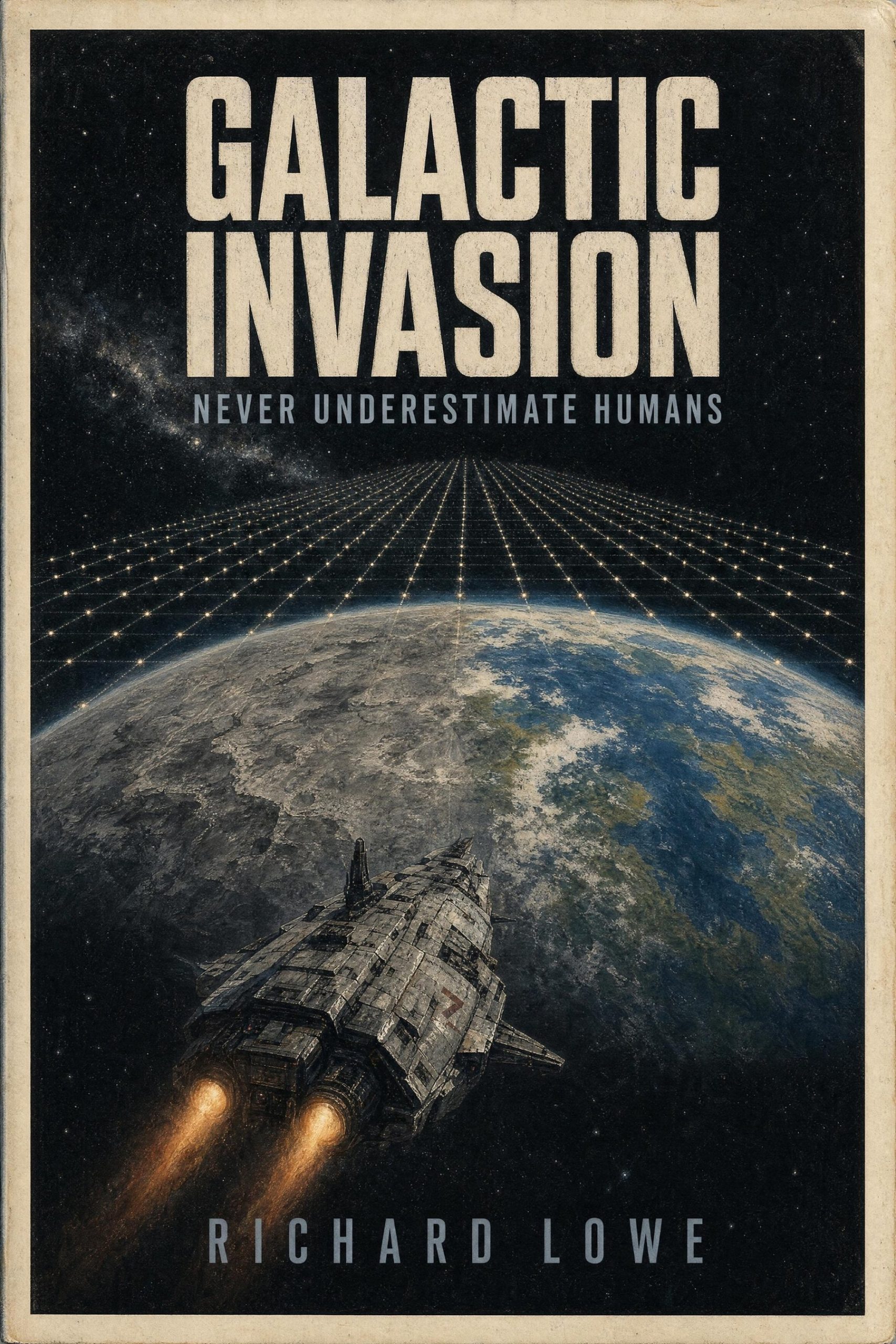
A four-hundred-million-year-old Confederation laughs at a small man from Earth who offers to win its war.
