TL;DR
8/10. One of the stronger Write Great Fiction volumes and a fine first dialogue book, teaching that every line must do work, advance plot, reveal character, carry emotion, and giving subtext the serious depth it deserves. Single-author focus beats a compilation for learning the skill whole. Pitched at developing writers, and reliably useful for stiff or on-the-nose dialogue.
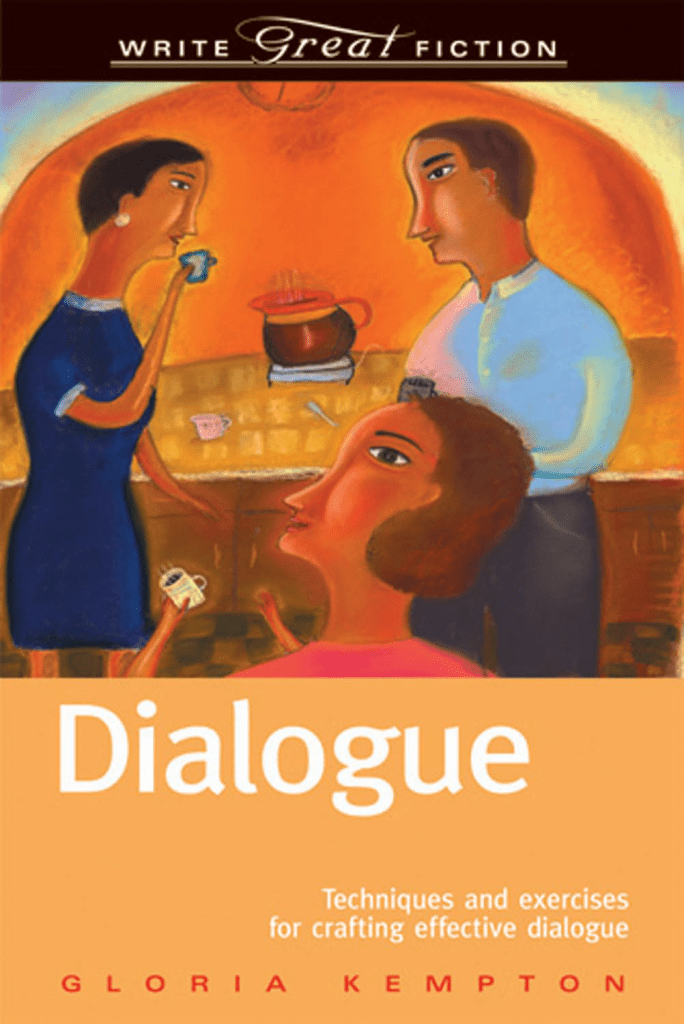
When should a character speak, what should they say, and, harder still, what should they leave unsaid? Dialogue by Gloria Kempton tackles one of fiction’s make-or-break skills with the focus of a dedicated treatment, and as part of Writer’s Digest’s Write Great Fiction series it gives dialogue the single-author depth that a compilation cannot. For a writer whose conversations read as stiff, on-the-nose, or interchangeable, this is the book that diagnoses why.
Dialogue is where amateur fiction most audibly gives itself away. Real speech and convincing fictional speech aren’t the same thing, and the gap between them is where Kempton works. Dialogue is where I’d look first in a manuscript that isn’t working, and after 113+ books of my own I still think it’s the hardest place to fake competence. Bad dialogue can’t hide. A reader hears it in the first exchange, and the book loses them there. Kempton goes straight at that problem, and I respect her for it.
Dialogue that does double duty
Kempton’s central teaching is that good dialogue is never just people talking; it’s always doing more than one job at once. A line should advance the plot, reveal character, carry emotion, or build tension, ideally several of these together, and dialogue that only conveys information is dialogue that should be cut or compressed.
She works through how to make speech sound natural without transcribing the dullness of real conversation, how to differentiate characters so each voice is distinct, and how to handle the mechanics, tags, beats, and action, without clutter. The principle that every line needs a purpose is the discipline that separates sharp dialogue from filler.
Characters explaining things to each other that they both already know is the dialogue sin I’d ban first. Kempton’s rule that every line has to do work kills it at the root, and a writer who takes that rule seriously will cut a lot of conversation and never miss it.
Keep reading
15 tips for writing dialogue that sounds real: Kempton’s every-line-earns-its-place discipline, in a full working approach to dialogue.
Subtext, the hardest skill
The book’s most valuable material is on subtext, the art of having characters mean more than they say. Kempton shows that the most gripping dialogue is rarely direct: people evade, imply, talk around the real subject, and let the unspoken charge the spoken. A scene where two characters argue about the dishes while really fighting about the marriage is doing what dialogue does best, and learning to write that gap between surface and meaning is the difference between flat exchanges and electric ones.
Subtext is the part of this book I’d underline twice. The argument about the dishes that’s really about the marriage is the kind of scene that excites me as a reader, and plenty of writers flinch from it because it means trusting the reader to get it.
Kempton treats this central skill with the depth it deserves, which a broad survey never can.
Keep reading
Subtext in dialogue: how characters mean more than they say: the unspoken beneath the spoken, treated as the skill that makes dialogue electric.
Voice and the genre-spanning approach
Kempton also addresses giving each character a distinct voice, the diction, rhythm, and verbal habits that let a reader know who’s speaking without a tag, and she draws examples across genres instead of confining herself to one. As with the strongest series entries, she pairs instruction with exercises and with excerpts from working fiction, so a writer studies the technique in action and then practices it. The result is a book that teaches dialogue as a coherent, learnable craft instead of a knack you either have or lack.
Distinct voices are where I’m least forgiving. If I have to check a tag to know who’s talking, the characters haven’t been built yet, and no amount of polish on the mechanics will fix that.
What are the limits of Dialogue?
The caveats are modest. As a fundamentals-series volume it’s pitched at developing instead of advanced writers, so a practiced novelist may find some of it familiar.
Its subject overlaps with the dialogue chapters in general craft books and with dialogue compilations, though Kempton’s single-author depth is the advantage over those. And, inevitably, dialogue is a skill built by writing and reading dialogue, so the book points the way but can’t substitute for the practice. These are small marks against a focused, useful guide.
I’m not troubled by the overlap with general craft books. A single author with room to develop the skill beats a chapter squeezed between plotting and point of view, and that depth is why this one stays on my shortlist.
Is Dialogue worth reading?
It’s one of the better Write Great Fiction volumes and the dialogue book I’d hand a developing writer first, because it treats the single most exposing fiction skill with real depth, gets the central principle right, that every line must do work, and gives subtext the serious attention it demands.
It loses little, mainly for being pitched at developing writers and for subject overlap. For a writer whose dialogue feels stiff or on-the-nose, it’s a clarifying, practical, and reliable guide to fixing it. A strong entry in a strong series.
Stiff dialogue is fixable, and it frustrates me how many good stories it sinks anyway. Do the exercises in this book instead of skimming them. The reading teaches you what to listen for, and the practice is where your ear changes.
Explore the hub
The Writing Hub: dialogue, subtext, voice, and the rest of the craft, gathered in one place.
Frequently Asked Questions
Other Books in the Write Great Fiction Series
Other Books From – Being an Author

About the author