
I’ve noticed that everything is turning into a subscription. It happens a little more every month.
I refuse to buy a new car. When I buy a car, it’s my car. I don’t want to pay an extra subscription fee to turn on the heated seats, or the rear wipers, or whatever they decide to charge for next. That’s ridiculous.
I certainly don’t want a big panel on my refrigerator showing me advertising. That’s even worse. I’m very anti-ad. I don’t want to see ads anywhere, and I keep learning more ways to get control over them. You Don’t Own Anything Anymore is the story of how all this came about and what it’s doing to our lives.
What made the author angry enough to write it?
They cut the smoking out of the cartoons. That one surprised me, and it’s a strange place for a book about licensing law to start.
Go looking for a Disney short you remember and you may find it shortened, with a cigarette painted out and a warning caption at the front. Some of the worst Looney Tunes, and there’s appalling material in there, aren’t available at all. Blackface in a 1940s cartoon is horrible. I don’t want it back and I won’t defend it. What I object to is somebody deciding, forty years later, that I shouldn’t be permitted to see that it existed.
I’m sixty-five. I can decide for myself whether something offends me, and having decided, I can still choose to watch it.
That was the anger. Then I went looking for the cause.
Was there a conspiracy to take ownership away?
No, and I say so in the Preface instead of making you wait three hundred pages for it.
I started the book believing I’d find one. I’m not a conspiracy person, but I’m not naive either. Anybody who thinks corporations never coordinate against the public should read what the tobacco companies knew and when they knew it. So I looked.
What I found was an evolution. Individual executives at individual companies made decisions that looked sensible inside their own quarter, and those decisions happened to point the same way. That’s less satisfying than a smoke-filled room. It’s also much harder to fix, because there’s nobody to arrest.
It’s partly us, too. Streaming really is more convenient. You press a button instead of finding the case and sitting through the studio logo. If the market had said discs, the companies would have said discs.
The book on this: You Don’t Own Anything Anymore follows how buying a thing stopped meaning the seller could never reach it again, from a 1908 Supreme Court case to heated seats sold by the month.
Did anybody ever own the movie?
You never owned the movie. That’s the first thing the Introduction says, because this book is not nostalgia for a right that never existed.
A videotape in 1985 was an object with a copy on it and a license to watch. The studio kept the film. What made the tape feel like property was that nobody could reach it. You could lend it, sell it, keep it thirty years, leave it to somebody, and nobody could do a thing about any of it.
I know this from the one time somebody tried. Years ago I bought a set of Star Trek blooper reels on VHS, and later a letter arrived explaining there’d been a licensing problem and I was required to destroy the tapes. I did, as far as I remember, which puts me in a very small minority. Almost everybody else would have thrown the letter away, and nothing would have happened, because there was nothing anybody could do.
Set that against July 17, 2009, when Amazon reached across a wireless network and removed 1984 from about two thousand Kindles before breakfast. Same legal relationship. Same kind of licensing problem. The difference is nobody had to write anybody a letter.
Owning a thing means nobody else can reach it. I learned that before I could read.
Why does a book about licensing begin with a childhood?
Because a reader is entitled to know why a man in his sixties keeps two thousand films in a closet and cares this much about the fine print.
I grew up in a house where the useful thing was to be invisible. My parents handed me things to make me go away and be quiet somewhere else, and it started before I can remember it starting. By eight I had a thousand magazines and bookshelves stacked three deep. A shelf of things that were mine made a space around me nobody came into.
I tell that story in My Life in Crazytown and I don’t relitigate it here. It’s in the Preface for one reason. When I argue that owning a thing means nobody else can reach it, I’m not working from legal theory. I learned it before I could read, and every argument in the book is downstream of that. You may as well have the bias up front.
What is the first sale doctrine?
It’s the rule that once a copy is sold, what the buyer does with it is the buyer’s business. It’s why used bookstores, record stores and libraries are legal.
It starts in 1908 with Isidor Straus at Macy’s, selling a forgettable novel for eighty-nine cents when the publisher had printed a line inside every copy saying no dealer was licensed to sell it for less than a dollar. The Supreme Court ruled against the publisher unanimously. A notice addressed to nobody and agreed to by nobody wasn’t a contract.
That ruling still holds. In 2013 a Thai graduate student named Supap Kirtsaeng won the same argument against a textbook publisher, six to three. Nobody repealed first sale. The industries in this book went around it: first by inventing a thing that is sold without being sold, then by making it illegal to open the box, then by removing the box.
What does a subscription do that a milk delivery never did?
When I was small the milk came to the door. You left a note saying how many bottles you wanted and a truck left them on the step. That was a subscription, nobody was diminished by it, and it went away because refrigerators and supermarkets made it unnecessary.
What the dairy never did was reach into the fridge and take last week’s milk back because an arrangement had lapsed somewhere upstream.
That’s the only test you need for any of this. Did the thing go away because nobody wanted it anymore, or did it go away while you were still paying, because somebody else decided? The first is history. The second is what I’m angry about, and the book follows it from software audits to a racing game switched off by its publisher, printers that reject a cartridge without the right chip, a car with heated seats you rent by the month, and a refrigerator that shows you advertising.
A refrigerator. In your kitchen. That you paid for. Who asked for that?
How did thirty-three years in corporate technology shape the book?
It’s why I noticed late. You notice a shelf getting shorter, a set that never got finished, and you file it under corporate stupidity. The filing is correct every time in isolation. It took me about a decade to work out that I’d been watching something.
It’s also why I trust one decision I made more than any argument. We had a vendor hosting a system we depended on, and I kept a full copy on a machine in our own office every night. Nobody told me to. When the vendor turned into a disaster, we paid about a hundred thousand dollars to get out of the contract and brought the system in-house, where it ran for years. I’d make that call again. A system you depend on should exist somewhere you control.
And it’s why Chapter Fourteen exists. Thirty-three years of sitting across tables from the people who build these systems taught me they aren’t villains and they aren’t stupid. So the strongest case against my book gets its own chapter, at full strength, before I answer it.
Does the author live the way the book recommends?
Mostly, and it costs me. No streaming subscriptions. Two thousand discs and three region-free players in a quarter of a walk-in closet. What I buy now is mostly older, indie and foreign, the films no major studio was ever going to keep in print.
I’m not pure about it. There’s a Paramount+ riding along on a Walmart+ account that I didn’t choose and don’t watch. That’s how this lands on everybody: as an accumulation, never as a decision.
And the book turns on me near the end. My own photo archive is encrypted, with long random passwords nobody else has, which is exactly what I’d tell any client to do. I made the data unreachable by anybody who isn’t me, and then I didn’t make myself reachable. I spent a whole book explaining how licenses end at death, and I haven’t written a will. I put that in because a book that only tells you the convenient half is lying to you.
My take
I hate that the most successful television program in American history stops on DVD around season twenty and exists after that only where a streaming service decides to show it. Nobody stole anything. Nobody had to. The company decides what exists, what gets recommended and what gets quietly filed where you’ll never find it, and the customer thanks them for the convenience. Walk your own house for an hour. Find out what still works with no account and no network. Then keep a copy of anything you’d be sorry to lose.
The Ownership Inventory
A one-hour workbook for walking your house, finding out what you actually own, and keeping the things you would be sorry to lose.
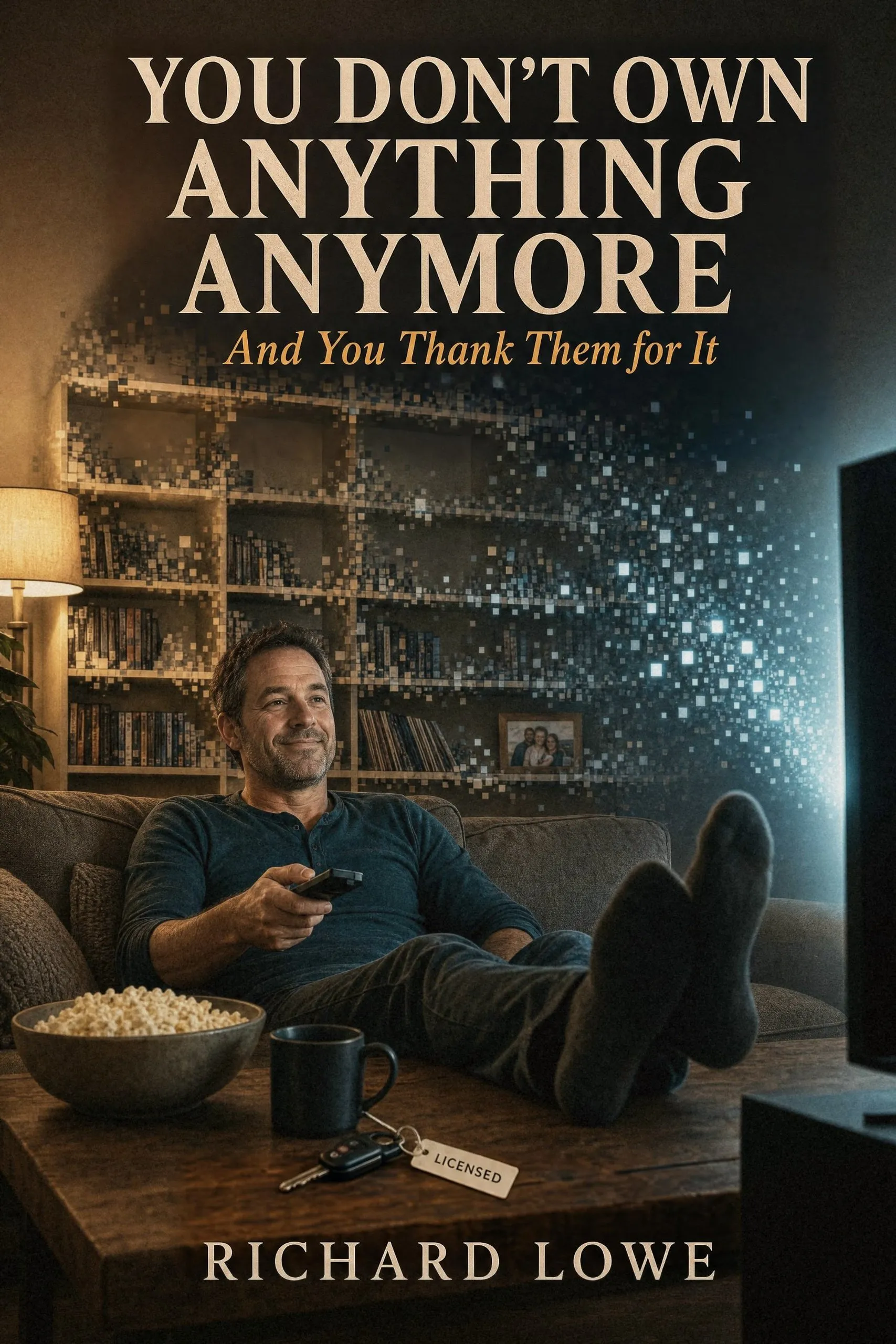
You never owned the movie, but for a century nobody could reach the tape on your shelf. Then they could.
Frequently Asked Questions
- Bobbs-Merrill Co. v. Straus, 210 U.S. 339 (1908), Justia US Supreme Court Center
- Kirtsaeng v. John Wiley & Sons, Inc., 568 U.S. 519 (2013), Justia US Supreme Court Center
- Bowman v. Monsanto Co., 569 U.S. 278 (2013), Justia US Supreme Court Center
- 18 U.S. Code § 2710, Wrongful disclosure of video tape rental or sale records, Legal Information Institute, Cornell Law School
