TL;DR
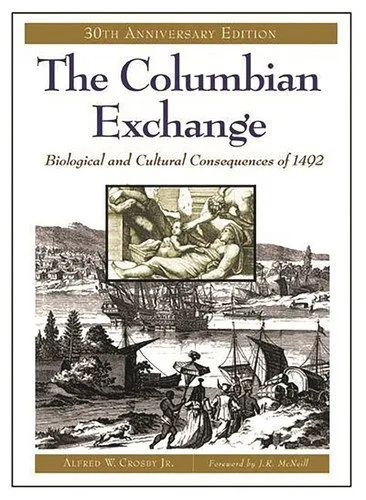
10/10. The book that reframed 1492 as a biological event and gave the field its name. Crosby argued that the most consequential thing about contact was the exchange of organisms, and he had trouble getting it published. It’s now foundational.
Crosby’s argument is that when two ecosystems separated for millennia are suddenly connected, the consequences dwarf anything the participants intended or understood.
Diseases move one way. Crops and animals move both. Populations collapse on one side of the ocean and, elsewhere, expand enormously on foods they’d never seen. Very few history books have changed how I see the world, and this one did. Crosby takes a date every schoolchild memorizes and shows you it was mostly about germs and seeds, and once he’s done it the old version looks childish. He had real difficulty placing it. Publishers didn’t know what it was, since it was neither conventional history nor biology, and it eventually appeared with a small press in 1972. It’s now on reading lists everywhere and the phrase in the title is the standard name for the phenomenon.
What moved in the exchange?
Westward: wheat, barley, rice, sugar cane, coffee, and bananas. Cattle, pigs, horses, sheep, goats, and chickens. And the diseases. They’re the part that killed. Eastward: maize, potatoes, sweet potatoes, cassava, tomatoes, chilli peppers, cacao, tobacco, vanilla, and beans. Almost no diseases of consequence went the other way. That’s the asymmetry the book exists to explain.
The animals count for more than people assume. Horses changed the plains cultures of North America within a few generations, producing a way of life that’s now thought of as ancient and that dates entirely from after contact. Pigs, released to breed freely, reshaped ecosystems ahead of the people who released them.
The horse detail is my favorite thing in the book. A way of life most people picture as ancient turns out to be a post-contact development, and that single fact dismantles a lot of lazy assumptions about what traditional means.
And the weeds and the earthworms traveled too, unnoticed, changing soil and vegetation in ways nobody recorded at the time.
Watch: The Columbian Exchange: Crash Course World History #23, CrashCourse
Why is the disease asymmetry so extreme?
Because epidemic diseases come largely from domesticated animals and dense settlement, and the Americas had far less of both.
Smallpox, measles, influenza, typhus, and diphtheria all have their origins in the close contact between humans and herd animals in Eurasia over thousands of years. Europeans arrived carrying an inheritance of survived plagues.
The Americas had few domesticable large mammals, no cattle, no pigs, no horses, and much lower population densities in most regions. Without the animals there was no crossover, without the crossover no endemic disease, and without endemic disease no immunity.
The consequence is that the collapse of American populations after 1492 was overwhelmingly epidemiological. Empires fell to organisms carried by people who didn’t know they were carrying them, frequently in advance of any European reaching a given region. That meant that the societies encountered by later explorers were already in the aftermath of a catastrophe.
This is the passage that haunts me. Whole societies were gutted before anyone arrived to see them, and the explorers who came later described a world already shattered without knowing it.
What happened on the other side of the Columbian Exchange?
The demographic effect running east is the part people forget and it’s enormous.
European populations rose considerably on American calories, especially the potato. That produces more food per acre on poorer ground and in worse weather than anything previously available in northern Europe. Maize did similar work in Africa and southern Europe, and cassava in tropical Africa.
The Irish famine is downstream of that dependence, since a population had grown to a size the potato could support and nothing else could. The population history of China in the same centuries is partly a story about maize and sweet potatoes reaching land that couldn’t grow rice.
So the exchange killed on one side and multiplied on the other, and both effects came from the same event and are usually taught separately.
It frustrates me that schools teach these two stories in separate units. They’re one event, and Crosby is right to insist on it.
Why did The Columbian Exchange change the field?
Because before it, contact was written as a story about people. Explorers, conquistadors, kings, treaties, and battles. Crosby made the organisms the actors. Once you see it that way you can’t unsee it, and the military history starts to look like a footnote attached to an epidemiological event.
The framing also traveled. Environmental history as a discipline expanded considerably in the decades after, Crosby extended his own argument in Ecological Imperialism in 1986, and Jared Diamond built a far more famous book on ground Crosby cleared first, which he credits.
Diamond got the fame and Crosby did the hard part first. I wish more readers knew his name.
It’s a rare case of a book creating a subject and then having the subject named after its title.
How does The Columbian Exchange read now?
Short, unshowy, and fifty years old. That shows in places.
The pre-contact population estimates are contested and the figures here sit at one end of a range specialists still argue about, with modern estimates for the Americas varying by a factor of several.
The treatment of indigenous societies is thinner than a book written now would allow, and the account is told largely from the European side of the exchange even while arguing that the organisms were the actors. None of that damages the frame. Crosby was making an argument nobody had made, and he makes it without theatrics. That’s a large part of why it still reads well. Those dated patches don’t bother me much. A book that invents a field is allowed to show its age, and I’d take Crosby’s plain argument over a dozen slicker books that borrowed it.
Verdict
One of the important history books of the last century, and shorter than its reputation suggests.
Read this before Guns, Germs, and Steel and the later book becomes much clearer, since it’s elaborating a frame Crosby built. A rare case of a book that created a subject and then had it named after it.
I’d hand this book first to anyone who still thinks history is a list of kings and battles. It’s short enough to finish in a weekend and strong enough to wreck that view permanently, and I can’t ask more of a history book than that.
Explore further
The Writing Hub: craft, technique, and the books worth learning from.
Frequently Asked Questions
Other Books From – History