Latest
The Money Appeared the Week After the DisasterHow a Stranger Decides You Are Credible in Nine SecondsWhat You Have to Decide Before Anybody WritesWriting It Before You Need ItCross Training Covered Everything Except the Role That Mattered MostBehind the Book: The Woke VirusBehind the Book: Galactic InvasionBehind the Book: You Don’t Own Anything AnymoreWhat’s New at The Writing King: Week of November 8, 2026Alexander Zhidkov: Decision MakingJessi Szurek: Expand Your RangeYou Don’t Own Anything AnymoreThe Budget Decided How My Department Was ShapedWhy Your Competitor’s Book Is Working and Yours Would NotWhy Are These Guys Smiling? A Business Book That Became a Wrestling MemoirPangram Wants to Decide Who Gets PublishedWhat You Have Enough Material For Right NowWhen a Book Is the Wrong ToolThe Woke VirusGalactic InvasionChatGPT Turns Four: From a Free Research Preview to GPT-6What’s New at The Writing King: Week of November 1, 2026Diwali: The Festival of Lights and the Story Behind the LampsHow Much Water and Power Does Heavy AI Use Take? I Ran My Own NumbersBad Boys: Ride or Die (2024)Vesuvius Day: The Teenager Who Wrote Down Pompeii’s Last DayAnti-Communism Week: Remembering the Writers Communism SilencedVoyager 1 One Light-Day: Fifty Years to Travel One Day of LightVellum Added an Optional AI Feature. A Pile-On Killed It in a Day.Are AI Subscriptions Losing Money? The Gym Membership Math Says NoAI Terms Every Writer Should Know, and Why Each One MattersWorking While Sick: What 24/7 On Call Cost MeHe Banned AI From His Writing Group. His Own Cover Got Called AI Slop.Who Writes the Fake Fan Mail Authors Get? Inside the Scam CompoundsSMS Appointment RemindersFree BooksDarrell Stern: Stop Being Invisible, Become UnmissableJoe Rockey: Ghostwriting His BookHow to Turn Your Expertise Into a Book People Want to Read | The Expert MethodWhat’s New at The Writing King: Week of October 25, 2026Challenger Remembrance Day: The Engineer Who Wouldn’t SignJoel Salomon: The Truth About MoneyReddit Is Putting Up a Login Wall. Wikipedia Won’t Be Far Behind.Victoria Chemko: The Body Is the First TechnologySir Patrick Stewart: A TributeA Year in the Bank: ADHD, Face Blindness and the Freedom to Walk Out | The Impossible Puzzles Show, Episode 326A Yale Economist Says We Won’t Be Missed. He Forgot the Bread Line.Walter Koenig: A TributeI Don’t Post Bad ARC Reviews. I Send the Author a Note.AI Has Paid Off Outside Tech. Apollo Is Reading the Wrong Scoreboard.
The Writing King Your Ethical Ghostwriter. Your Story, Done Right.

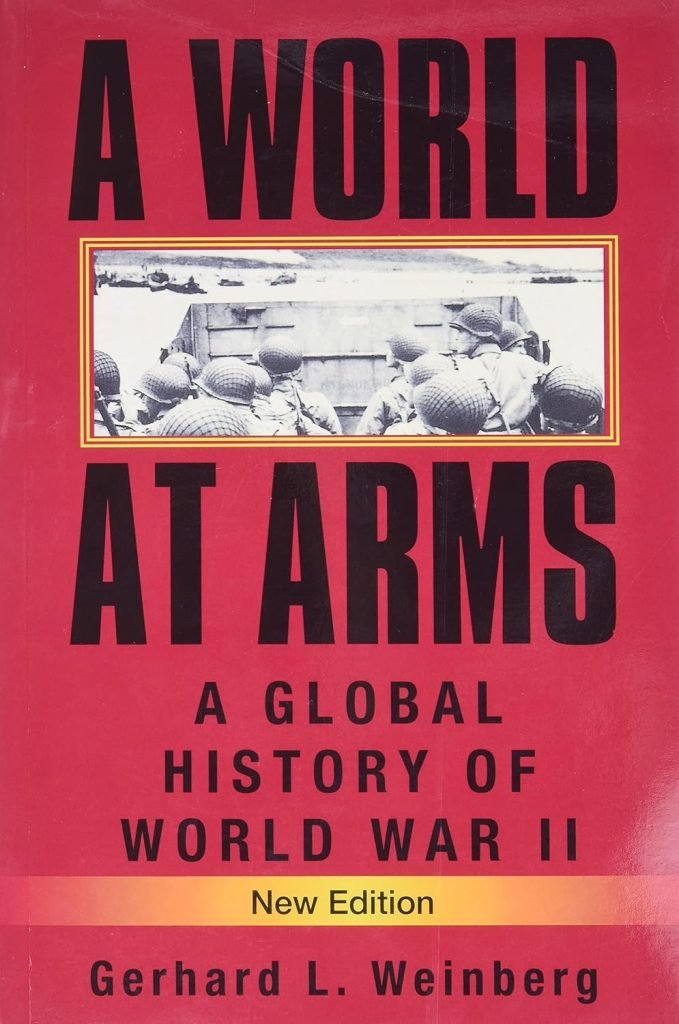
A World at Arms: A Global History of World War II

A World at Arms: A Global History of World War II

A Global History of World War II

Category:History
ISBN:0521443172
ISBN:9780521443173
Language:English
Share:

Buy Now

Description:

TL;DR

Gerhard Weinberg’s one-volume history of World War II across every continent, more about why things happened than about the battles. It’s one of the two nonfiction books I keep rereading.

Two nonfiction books sit on my reread pile, and people are surprised by that because neither one is light. A World at Arms is the heavier of the two, a single volume that runs well over a thousand pages.

I’ve read it several times anyway.

What is A World at Arms about?

The whole war, everywhere at once. Cambridge University Press published it in 1994 as a global history of World War II, and it means global: six continents, the Axis, the Allies and the neutral countries, every theater.

What sets it apart is everything behind the battles: the politics, the demographics, the geography, the food and the raw materials and the supply. Weinberg explains why things happened. Why Hitler felt he had to attack Russia. Why a decision in one capital set off a chain of consequences on the other side of the world. He keeps showing how events in one theater shaped what happened in another. Most war histories never manage that.

It opens with how Europe and its empires were remade after World War I, so the reader understands the board before the pieces start moving. It closes with a long bibliographic essay that’s a reading list in its own right.

Who is Gerhard Weinberg?

Weinberg was born in Hanover, Germany, in 1928. His family left for England in 1938 and New York in 1941. He earned his doctorate at the University of Chicago, taught at Kentucky and Michigan, and spent the rest of his career at the University of North Carolina at Chapel Hill. He also edited and translated Hitler’s unpublished second book.

How was A World at Arms received?

About as well as a history book can be. It won the American Historical Association’s George Louis Beer Prize in 1994. Historians including Ian Kershaw, Norman Stone and Andrew Roberts praised it, and David Reynolds called it a tour de force in the New York Times. American Heritage rated it the finest one-volume history of the war.

Cambridge put out a second edition with a new preface in 2005.

Is A World at Arms worth the time for writers?

Anyone who wants to understand the war instead of just following it. It’s a long commitment, and the payoff is that afterward the battles make sense. Writers working on anything set in the 1940s will find the background they need here, and they’ll find it explained.

Background is where historical fiction usually fails. A novel set in 1943 goes wrong when the writer knows the battles and not the rationing, the shipping losses, the politics in the capitals and what ordinary people in a neutral country could and couldn’t buy. Weinberg covers all of that, and he covers it across every continent, so a writer can check what was happening on the far side of the world on the day a scene takes place.

The taste goes back a long way for me. The first adult book I read, at seven, was a history of Iwo Jima. I’ve been reading about the war ever since.

Keep reading

The books I reread: why two heavy histories sit on my reread pile next to the novels.

Frequently Asked Questions

Is A World at Arms a single-volume history of World War II?
Yes. Cambridge University Press published Gerhard Weinberg’s one-volume global history in 1994. It covers every theater and focuses on why events happened, with the battles as consequences.
How long is A World at Arms?
It’s long. The second edition runs well over a thousand pages, including notes, maps and a bibliographic essay.
Did A World at Arms win any awards?
Yes. It won the American Historical Association’s George Louis Beer Prize in 1994.
Where did Gerhard Weinberg teach?
Weinberg, a German-born American historian, taught at the University of Kentucky and the University of Michigan, then spent decades at the University of North Carolina at Chapel Hill. He is one of the leading historians of World War II.
Is there a second edition of A World at Arms?
Yes. Cambridge published a second edition with a new preface in 2005.
Is A World at Arms good for writers of historical fiction?
Yes. Its focus on politics, supply, geography and the connections between theaters gives writers the background that makes a story set in the war feel grounded.
Categories and tags

About the author

Gerhard L. Weinberg

Gerhard L. Weinberg is a historian of World War II, born in Hanover, Germany, in 1928, whose family fled to England in 1938 and New York in 1941. He taught for most of his career at the University of North Carolina at Chapel Hill. His one-volume global history, A World at Arms, won the American Historical Association's George Louis Beer…

More about Gerhard L. Weinberg

Back