TL;DR
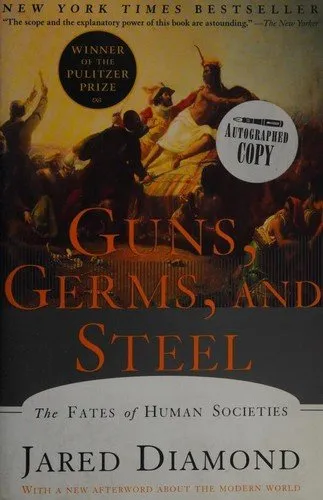
8/10. Why did some societies end up with steel and ocean-going ships and others didn’t? Diamond’s answer is geography and biology, and not people. Pulitzer-winning, enormously influential, and contested by specialists in almost every field it touches.
The question comes from a New Guinean politician named Yali, who asked Diamond why Europeans had so much cargo and his own people had so little. The book is a six-hundred-page answer, and the answer is that the differences are environmental and not anything about the people involved.
It won the Pulitzer Prize for General Nonfiction in 1998 and has sold in enormous numbers, and it’s probably the most influential work of popular history of the last half century.
Diamond’s nerve thrills me even where his argument wobbles. He takes one plain question from Yali and chases it all the way back to the origins of agriculture, and I can’t resist a book with that kind of reach, even when I want to argue with half of it.
What is the argument of Guns, Germs, and Steel?
It runs in a chain and each link matters.
Eurasia happened to contain more domesticable plants and animals than anywhere else. Of the large mammals suitable for domestication, almost all were Eurasian, and the ones elsewhere were unsuitable for reasons of temperament and biology. A zebra won’t take a harness. The zebra line is the kind of detail I wish more historians used. One stubborn animal makes a continent’s fate concrete in a way no chart ever could.
Eurasia also has a long east-west axis. Crops and livestock spread easily along a line of constant latitude, because day length and climate stay similar, so an innovation in one place transfers. The Americas and Africa run north to south, so a crop domesticated in one region hits a climate barrier before it travels far.
Agriculture produces surplus. Surplus produces specialists. That means people who aren’t growing food: soldiers, priests, metalworkers, scribes. Specialists produce cities, writing, and technology. And dense populations living alongside domesticated animals produce epidemic disease, along with the partial immunity that comes from surviving it. That’s the final link and it’s the one that did most of the killing.
Watch: Jared Diamond - Guns Germs and Steel Audiobook, Hugo Lynch
Why is the disease section the strongest?
Because it explains something puzzling with a mechanism you can check. Smallpox, measles, influenza, and typhus went west across the Atlantic and almost nothing came back. That asymmetry isn’t obvious and it’s not luck. Epidemic diseases require dense host populations and a reservoir, and most of them crossed into humans from domesticated animals living in close quarters with them. The Americas had almost no domesticable large animals. No cattle, no pigs, no chickens, no horses. Without the animals there’s no crossover, without the crossover there’s no endemic disease, and without endemic disease there’s no immunity when somebody arrives carrying it. Population collapse in the Americas after contact was overwhelmingly epidemiological, and the military history is close to a footnote by comparison. Empires fell to organisms carried by people who didn’t know they were carrying them.
This is the chapter I’d hand to anyone who still pictures the conquest as a story of horses and steel. The microbes did most of the killing, and Diamond makes the mechanism impossible to unsee.
What are the objections to Guns, Germs, and Steel?
They’re serious and specialists have spent thirty years making them.
The first is environmental determinism. If geography decided everything, then human agency disappears from history and conquest starts to look inevitable and therefore blameless. Diamond doesn’t intend that reading and the structure of the argument invites it.
The determinism charge is the one I take most seriously. A theory that makes conquest look inevitable lets the conquerors off lightly, and whatever Diamond intended, that reading is sitting right there for anyone who wants it.
The second is that it stops explaining well after about 1500. Once societies are in contact and technology transfers freely, institutions and political choices dominate, and the axis argument has nothing to say about why one European power industrialized before another. The third is technical. Historians and anthropologists have challenged specific claims about which species were domesticable, about how far the axis argument constrains diffusion, and about the treatment of particular societies, especially New Guinea and sub-Saharan Africa. They’re handled as illustrations of a thesis instead of on their own terms. The fair reading is that Diamond built a good frame for the first ten thousand years and pushed it further than it holds.
What was Guns, Germs, and Steel arguing against?
This gets forgotten and it matters for judging the book. It was written when the mainstream explanation for uneven development, when anybody offered one, still carried assumptions about cultural or racial capacity. Diamond’s answer removes the people from the causation entirely, and that was the point. Nobody was better or worse at anything; some places had wheat and cattle and some didn’t.
That was a necessary argument to make in a popular book in 1997, more necessary than people now remember, and the book’s enormous reach means it did the job. A critic can be right that the thesis overreaches and still be wrong about whether it was worth writing.
How does Guns, Germs, and Steel relate to Crosby?
Alfred Crosby got there first. The Columbian Exchange, published in 1972, made the biological argument about 1492 twenty-five years before this book and named the field.
Diamond credits him and takes the frame considerably further back in time, from 1492 to the origins of agriculture. That’s a real extension and not a repackaging.
Read Crosby first and this book becomes much clearer, because you can see which parts are Crosby’s mechanism applied at a larger scale and which parts are Diamond’s own and are doing more work than the evidence supports.
I’d make Crosby required reading before this. It’s a smaller book with fewer grand claims, and it shows you exactly where Diamond is standing on someone else’s shoulders and where he’s out on a limb by himself.
Verdict
Read it, and read a critic alongside it. It changed how a generation thinks about early history and it’s a case study in what happens when a synthesizer works across fields the specialists guard.
Judge it as a hypothesis that reframed a question, not as an answer, and it holds up well. Judge it as settled history and somebody who knows one of its chapters properly will correct you.
An eight, and a fond one. It overreaches in its later reaches and I’d still give it to any curious reader who has never wondered why the map looks the way it does, as long as a good critic goes in the bag with it.
Explore further
The Writing Hub: craft, technique, and the books worth learning from.
Frequently Asked Questions
Other Books From – History