TL;DR
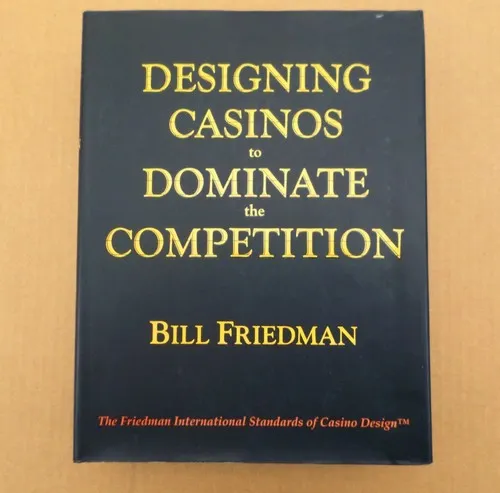
Bill Friedman’s 2000 textbook on casino layout, built from years of studying how players move through Nevada casinos. It’s where the maze floor, the low ceilings and the missing clocks got their rationale.
Las Vegas casinos have no clocks and no windows because time is the enemy of the house. A player who notices it’s three in the morning goes to bed, and a player in bed stops losing money.
Bill Friedman wrote the textbook on that idea.
What is Designing Casinos to Dominate the Competition about?
How a casino’s physical layout decides whether people walk in and stay. Friedman studied more than eighty Nevada casinos, covering designs from the start of legal gaming in the 1930s through the 1990s. He watched where players went, where they stopped and which places stood empty. His measure of success was blunt. He looked at total casino win, slot win, slot occupancy and player counts, and he compared the number of slots and players to the number of hotel rooms. A casino with more players than rooms was pulling gamblers away from its rivals.
His own summary: what percentage of visitors gamble, and what percentage come back to gamble? Nothing else matters.
The Institute for the Study of Gambling and Commercial Gaming at the University of Nevada, Reno, published the result in 2000, a hardcover of more than 650 pages counting the front matter.
What are Friedman’s thirteen principles of casino design?
Each one is written as a contest, and the titles do the arguing. A physically segmented casino beats a completely open barn. Gambling equipment immediately inside the entrance beats empty lobbies and raised landings. Short lines of sight beat extensive visible depth. The maze layout beats long, wide, straight aisles. A compact, congested layout beats a vacant, spacious one.
The rest follow the same logic. Low ceilings beat high ceilings. The gambling equipment itself should be the decor, and standard decor beats elaborate interior themes. Pathways should lead past the machines. Friedman set that against what he called the Yellow Brick Road. Perception beats reality. And several different settings inside one casino beat a single atmosphere throughout.
The second half of the book applies the principles to named properties one by one, from the Mirage, Caesars Palace and the MGM Grand on the Strip to Downtown’s Golden Nugget and El Cortez, the Boulder Highway casinos, Laughlin, Lake Tahoe and Reno.
Who was Bill Friedman?
An unusual expert. He came into the business as a gambling addict and turned what he knew into a career. From 1970 to 1979 he taught Casino Operations and Management at the University of Nevada, Las Vegas, the first casino management course anywhere, and his textbook Casino Management came out in 1974. Then he ran two Strip casinos at once, the Castaways and the Silver Slipper, for the Howard Hughes organization. The Castaways site later became the Mirage. He knew the floor from both sides of the table.
Did casinos follow Friedman’s rules?
For a long time.
The challenge came from a playwright. David Kranes, a University of Utah English professor, argued that casinos should be playgrounds: legible, inviting and energizing, with daylight, warm colors, greenery and moving water. The two men debated maze against open floor in front of casino executives at Lake Tahoe. The Las Vegas Sun ran a story in 2001 under the headline “Author sets off a debate over casino floor design.”
Then the Bellagio opened in 1998 with high ceilings, skylights, visible clocks and a conservatory full of flowers, and it made money anyway. Plenty of newer resorts followed it. Researchers at the University of Guelph later tested the two models and found players rated the playground designs more pleasant. The argument isn’t settled.
The casinos of the 1980s were the old maze kind. Most Strip hotels still route you past the gaming floor on the way to everything else, the restaurants and the elevators included. Stay in town for six months and you’ll walk past a lot of slot machines.
Keep reading
Six months in Las Vegas: what living in the city taught me about systems that never sleep, and why the casino floor works the way it does.
Frequently Asked Questions
Other Books From – Business and Economics