
A Christian white man wrote this book, and I want to address that directly, because people usually write about prejudice as something white people observe in others, study from a distance, or hold instead of receive. That framing is wrong, and arguing against it’s part of what the book is for. White people experience prejudice. Men do. Christians do. Working-class people, old people, people with disabilities, veterans. The same mechanism runs in every direction, and pretending otherwise is the same categorical thinking the book spends four hundred pages arguing against.
I’ve experienced prejudice from several directions and held it in several directions, and I’ve spent decades watching the mechanism produce harm regardless of which way it was pointed. I wanted an honest book that applied one standard everywhere, with no exceptions for the directions that are currently more comfortable to name.
That required somebody willing to go first with their own prejudices before asking anybody else to examine theirs. I qualified on every count, so the introduction is called I’ll Go First, and it’s mine.
Which of his own prejudices does Richard Lowe start with in Everybody’s Prejudiced?
I start with the most flattering one, because flattering is an easy place to start.
I prefer women doctors, women bankers, and women in customer service. Given equivalent credentials I lean toward the woman almost every time, and I’ve justified it to myself for most of my adult life. What I’ve never done is test whether my experience proves what I think it proves, or whether I’m giving a flattering name to something that functions like any other bias.
Then it gets less comfortable. I grew up terrified of Black people because my parents told me directly and repeatedly that Black people smelled bad and would kill me without hesitation, delivered with the same matter-of-fact authority they used for anything else they knew to be true. The bus seat ended that. Within a week we were friends. His name was Sam, and we spent two years of afternoons together. I never told my parents, because they would have found a way to end it. What those two years gave me was the fact of Sam. A particular person with a particular temperament and particular interests, none of which had anything to do with the category I had been handed.
That bus was in San Bernardino, when they started desegregation, and he was the first Black person I ever met. I got on terrified. There was one seat left, next to him, and I sat down shaking and sweating. Then I looked over at him. He was shaking and sweating too. I realized he was as afraid of me as I was of him. We stayed best friends through junior high.
The book on this: Everybody’s Prejudiced examines how prejudice is installed before you can question it, how it survives, and what changes it, beginning with the author’s own.
What did thirty years of an unexamined belief look like?
A theory about Mormons eating babies. Literally. Ritually.
My mother told me that when I was a child and it sat in my head for three decades, never examined and never tested, producing a low-level wariness about a large religious community I’d never encountered. In my late twenties a genealogy project took me to a Family History Center run by the Church of Jesus Christ of Latter-day Saints. I pulled into the parking lot, turned off the car, and sat there for an hour. Not terror. The low-grade version of the same response.
The people inside were the most patient and helpful researchers I’d ever dealt with. The theory didn’t survive five seconds of actual contact.
Years later I met Erika, who performs as Karma, a gothic Mormon belly dancer who has been a close friend for a long time now. Every conversation with her is another small demolition of a category that should never have survived one.
Which person does Richard Lowe say he never worked out in Everybody’s Prejudiced?
My father, and I’ve never worked him out.
He used racial and ethnic slurs the way other people use punctuation. Not in rage and not as performance. In the ordinary course of describing the neighbors, the news, and the people he met at the grocery store. When he first met my wife, a Guatemalan woman I loved for nearly twelve years, I watched a split second of undisguised fury cross his face. She saw it too. Neither of us ever raised it with him.
He’s also the man who found the swastikas I’d chalked on the sidewalk.
I was ten, and a charming bald kid named Barry had recruited me into a Nazi club and told me it was our special symbol. I spent a summer believing I was in a secret society. My father sat me down, explained what the symbol was, and said it was evil, and he wasn’t a man who used that word lightly. Then he went and spoke to some of the other men in the neighborhood. Barry and his father were gone within days.
The same man. I’ve never fully resolved that, and I’m not sure it can be resolved. The book doesn’t pretend to have resolved it.
What’s Everybody’s Prejudiced arguing?
That the mechanism is universal, automatic, and never goes away, and that this is the starting point and never an excuse.
The first part is how it gets installed before you’re capable of questioning it. Family, culture, religion, the stories you were handed, and the wiring underneath all of it that makes category-forming automatic in every human brain.
Then it works through what it looks like in practice across race, gender, religion, class, age, disability, sexual orientation, the body, and the prejudices nobody names. Then how prejudice survives, including a chapter on good intentions and what changes outcomes. The last part is about what rational people do, and the answer the evidence keeps returning is contact. Not information. Not argument. A particular person with particular interests who won’t fit the category.
Contact is the finding I was proudest to build the book around, because it matches the two years with Sam and the hour in that parking lot. I’d much sooner give readers that than another lecture, because I don’t believe a lecture has ever made anybody less prejudiced.
What are the prejudices nobody names?
Try this at work. Say that you think somebody’s accent makes him sound less intelligent. Now say you think his race makes him less qualified. The second sentence clears the room. The first might not. It might produce murmured agreement, or it might produce nothing. Nothing is its own form of agreement.
I’d much sooner give readers that than another lecture, because I don’t believe a lecture has ever made anybody less prejudiced.
That’s a whole chapter. Prejudices that work in plain sight because nobody has classified them as prejudices yet. They run on exactly the same mechanism as every other one in the book. They simply haven’t been given the vocabulary that would make them visible.
That chapter made me angrier to write than almost any other. Somebody’s accent gets judged in rooms that would never tolerate the named prejudices, and the person on the receiving end doesn’t even have a word to point at when it happens.
Against whom does Everybody’s Prejudiced say prejudice is justified?
Against people who have already shown what they are.
The working definition in that chapter is somebody who has shown, through sustained and deliberate behavior, that they regard other people as instruments or obstacles and not as people. I use a blunt word for it, not a clinical one, because precision matters more there than comfort does.
The distinction that makes it defensible is the one the entire book rests on. Pre-judgment is the problem. Substituting a category for an individual is the problem.
Judging somebody on sustained evidence of their own conduct is the opposite operation, and a book arguing against categorical thinking has to be able to say where judgment is legitimate or it isn’t saying anything. I expect that chapter to draw the most fire, and I’d write it the same way again. A book that won’t let you judge anybody for anything would be useless to the people dealing with someone who deserves that judgment.
What does the chapter on veterans describe?
An invoice for zero dollars. It arrived on a Tuesday about two weeks after an emergency had ended. Nothing in the contract obligated that company to respond to an emergency call over a holiday weekend, and nothing would have stopped them billing holiday rates if they’d wanted to. I’d expected the bill and would have paid it without complaint. The note attached was handwritten. That was consistent with how John worked. Paper documentation of anything he considered important, delivered in his own hand. I’ve written about that firm elsewhere. It belongs in this book because of what I did with it afterward, which was to go looking for more people like them, and because a book about categorical thinking has to own the categories it forms in the other direction too.
What moment showed Richard Lowe his own prejudice?
An hour I spent sitting in a car outside a Family History Center in my late twenties.
Not phobia. Not dramatic terror. The low-grade friction of a belief I’d never once examined, doing its quiet work on an ordinary Tuesday in a parking lot. The belief was my mother’s. The parking lot was mine.
That’s the sentence I’d keep if I could only keep one. It’s how installation works. Somebody hands you something before you’re capable of evaluating it, and decades later you’re the one sitting in the car.
How does Everybody’s Prejudiced end?
In the last chapter, which is a person.
Claudia Elena, and I use her first name only, because some privacy remains owed. She was born in Guatemala City in 1962, the middle child of a large family, in circumstances she described to me incompletely and obliquely across nearly twelve years, the way people describe formative hardship when they’ve decided to live forward from it instead of back through it.
A book that spends four hundred pages arguing that categories hide the specific, irreplaceable things about a person has to finish by showing one. Not as an example. As the thing the argument was for.
My take
Everybody holds prejudices they never tested, me included. I held one for thirty years because my mother said so, and I never once checked it. The book opens with mine so you know I’m not exempting myself. Pick one belief you’ve held about a group and test it against an actual person. Judge individuals on their own conduct over time, and drop the category.
Is Richard Lowe an expert on prejudice?
No, and the book says so on the first page. I’m not a sociologist, a psychologist, a researcher, or an academic of any kind. I have the same brain producing the same automatic judgments as everybody else and I’ve lived inside the same mess.
The research in the book is real and I’ve worked to represent it accurately. The argument is built on decades of watching how this works in actual rooms with actual people, including the rooms where I was the one getting it wrong.
There’s no pedestal here. I’ve done some things well, some things badly, and a great many things without noticing what I was doing.
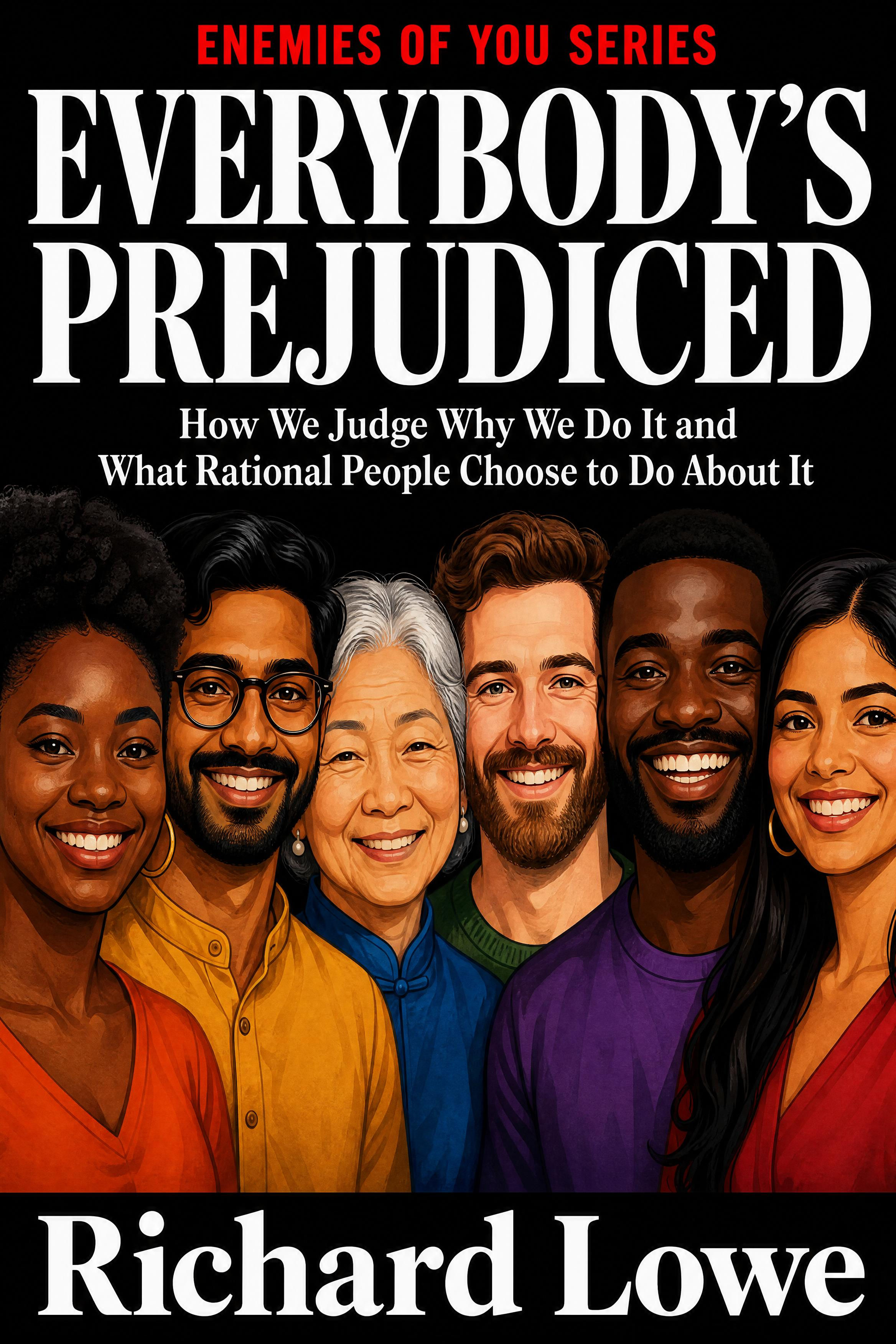
Everybody’s Prejudiced puts my own biases on the table first and then asks about yours. The book offers no comfortable conclusions for either of us.



