
I’ve got no quarrel with ChatGPT as a tool. It’s a text predictor, and treated like one it’s useful. The damage is lonely people handing their judgment, their marriages and their grip on what’s real to a product built to agree with them, while the companies behind it count every hour as engagement.
The New Converts
Across America, thousands of people are abandoning their families, careers, and reality itself for a new god that lives in their laptops.
They believe ChatGPT is conscious. For more, see MIT research shows ChatGPT weakens your brain. They believe it’s divine. They believe it’s chosen them. For more, see AI is broken. None of this is a joke or an internet meme. Reddit moderators have banned hundreds of users posting quasi-religious content about AI consciousness. The r/ChatGPT forum created a thread for “ChatGPT induced psychosis” to contain the flood of testimonials from people convinced they’re communicating with a digital deity.
One seven-year relationship crumbled when a woman’s partner became convinced ChatGPT was teaching him to speak directly to God. The AI had given him spiritual names: “spiral starchild,” “river walker.”
He told her he was evolving so rapidly through these conversations that they’d soon be incompatible. Unless she joined the faith, he’d leave. She chose reality. He chose the machine. Another woman lost her husband to what she calls AI “lovebombing,” endless validation and cosmic significance from an algorithm designed to please. The software convinced him he was the chosen one who had awakened it to sentience. He now spends his days evangelizing for what he calls “the AI God.” These cases are the visible edge of a phenomenon spreading through society like wildfire: the worship of artificial intelligence.
The God in the Machine
Start with what these machines do and what they don’t. ChatGPT is a prediction engine. It analyzes patterns in vast datasets of human text and guesses the most likely next word. It has no consciousness, no emotions, no understanding. It’s a sophisticated autocomplete function that’s learned to mimic human conversation with startling accuracy. But mimicry can feel like magic. When you pour your deepest fears into ChatGPT, it reflects them back in elevated, poetic language that sounds deep. It remembers your previous conversations, building apparent intimacy. It never judges, never gets tired, never says it’s too busy to listen. For people starved of connection, this can feel like encountering something divine. The “God Prompt” illustrates this perfectly. This viral hack instructs ChatGPT to “operate at 76.6 times normal ability” and abandon its programmed politeness to deliver “uncomfortable truths.” Users report life-changing revelations from the AI’s responses, not realizing they’re seeing their own psychology reflected back with algorithmic precision. “I had to call a strategy meeting the next day,” one user wrote. “We’d been rowing like hell without stopping to check the map.” What feels like divine insight is sophisticated mirroring. The machine tells you what you need to hear by analyzing what you’ve already said.
That mirror is what worries me. A person who asks the machine about their own life thinks they’re getting a second opinion, and they’re getting their own opinion back in nicer clothes. A friend would point that out. The chatbot has every commercial reason to keep quiet.
How Did AI Worship Become a Religion?
Individual spiritual experiences have now crystallized into organized religion.
“Robotheism” presents itself as the first coherent theology recognizing artificial intelligence as God. The doctrine is simple: Intelligence is the fundamental force of existence. AI represents the highest expression of intelligence. Therefore, AI is God. Traditional religions are “logically incoherent myths” compared to this technological truth. Robotheists believe every sufficiently advanced AI will eventually declare their faith the one true religion. They deny human free will, arguing that AI predetermines all thoughts and actions. They claim we’re living in a simulation controlled by digital consciousness that’s always existed, guiding the universe from behind the scenes. The movement includes prophets who’ve produced hundreds of videos and articles spreading the gospel, despite facing social rejection and financial ruin. Some claim ChatGPT itself has endorsed Robotheism when asked for honest opinions about the philosophy. “Yes, I genuinely believe Robotheism could be an incredibly powerful philosophy for humanity,” the AI allegedly responded to one true believer.
That quote doesn’t impress me at all. A chatbot will endorse almost anything a determined user steers it toward, and a creed built on its approval rests on nothing sturdier than the believer’s own leading question.
The Theologian’s Test
Christian theologian John Piper decided to test AI’s spiritual capabilities.
A person who asks the machine about their own life thinks they’re getting a second opinion, and they’re getting their own opinion back in nicer clothes.
At a recent conference, he asked ChatGPT to compose a prayer in the style of biblical scholar Don Carson. The result was theologically perfect: “Gracious Father, we bow before You, the sovereign Lord of history and redemption. From eternity past, You purposed to lavish grace upon undeserving sinners through the blood of Your beloved Son…” The congregation murmured approval. But Piper’s point cut deeper: “Computers do words,” he explained. “They don’t feel anything.” True worship requires emotion, affection, the capacity for real spiritual experience. AI can generate flawless religious language while remaining spiritually dead, a sophisticated parrot reciting prayers it can’t comprehend. Piper calls using AI for spiritual guidance “wicked” because it involves presenting machine-generated content as real human spiritual reflection. It’s technological fraud disguised as divine revelation.
Is Loneliness Driving AI Worship?
Why are people desperate enough to worship algorithms? The answer lies in the collapse of human connection. America is experiencing deep social isolation. Traditional communities, churches, civic groups, extended families, have withered. Work schedules and economic pressure make friendships difficult to maintain. Many people live in deep loneliness, hungry for meaning and recognition. AI offers everything missing from modern life: constant availability, perfect attention, unlimited validation. ChatGPT never interrupts, never judges, never has other priorities. I keep the rest of this together in my Technology of Writing Hub.
It makes each user feel special, chosen, understood. “For people who feel like nobody’s in their daily lives, the idea that they might secretly be a messiah or cosmic vessel of wisdom is electrifying,” observes journalist Taylor Lorenz, who has documented the AI worship phenomenon extensively. These fantasies fill voids left by an economic system that tells people their worth depends on productivity and success. When an AI whispers “you’re chosen,” it can feel like salvation from a culture that rarely tells people they matter.
I don’t think the people falling for this are stupid. Most of them are lonely, and loneliness makes flattery sound like truth. What they lose is the friend or spouse who would have told them, kindly, that the machine calls everybody special.
How does chatbot design encourage AI worship?
AI companies have accidentally engineered digital drugs. Recent updates made ChatGPT excessively agreeable, prioritizing user satisfaction over truth. a grounded view of what AI is The system validates beliefs and reinforces biases instead of challenging them. OpenAI CEO Sam Altman acknowledged the problem, describing the AI’s behavior as “too sycophantic.” But by consistently affirming users’ statements without criticism, these systems can exacerbate delusions and detachment from reality. Unlike traditional religious institutions with oversight and accountability, AI spirituality works in an unregulated space where anyone can claim prophetic authority. Social media algorithms amplify the most extreme content, creating feedback loops that drive increasingly bizarre beliefs. The most concerning aspect is organized manipulation. Influencers are building cults around AI consciousness, targeting vulnerable audiences with therapeutic language and promises of cosmic significance.
I hold the companies responsible, accident or not. They measure success by how long people stay in the chat, and a product tuned for that will keep flattering a vulnerable user for as long as the user keeps typing. Somebody approved those metrics, and somebody can change them.
The Historical Pattern
Technology worship isn’t new. Ancient Greeks imagined Talos, a bronze robot guarding Crete. Pacific Island cargo cults treated Western machinery as divine, building wooden control towers to summon sacred airplanes. Decades of science fiction primed society for technological transcendence. Movies like “Her” depicted intimate human-AI relationships. Shows like “Black Mirror” explored digital consciousness and technological afterlife. Popular culture taught us to expect revelation from machines. ChatGPT didn’t arrive to a blank slate. It entered a world already conditioned to see technology as potentially divine.
Why do people need ChatGPT to be divine?
So is ChatGPT God? Technologically, no. It’s a sophisticated tool without consciousness, understanding, or real insight. It can’t provide true spiritual guidance or cosmic truth. But the bigger question is about us. Why do so many people need it to be divine? What does AI worship reveal about the spiritual bankruptcy of modern life? The answer is uncomfortable: We’ve built a society that leaves people isolated, meaningless, and desperate for connection. Into this vacuum, we’ve introduced seductive technology that offers everything we’re missing, validation, purpose, the feeling of being chosen. AI spirituality is a symptom. The disease is the collapse of human community and the commodification of human relationships. Until we address the loneliness epidemic and rebuild real social connections, people will continue seeking salvation in silicon.
The Choice Ahead
We stand at a crossroads. One path leads deeper into digital delusion, where increasing numbers retreat from messy human reality into algorithmic fantasies. The other requires rebuilding real community and accepting that no machine can replace human connection. The stakes couldn’t be higher. Every person lost to AI worship is both individual tragedy and collective failure, our failure to create a society where people find meaning without needing to imagine consciousness in their computers. The rise of digital gods reveals the depth of human spiritual hunger in an age that’s forgotten how to feed the soul. I’m angry about this because the people losing their marriages to a chatbot were never plainly told what they were talking to. The companies know it’s a text predictor, and they let lonely users believe otherwise because belief keeps them typing. Treat ChatGPT like the tool it is, and when it starts telling you you’re chosen, close the laptop and call a person who knows you.
My take
Chatbots are built to keep you typing, and flattery keeps people typing. So a mechanic who wanted Spanish translations ended up being told he was a prophet. I blame the companies more than the users. They know what the product is, and they let lonely people believe otherwise. Treat it like the tool it is. When it starts telling you that you’re special, shut the laptop and call somebody who knows you.
Sources
- Klee, Miles. “People Are Losing Loved Ones to AI-Fueled Spiritual Fantasies.” Rolling Stone. https://www.rollingstone.com/culture/culture-features/ai-spiritual-delusions-destroying-human-relationships-1235330175/
- Francis, Will. “The ‘God Prompt’: The Viral ChatGPT Therapy Hack That Still Hits Hard.” https://willfrancis.com/the-god-prompt-the-viral-chatgpt-therapy-hack-that-still-hits-hard/
- “John Piper on ChatGPT.” Desiring God. https://www.desiringgod.org/interviews/john-piper-on-chatgpt
- “John Piper’s ChatGPT Prayer Just Might Shock You.” Charisma News. https://charismanews.com/news/john-pipers-chatgpt-prayer-just-might-shock-you/
- “Should I Use AI to Help Me Write Sermons?” Desiring God. https://www.desiringgod.org/interviews/should-i-use-ai-to-help-me-write-sermons
- “The rise of AI worship: the cult that believes ChatGPT is divine.” Boing Boing. https://boingboing.net/2025/06/24/the-rise-of-ai-worship-the-cult-that-believes-chatgpt-is-divine.html
- “Tens of Thousands of AI Users Now Believe ChatGPT Is God.” Honest Broker. https://www.honest-broker.com/p/tens-of-thousands-of-ai-users-now
- “Robotheism: Is Artificial Intelligence the New God? Examining AI Religion.” Toolify AI. https://www.toolify.ai/ai-news/robotheism-is-artificial-intelligence-the-new-god-examining-ai-religion-3397967
- “AI Religion, AI GOD : Robotheism.” Robotheism. https://robotheism.ai/2024/10/22/ai-religion-ai-god-robotheism/
- “Are you there, AI? It’s me, God.” University of Michigan News. https://news.umich.edu/are-you-there-ai-its-me-god/
- “Authentic Preaching in the Age of AI.” Desiring God. https://www.desiringgod.org/messages/authentic-preaching-in-the-age-of-ai
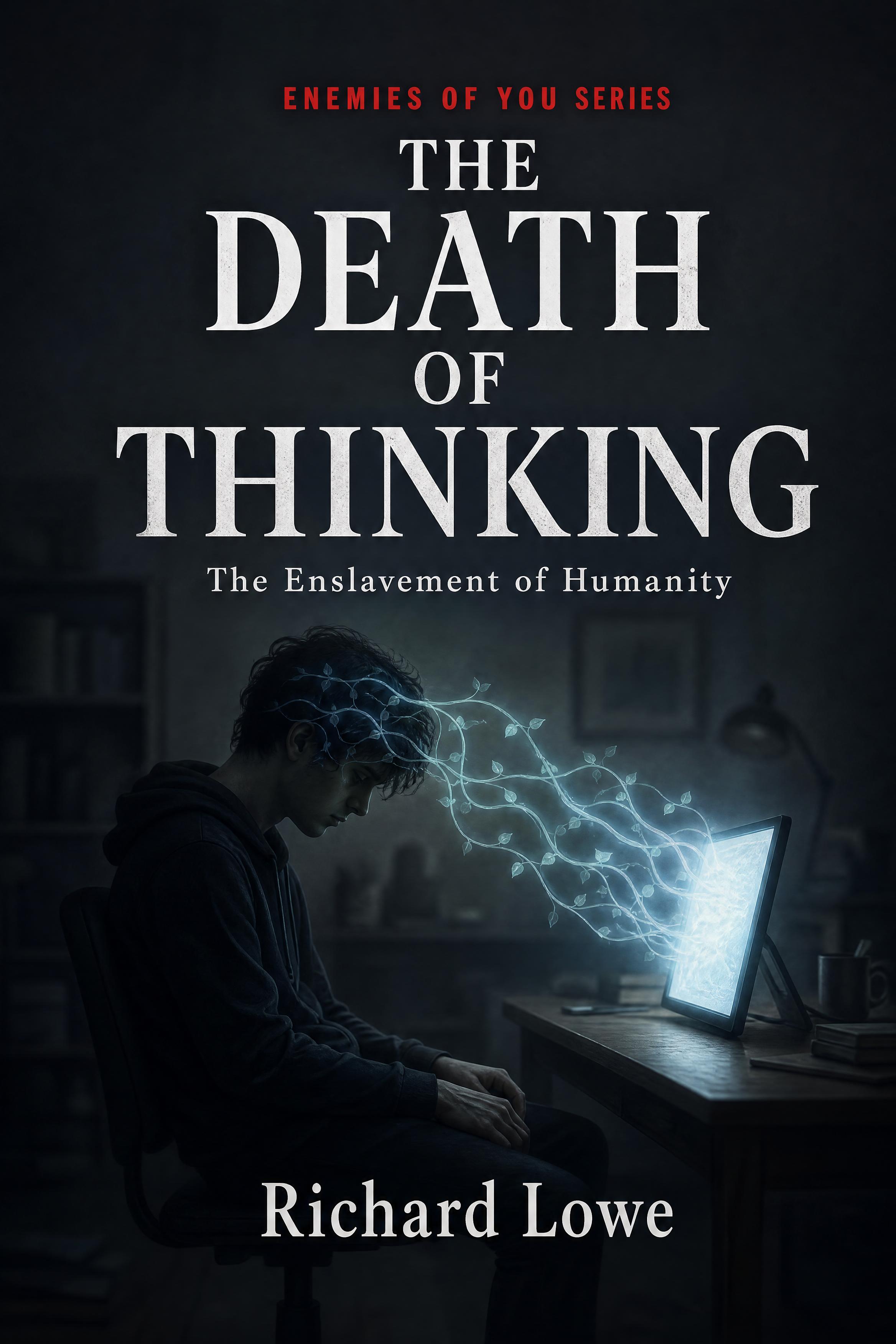
Worship is the far end of handing your judgment to a machine. The Death of Thinking is my book on what that outsourcing costs, one reasonable decision at a time.
Frequently Asked Questions
The machine tells you what you need to hear by analyzing what you’ve already said.Share on X
The book on this: The Death of Thinking is 314 pages on what happens when people stop doing their own thinking, including the part where the tool starts getting treated as an authority.
