TL;DR
General Stanley McChrystal and three co-authors turn the way his special operations task force fought in Iraq into a management book for any large organization. Its argument: in a fast, complex world, networks of small teams beat a top-down chain of command.
Al-Qaeda in Iraq was smaller, poorer and worse equipped than the task force hunting it. It kept winning anyway, because it moved faster.
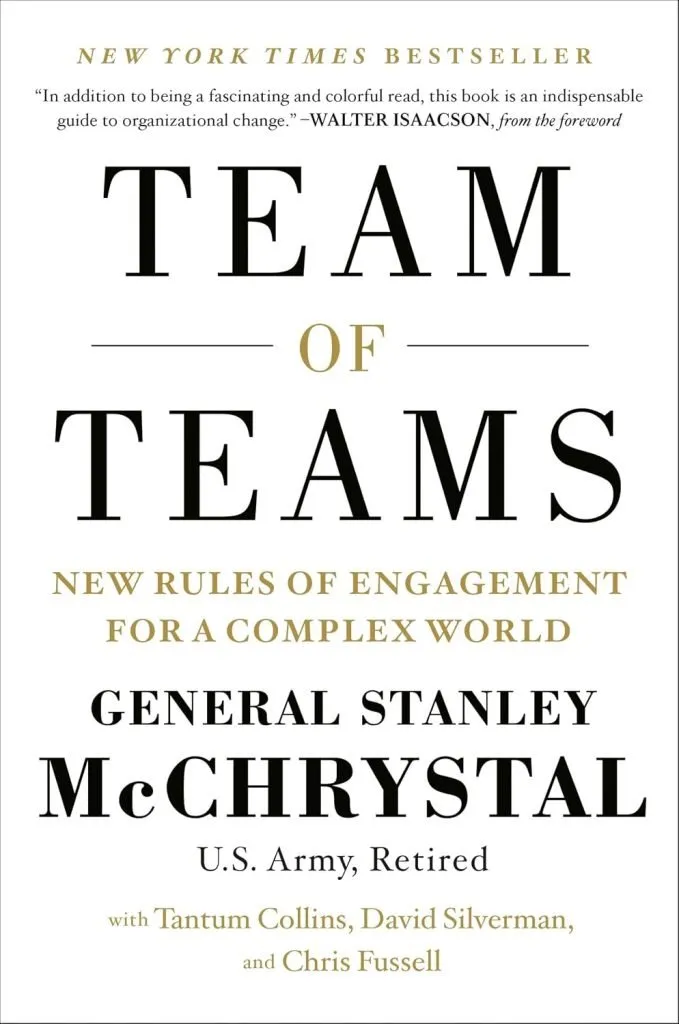
Team of Teams is what Stanley McChrystal and three colleagues learned from that problem. Portfolio published it in May 2015, and it became a bestseller.
What is Team of Teams about?
How an organization built for efficiency learns to adapt. McChrystal’s Joint Special Operations Task Force was a precise, top-down machine, and it was losing to a loose network that could change shape overnight. The book explains how the task force rebuilt itself. The answer was a team of teams. Small units already trusted each other inside their own groups, and the task force set out to extend that trust across the whole organization.
That meant sharing information far more widely than a military command normally would, holding daily briefings that people across the network could join, and pushing decisions down to the people closest to the problem instead of waiting for approval from the top.
The authors call the first half of the idea shared awareness: everyone in the network sees the same picture. The second half trusts the people closest to the problem to act on what they see without waiting for permission. The authors carry the idea well past the military. They pull in examples from NASA, hospital emergency rooms and business, and argue that any big organization facing fast, complicated conditions has to trade some efficiency for adaptability.
The history in it reaches well beyond Iraq. The authors set Nelson at Trafalgar against Frederick Taylor’s century-old gospel of efficiency, and they organize the argument in five parts, from what they call the Proteus problem to looking forward, each ending with a recap.
Not every reviewer bought all of it. Kirkus found the story engaging and the jargon heavy. A Foreign Policy reviewer liked the book but thought it leaned too hard on the special operations side and gave too little credit to earlier practice, and an Air University reviewer pushed back on its dismissal of Taylor.
Who wrote Team of Teams?
McChrystal is the lead author. He commanded Joint Special Operations Command from 2003 to 2008 and later led forces in Afghanistan. His co-authors are Tantum Collins, David Silverman and Chris Fussell, who worked with him at the McChrystal Group after he retired. McChrystal co-founded the McChrystal Group, a consulting firm in Alexandria, Virginia, in 2011. Collins later worked at Google DeepMind and on the White House’s National Security Council staff.
Why did Team of Teams reach business readers?
It sold an idea many managers already half believed: the org chart in the binder isn’t how work gets done. McChrystal gave them a war story that proved it, told by a general they couldn’t dismiss as a consultant.
It’s the clearest example of a military leadership book written for the boardroom. The lessons came from combat, and the readers are executives.
Look at the cover too: one general, three co-authors.
That’s how a book this ambitious gets built. The leader brings the experience, and a team turns it into chapters, research and examples that work for people who’ve never worn a uniform. It pairs naturally with McChrystal’s memoir, My Share of the Task.
Keep reading
Hiring a ghostwriter for a retired general’s or admiral’s leadership book: how senior military leaders turn a career into a book, and what has to stay out.
- Team of Teams, Penguin Random House
- Team of Teams, Kirkus Reviews
Frequently Asked Questions
Other Books From – Business and Economics