
I get these several times a day. With as many books as I have out there, my inbox is a magnet for them.
They all sound wonderful. The writer has discovered my book, kind of, sort of. They were moved by it, or impressed by it, or they see enormous potential in it. They have a solution that’ll get it in front of the readers it deserves. It’s all pleasantly vague, because it’s all AI crap, and they make themselves sound like the best thing since sliced bread. Nearly every one comes from a Gmail address. Not every one, but nearly.
And none of them ever mention a price. It’s just “if you’re interested, let me know.”
I replied to one of them once, to see where it went. It turned out to be a $500 package. Pay $500, and they’d do this and this and this for my book. I deleted it, blocked the sender, and never heard from them again. I imagine $500 is pretty normal for these, and I imagine a lot of authors pay it.
This is a full-blown industry now, and it runs on a simple fact: publishing a book puts your name, your title and your book description on a public page that anyone can scrape. Scammers don’t need to read your book. They feed your Amazon listing into a chatbot, ask it to write a warm, personal-sounding note about how much your story touched them, and send it to ten thousand authors before lunch. The cost to them is nearly zero. They only need a few of us to bite.
New authors get hit hardest, because a new author wants to believe it. You’ve just put years of work into the world, sales are slow, and here’s somebody who finally gets it. That hope is exactly what they’re selling against. Who wouldn’t want to believe it? and every first-time writer who asks in a group whether one of these is real shows how well the bait works.
What do author scam emails look like?
They follow a template, and once you’ve seen twenty of them you’ll recognize the twenty-first in the first line.
The opening is flattery about your book, built entirely from your own ad copy. One author in a writers’ group nailed it. They pretend they’ve read her books. Everything they know about her story lines comes from her Amazon description. Look for that. If the “reader” never mentions a scene, a character’s choice or anything past the blurb, nobody read anything.
Then comes the vague promise. More readers, more reviews, a book club spot, a feature, a movie adaptation, a “strategic partnership.” No details. No price. Just an invitation to reply.
The sender is someone you’ve never heard of, or someone famous. The address is Gmail, Outlook or Yahoo. The ones that don’t use Gmail use a domain that looks almost right.
And the ask always arrives in the second or third message, after you’ve replied. That’s when the package, the fee or the “friend who can help” shows up.
Why do scammers pretend to be literary agents?
Because an agent’s name opens doors that a book promoter’s never will. A new scheme making the rounds this fall uses the names of real, working literary agents.
An author in one of the big self-publishing groups laid it out. An email arrived from a well-known agent at a real agency, saying he’d come across the author’s work, without naming which book. Lots of generic sunshine. Was the author working on anything? Send over your Amazon author page link. When the author replied, the “agent” came right back to say the author page was deficient, and happened to know a friend who could tune it up with better keywords. Use the friend’s service first, then we’ll talk about representation.
The real agent almost certainly never sent it. Other authors in the thread said he’s a genuine agent. The scammers borrow real names because real names check out on Google. One author said a friend of hers, a New York Times bestseller, got one of these supposedly from his own agent. Another author got one “from” a publisher she already works with.
Look hard at that request for your Amazon author page link. Why would a professional need you to send it? Any real professional can find your author page in less time than it took to type the email. Asking you to send it is a test to see whether you’ll respond. Once you do, you’re a live one.
Nobody who found your book on their own asks you to send them the link to it. – Richard LoweShare on X
How do you tell if an email from a literary agent is a scam?
Check the address before you read another word. The authors in that thread said it over and over, and they’re right.
The scammers borrow real names because real names check out on Google.
A real agent at an agency writes from that agency’s domain. A Gmail address with a famous agent’s name on it is a scam. So is a domain one letter off, or the real agency name ending in dot co where the real one ends in dot com, or an extra word tucked into the domain. Some scammers go so far as to put up a cloned website that looks almost like the real agency’s. Compare the address against the one on the agency’s actual website, character by character.
Look hard at the letters, too. Scammers register domains with homoglyphs, characters from other alphabets that look identical to ours, like a Greek alpha or a Cyrillic “a” standing in for the Latin one. Your eye reads the agency’s name and your mail program goes somewhere else entirely. Copy the domain into a plain text editor or search it before you trust it.
And check the headers. In Gmail it’s “Show original,” and most mail programs have something like it. Look for the lines that report SPF, DKIM and DMARC. A real agency’s mail passes all three from its own domain. A forged one usually fails, or passes for a domain that has nothing to do with the agency. Thirty-three years in IT taught me to trust the headers over the signature line every time.
One working agent in the thread made a fair point: plenty of independent agents and publicists do use Gmail, so Gmail alone doesn’t prove fraud. What a real one always includes is something you can verify. A link to their agency listing, their client list, the deals they’ve made. A scammer offers none of that, because none of it would survive a search.
Still unsure? Go to the agency’s real website, find the published contact address, and ask whether that person emailed you. Several authors in that thread did exactly that and the agencies confirmed it was a scam. A few agencies have started posting warnings about it on their own sites.
Why do scam emails never mention a price?
Because the price is where you’d stop reading. Would you answer an email that opened with a $500 invoice?
A $500 fee in the first email gets deleted. A friendly note with no number in it gets a reply, and a reply is worth more to a scammer than anything else you can give them. It tells them your address is real, that a human reads it, and that you’re curious. From there the pitch can warm up slowly, with more flattery and more urgency, until the price feels reasonable.
That’s how my one reply went. Nothing about money in the first message. A $500 package the moment I answered.
Some of them are long cons. One author described a friend who got pulled into a web where a fake famous author befriended her over weeks, texting and emailing constantly, and then recommended an editor, then a PR person, then a cover artist, each one billing her. When she ran out of money, the “famous author” turned aggressive and pushed her onto a payment plan. Would you have spotted it? That’s not a spam email anymore. That’s a slow-motion robbery, and it works because the victim thinks she’s made a friend.
Should you reply to a suspicious author email?
No. Delete it, block the sender, and report it as spam or phishing in your email program.
My own blocking is very precise. I keep a shell script that deletes probably a thousand different emails, because I don’t want to deal with each new one by hand. About 90% of what reaches me is outright scams. They scan through Amazon, find my book, and send me an email saying they can help me promote it. Every single one of those has been a scam.
Replying, even to say no thanks or to tell them off, confirms your address is active. Your name then goes on a list of authors who answer. That list gets sold. One author in that group said she never responds for exactly that reason. She’s right to worry. Reply once and the volume goes up.
Don’t click the links either. Some of these emails are straight phishing, built to steal your Amazon, KDP or email login. A fake “book club” or “review service” page that asks you to sign in with Amazon is after your account, and a stolen KDP account can have its royalties redirected before you notice.
If a real agent’s name is being used, send a short note to the actual agency through the contact address on its website. They can’t stop it, but they can warn other authors.
Do legitimate book promoters ever email authors first?
Rarely, and never the way these do. A real service you’d want to hire doesn’t need to cold-email authors with made-up praise. It has a website with prices on it, a track record you can check, and clients whose names you can look up.
One author noticed she’d never once had a legitimate inquiry from a stranger through her author email. The real ones came through social media, from people she could see. That matches my experience. The good opportunities I’ve had came from people I already knew or could look up in two minutes, never from a flattering stranger with a Gmail address.
Book promotion isn’t always a scam. Paid ads, newsletter promotions and honest review services exist, and some of them work. The difference is who starts the conversation. When you go looking for a service, you can research it first. When it comes looking for you, it’s already researched you, and it’s after your wallet. My piece on getting honest Amazon reviews covers the review side, and why selling a self-published book is so hard covers what does sell books.
What should an author do after paying a book promotion scammer?
Move fast. Call your card company or bank, report the charge as fraud and ask for a chargeback. Payment disputes have deadlines, and some payment apps give you almost nothing back once money is sent.
Change your passwords if you clicked anything or signed in anywhere, starting with your email and your Amazon and KDP accounts. Turn on two-step login everywhere it’s offered.
Then report it: to the platform the scammer used, to the Federal Trade Commission at ReportFraud.ftc.gov, and to Writer Beware. Writer Beware tracks schemes aimed at writers. And stop answering anyone connected to the first scammer, because the “friend” who offers to get your money back is the same crew going for round two. I’ve written more about the patterns in Amazon publishing scams and fake ghostwriting companies, and about the time a $35K ghostwriting scam almost fooled me.
Don’t be embarrassed about it. These are built by people who do this all day, aimed at the moment you most want to believe someone. Losing money to one tells you the scam was good. It doesn’t say anything about your book.
My take
Delete it. Any stranger who loves your book and has a service to sell is running a scam, and the praise came from your own Amazon description. Check the domain, block the sender, and never pay anyone who found you first. If you already paid, move fast on the dispute, change your passwords, and report it to the FTC and Writer Beware. A lost payment says the scam was good, and it says nothing about your book.
How do you protect yourself from author scams for good?
Adopt one rule and never break it: you don’t pay anyone who found you first.
If you want promotion, editing, a cover or an agent, you go looking. You check the website, the prices, the client list and the reviews. You search the name with the word “scam” after it. You ask in a writers’ group. And when a stranger shows up in your inbox with glowing praise and no price, you already know what it is.
Check every address. Never send money by wire, gift card or crypto. Never sign in through a link in an email.
Warn the new authors you know, because they’re the ones these crews are built to catch. The publishing and marketing hub has the rest of the picture, and if you’d like help from someone you can look up in two minutes, my publishing services have my name, my books and my prices right on the page. A stranger who loves your book that much will buy a copy. They won’t send you an invoice.
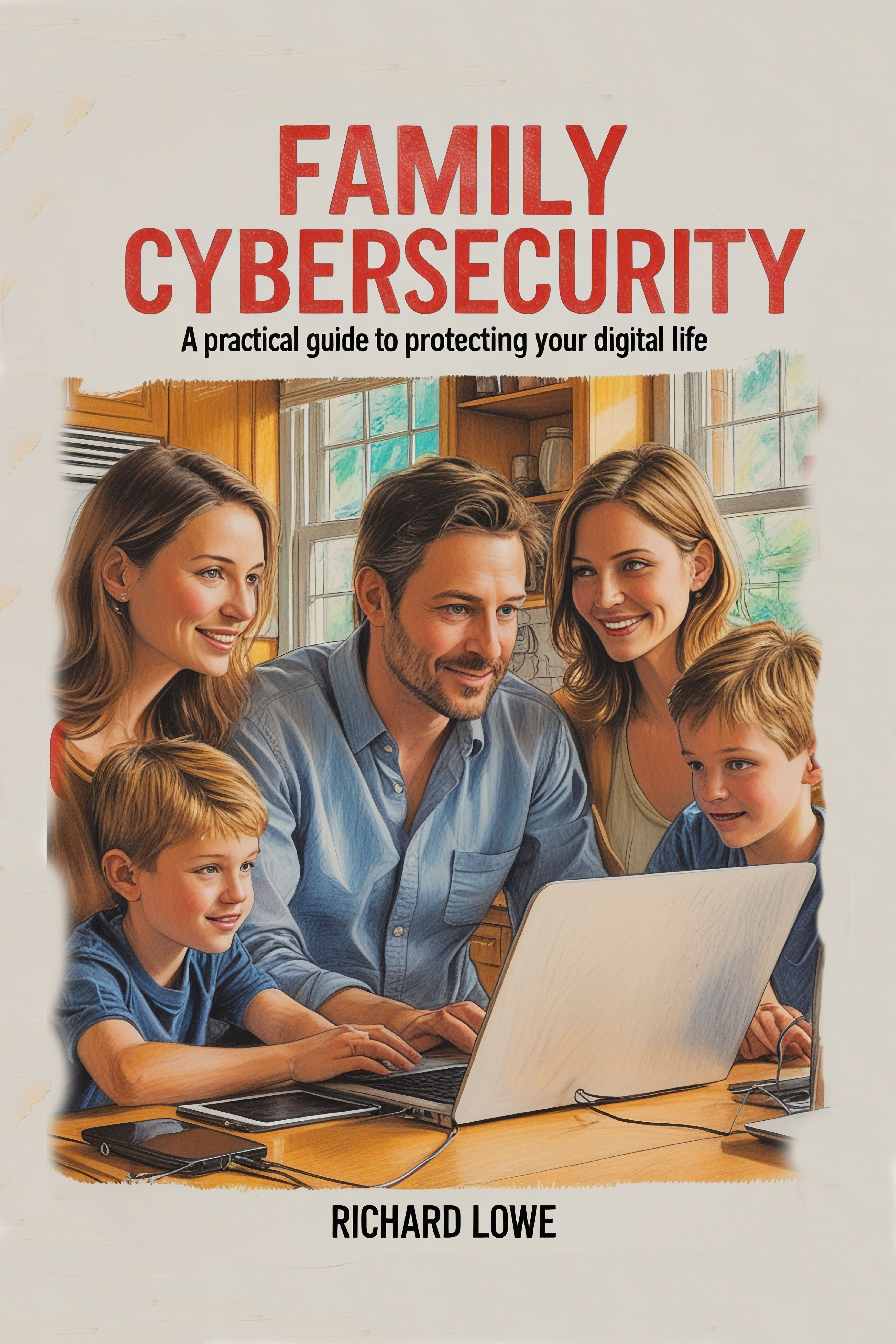
Family Cybersecurity is my book on protecting the people in your house. It opens with a friend who clicked an ordinary looking attachment and lost thirty years of photos.
