
Every era has its chokepoints. For most of the last century it was oil: the fields, the refineries, the tankers and the narrow straits they had to pass through. Nations went to war over them, and spies spent careers watching them.
AI has its own chokepoints now. The chips come from a handful of factories, most of them on one island. The data centers that run the chips need more electricity than some cities. And the knowledge of how to build the whole stack lives in the heads and hard drives of a few thousand engineers.
I spent 33 years in technology, much of it around security, and I’ve watched plenty of things get called strategic that weren’t. AI compute isn’t one of them. The countries involved are treating AI data centers the way they once treated refineries, and they’re behaving accordingly.
Why do AI data centers matter to national security?
Because computing power has become a resource that can be stockpiled, denied and stolen.
The chips come from a handful of factories, most of them on one island.
A country with enough data centers and enough chips can train the most capable AI models, and those models are already being used in intelligence analysis, cybersecurity, scientific research and the economy at large. A country without them rents compute from somebody else, on somebody else’s terms.
The buildout is concentrated in two places. The International Energy Agency expects the United States and China to account for nearly 80 percent of global growth in data center electricity use through 2030.
Governments have started treating data centers as part of the critical plumbing of the state. In September 2024 the United Kingdom designated them Critical National Infrastructure, alongside water, energy and the emergency services. That gives operators priority access to the National Cyber Security Centre and government support during a major incident. “Data centres are the engines of modern life,” the UK’s technology secretary said at the time.
Once something is critical infrastructure, it’s also a target.
That stopped being theory in October 2026. Starting October 8, Ukrainian drones hit three of the five data centers run by Yandex, Russia’s biggest technology company, and services went down in at least eight countries, according to an analysis by Geopolitical Futures. Yandex handles about a fifth of all the data processed in Russia, and some 51,000 corporate clients rent computing power from its cloud. Russia hit back at a Ukrainian bank’s data processing center two days later.
A bombed warehouse can restock. A data center can’t, at least not quickly. The same analysis says Yandex may not be able to rebuild until 2028, because so much of the world’s memory chip production is already contracted for 2027. The chip shortage and the shooting war are tangled together.
Watch: Inside the AI Chip War: From Nvidia’s Dominance to Intel’s Turmoil | The Real Eisman Playbook Ep 28, Steve Eisman
What are the US export controls on AI chips?
They’re the main weapon in the race, and they’ve changed direction several times.
Starting in 2022, the United States began restricting the sale of high-end AI chips, chip design software and chipmaking equipment to China. The rules were extended in 2023 and again in 2024 as companies found ways around them.
In January 2025, the outgoing administration issued what it called the AI Diffusion Rule. It sorted the world into three tiers. Eighteen close allies got nearly unrestricted access to advanced chips, most countries needed licenses, and arms-embargoed nations stayed cut off. It also capped how much AI computing American companies could place outside the top tier. Four months later, two days before it was due to take effect, the new administration rescinded it. Nvidia had warned the rule would weaken America’s global competitiveness, and the new administration called it overly complex and overly bureaucratic.
Then came the whiplash over Nvidia’s H20, a chip designed to fall just under the export limits. In April 2025 the Commerce Department declared it noncompliant, and Nvidia took a $5.5 billion write-off. That summer Commerce reversed course and allowed sales again. By then, according to a Brookings analysis, Chinese authorities were discouraging companies from buying it, citing security concerns.
In December 2025 Washington approved exports of the more powerful H200. In January 2026, Chinese customs agents were reportedly told the H200 wasn’t permitted into the country, and as of mid-May, Brookings reported, not a single one had been sold to a Chinese company.
Brookings concluded that US chip companies “have exactly zero market share of the AI chip market in China and have no prospect of returning to their once-dominant position there.” In 2021, by Huang’s own account, Nvidia had about 95 percent of it.
Are AI chip export controls working?
It depends on what you think they were for, and serious people disagree.
The case that they work comes from the numbers on chips. Chris McGuire of the Council on Foreign Relations calculated in December 2025 that the best American AI chips are about five times more powerful than the best Chinese ones. Huawei, China’s leading chip designer, produced somewhere between 200,000 and 800,000 AI chips in 2025, by various estimates, against 4 to 5 million for Nvidia.
McGuire estimated Huawei’s total output in 2026 at about 5 percent of Nvidia’s computing power. “Huawei is not a threat that justifies loosening controls; it is evidence that the controls are working,” he wrote.
The case that they failed comes from the market. Nvidia’s chief executive, Jensen Huang, said at Computex in May 2025 that “export control was a failure, the facts would suggest it.” Nvidia’s share of the Chinese market, he said, had fallen from nearly 95 percent to 50 percent in four years, and the company had written off billions. His argument was that China would build its own chips anyway, and the controls only handed that market to Chinese companies.
Both can be true. The controls appear to have slowed China’s access to the most powerful chips. They also pushed China to build its own industry and shut American companies out of a huge market. Which matters more depends on whether you care more about the next five years or the next twenty.
Every era has its chokepoints. Oil had refineries and straits. AI has chip factories, power grids and the engineers who know how to wire the whole thing together. – Richard LoweShare on X
How do the AI chip rules affect American allies?
They’ve left some of them unsure where they stand.
Under the January 2025 Diffusion Rule, the closest allies, including the other Five Eyes members Britain, Canada, Australia and New Zealand, landed in the top tier with nearly unrestricted access to American chips. When the rule was rescinded four months later, that status went with it. Australia’s United States Studies Centre pointed out that Australia now has to compete with other countries for access and convince Washington it’s a reliable partner.
The Gulf deals show the other direction. Countries that aren’t treaty allies can still get access to enormous amounts of American compute if they sign the right partnership agreements. Access to AI chips has become something governments negotiate over, the way they once negotiated over arms sales and oil.
How do AI chips get smuggled into China?
The same way contraband always moves: through middlemen, false paperwork and somebody willing to look the other way.
The biggest case so far was unsealed in Manhattan in March 2026. Federal prosecutors charged three people connected to Super Micro Computer, a major American server maker, including its co-founder, with smuggling at least $2.5 billion worth of US AI technology to China. According to the indictment, servers were shipped through Taiwan to Southeast Asia, repacked in unmarked boxes and sent on to China. Prosecutors said the defendants staged fake equipment to pass inventory audits and used hair dryers to peel labels and serial numbers off the real machines.
Super Micro itself wasn’t charged and said it cooperated with investigators. Its stock fell 8 percent anyway.
That case wasn’t the first. The Justice Department brought several smuggling cases in 2025, and in July 2026 prosecutors in Taiwan reportedly detained an Nvidia employee in a separate probe. A chip small enough to fit in a backpack and worth tens of thousands of dollars is a smuggler’s dream, and demand on the other side of the border isn’t going away.
Is China stealing AI secrets from American companies?
At least one jury said yes.
Linwei Ding was a software engineer at Google. Between May 2022 and April 2023, according to the Justice Department, he copied more than 2,000 pages of confidential information about the infrastructure behind Google’s AI: its custom TPU chips, its GPU systems, the software that lets thousands of chips work together as one supercomputer, and its custom network cards. While he was doing it, prosecutors said, he was in talks to become chief technology officer of a Chinese startup and then founded his own AI company in China.
In January 2026 a jury convicted him on seven counts of economic espionage and seven counts of theft of trade secrets.
The sentence surprised a lot of people. In September 2026, the judge gave him just under a year in prison, plus restitution and a fine. Judge Vince Chhabria called it “a systematic, brazen effort to steal Google’s property,” and said a sentence with no prison time at all would have been “hard to swallow.” The defense had asked for home confinement so Ding could care for his young son.
Look at what he took. He went after the data center: how to build the hardware and wire it into a machine that trains AI. Software leaks out over time. Knowing how to build and run a supercomputer at that scale is much harder to copy, and worth a great deal to a country that’s short of chips.
What do the Five Eyes intelligence agencies say about AI?
The Five Eyes are the intelligence alliance of the United States, the United Kingdom, Canada, Australia and New Zealand. They rarely appear together in public. In October 2023 they did, at Stanford’s Hoover Institution in California, for a summit on emerging technology and security.
The message was blunt. FBI Director Christopher Wray said China’s hacking program “is bigger than that of every other nation’s combined,” according to The Register’s account. Mike Burgess, head of the Australian Security Intelligence Organisation, said the Chinese government had engaged in “the most sustained, scaled, and sophisticated theft of intellectual property and acquisition of expertise,” and said nothing like it had happened before in human history. Ken McCallum of MI5 warned that technology workers who have no interest in geopolitics are now targets for recruitment anyway.
They also flagged AI itself as a tool for attackers: finding software vulnerabilities, writing exploit code, crafting convincing phishing messages, and producing deepfake audio and video.
In May 2025 the US National Security Agency, the Cybersecurity and Infrastructure Security Agency and the FBI, joined by allied cybersecurity agencies, published joint guidance on AI data security. It warned about three risks: compromised data coming in through the supply chain, training data deliberately poisoned by attackers, and data that drifts over time until a model stops working the way it should. It told organizations to check where their data comes from, use digital signatures to prove it hasn’t been altered, and audit their models regularly.
That wasn’t the only joint warning. In April 2024, cybersecurity agencies from all five countries co-authored guidance called Deploying AI Systems Securely: the NSA, CISA and FBI in the United States, the UK’s National Cyber Security Centre, the Australian Cyber Security Centre, the Canadian Centre for Cyber Security and New Zealand’s National Cyber Security Centre. It was written with state-sponsored attackers in mind, and it told organizations to harden AI systems against theft and disruption, validate their models, and keep watching for new risks.
Read the two documents together and you can see what the intelligence agencies think a data center is worth stealing from. First come the chip designs and the engineering know-how, the material Ding took. Then the training data, something an attacker can steal or poison. Then the finished models themselves. A frontier model represents months of computing and an enormous amount of money, and once somebody is inside, it’s just a very large file to copy.
Are hackers targeting the power and water that data centers need?
The Five Eyes say Chinese state hackers have been inside that infrastructure for years.
In early 2024, US agencies and their Five Eyes partners published advisories on a group they call Volt Typhoon. Their assessment was that Chinese state-sponsored actors were “seeking to pre-position themselves on IT networks for disruptive or destructive cyberattacks against U.S. critical infrastructure,” in communications, energy, transportation and water systems. In some victims’ networks, they’d held access for at least five years.
That isn’t ordinary spying. Stealing secrets is about learning things. Pre-positioning is about being able to turn things off, in a crisis or a war.
The advisories don’t single out data centers. But a data center is only as secure as the grid that feeds it and the water that cools it. A two-gigawatt AI campus is about the most concentrated, valuable load on any power system, and it depends on exactly the sectors the Five Eyes say are compromised. My environment article and this one end up at the same question: who controls the power.
Why does Taiwan matter so much to AI?
Because almost every advanced AI chip in the world is made there.
Taiwan Semiconductor Manufacturing Company, or TSMC, makes the chips Nvidia, Apple, AMD and most other designers sell. Taiwan produces about 90 percent of the world’s most advanced semiconductors, according to the Council on Foreign Relations. For years that dependence was called Taiwan’s “silicon shield,” on the theory that no country would risk a conflict that destroyed the factories everyone needs.
The United States has been trying to reduce the risk. In March 2025 TSMC raised its planned investment in Arizona to $165 billion, covering new chip factories, advanced packaging plants and a research center. The company called it the largest single foreign direct investment in US history. Its first Arizona plant is in production.
Washington has put public money behind that effort too. The CHIPS and Science Act of 2022 set aside about $52.7 billion for American chip manufacturing and research, and TSMC was promised up to $6.6 billion in federal incentives for its Arizona plants. TSMC’s own reason for expanding was simpler. “Seventy percent of our revenue is from the U.S., and most of these customers want advanced technology,” its chief financial officer, Wendell Huang, told NPR. “Therefore, we are expanding in Arizona the advanced technology fabs.”
Even so, the most advanced production will stay in Taiwan for years.
A chokepoint that took decades to build doesn’t move in one.
Is electricity the real AI arms race?
A lot of people in the industry think so.
In October 2025, OpenAI sent a letter to the White House Office of Science and Technology Policy. It warned about what it called the “electron gap.” According to Utility Dive, the letter said China added 429 gigawatts of new power capacity in 2024, while the United States added 51.
OpenAI urged the country to build 100 gigawatts of new capacity a year. “In pursuit of its goal to overtake the US and lead the world on AI by 2030,” the company wrote, China “has built real momentum in energy production, treating capacity as the foundation of industrial competitiveness.”
OpenAI has an obvious interest here. It needs enormous amounts of power for its own campuses. The numbers still hold up. China’s National Energy Administration reported 543 gigawatts of new capacity in 2025, and the total China has added since 2021 exceeds the size of the entire US grid. It built record amounts of solar and wind, and it also launched about 78 percent of the new coal plants started worldwide that year.
Power is the chip problem turned inside out. America can design and buy the best chips and struggles to plug them in. China can plug in almost anything and struggles to get the best chips.
It also explains why I keep coming back to the same point about power. A country that wants AI data centers without wrecking its grid needs those campuses to bring their own generation, clean wherever possible, the way Ireland now requires. That’s an environmental rule and a national security rule at the same time.
Who is winning the race to build AI data centers?
On spending, the United States, by a wide margin. The five biggest US cloud and AI companies committed $660 billion to $690 billion in capital spending for 2026, according to the Futurum Group.
China is building on a different model. Its data centers used an estimated 150 to 200 terawatt hours in 2025, according to government figures cited by Carbon Brief. In 2022 the government launched East Data, West Computing, a national program to put new data centers in western provinces, near big solar and wind farms, and send work there from the crowded east. China’s grid still runs about 60 percent on coal, and eastern data centers draw around 70 percent of their power from it.
China’s real constraint is chips. America’s real constraint is power, and the arguments over transmission lines, permits and power bills I covered in the environment article. Each country is short of what the other has.
The money side of the race is in the economy article.
The third player is money looking for a seat at the table. In May 2025 the Emirati AI company G42 announced Stargate UAE, a one-gigawatt cluster inside a planned five-gigawatt AI campus in Abu Dhabi, with OpenAI, Oracle, Nvidia, Cisco and SoftBank as partners. The first 200 megawatts were scheduled to come online in 2026.
Oracle’s Larry Ellison pitched it as a platform that would let “every UAE government agency and commercial institution” connect its data to the most advanced AI models. That’s the idea behind what governments now call sovereign AI: compute inside your own borders, under your own laws. It was framed as part of a US-UAE partnership. The deal was about more than data centers. It was about which side the world’s AI compute ends up on.
What does the AI chip race mean for ordinary people?
More than most people think.
The price and availability of the AI tools you use depend on chips that cross the Taiwan Strait, power that crosses your county, and export rules that change with each administration. A conflict over Taiwan wouldn’t just be a foreign policy story. It would hit the price of every phone, laptop, car and cloud service in the world.
It also matters where your data lives. If you use AI to work on a manuscript, a business plan or client material, the servers handling it sit in some country, under that country’s laws, inside infrastructure that intelligence agencies say is being probed. Read the privacy terms. Turn off model training on anything you care about. I explained how in turning off AI training before you upload your book.
And it explains a lot of the money. When you hear about hundreds of billions going into data centers, part of that is business. Part of it is a race between two countries that both believe the winner gets to set the rules for everyone else.
Is the AI buildout going to stop?
No. As I said about the environmental side, I think AI data centers are inevitable. The geopolitics make that even more certain. No country is going to stop building when it believes its rival won’t.
So the rules matter even more: who gets the chips, who gets to build where, how a campus is secured, and whether its power comes from a grid that a foreign intelligence service may already be inside. Those are decisions for governments and for the companies building the campuses, and they deserve more public attention than the latest chatbot release.
My take
Treat compute like oil, because every government involved already does. Chips, power and the grid behind them are strategic assets now, and the buildout won’t stop while two rivals both think the winner sets the rules. For a writer, the practical part is closer to home. Your manuscript sits on a server in some country, under that country’s laws. Read the privacy terms and turn off training on anything you care about.
The new straits
The old chokepoints were straits that tankers had to squeeze through. The new ones are a few chip factories on an island, a few hundred data center campuses, the transmission lines that feed them, and the people who know how to wire them together. Every intelligence service in the world knows where they are.
The AI and writing hub has more on AI’s bigger picture and what it means for writers. If you’d like help figuring out where AI belongs in your own work, my AI services cover that. Keep an eye on the straits, because the next chapter of this story gets written there.
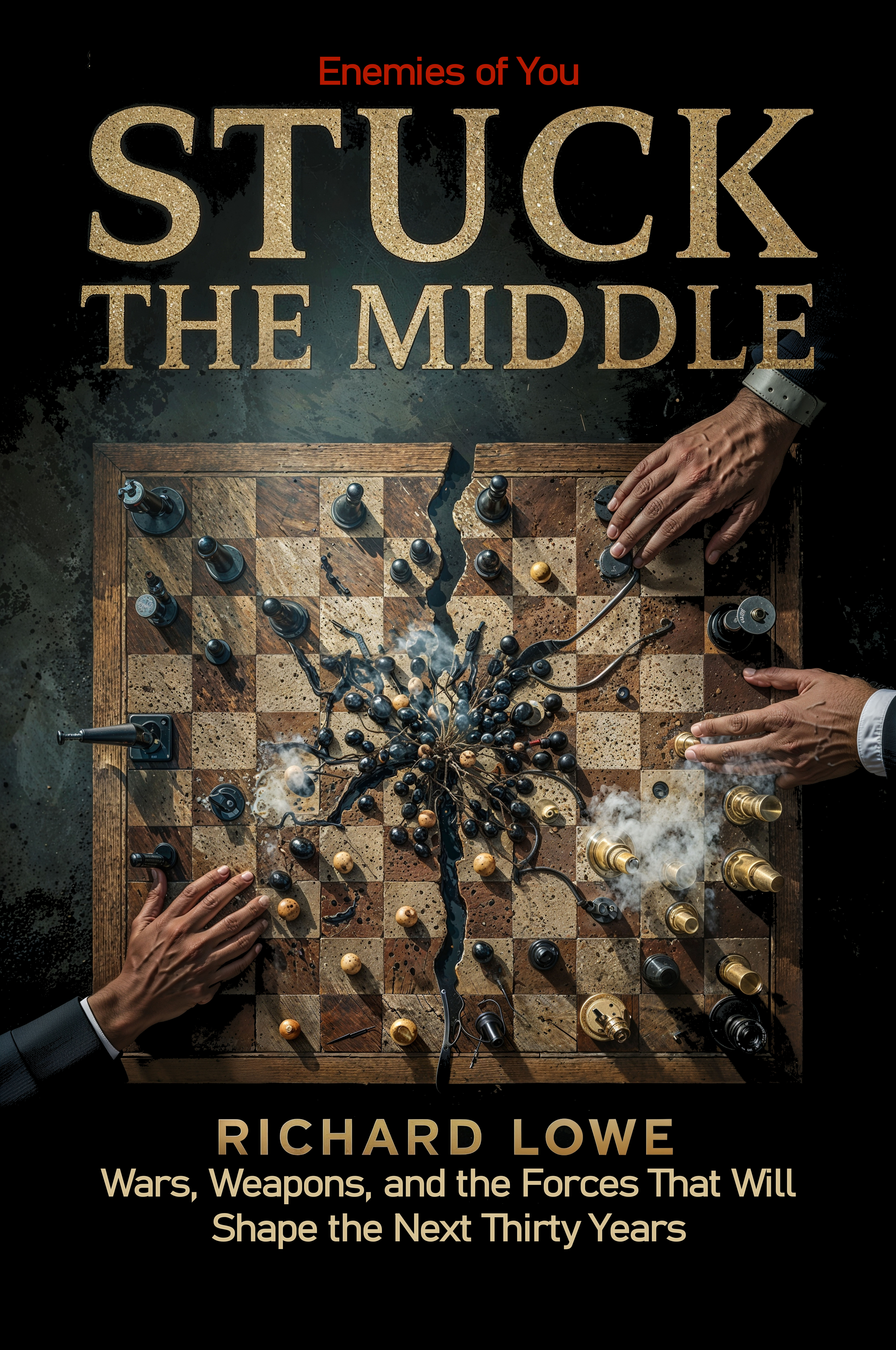
Chips and data centers sit inside a bigger contest. Stuck in the Middle, my book on wars, weapons and the next thirty years, starts with the 2026 Iran war and looks ahead.
