TL;DR
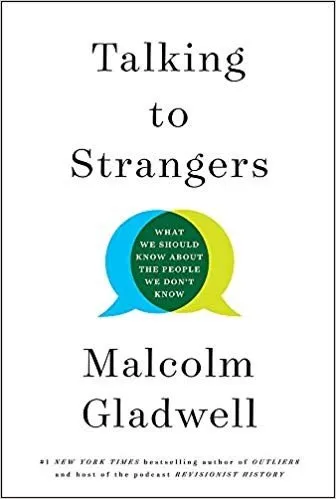
7/10. We’re far worse at reading strangers than we believe, and the errors are systematic. The strongest idea is that our default assumption of honesty is a feature of a functioning society and not a flaw. That means the failures are the price of the thing working at all.
Gladwell builds the book around a traffic stop in Texas that escalated into an arrest and then a death in custody, and works backward through a set of cases where people badly misread other people.
A judge misjudging a defendant at a bail hearing. Investors who missed an obvious fraud for years. A diplomat convinced he’d taken the measure of a dictator across a table.
A university that failed to see what was happening in a building it owned. A campus assault where two people gave irreconcilable accounts of the same night.
The through line is that all of these failures share a shape, and that the shape isn’t stupidity.
What is truth-default theory?
This is the idea worth the price of the book, and it comes from the communication researcher Tim Levine.
We assume people are telling the truth because a society in which everyone verified everything couldn’t function. Every transaction, every hire, every conversation would require evidence, and the cost of that is prohibitive.
Doubt doesn’t accumulate gradually. It requires a threshold of evidence to trigger, and until the threshold is crossed we go on believing and explaining away the anomalies. Levine’s experiments show people continuing to believe in the face of considerable contrary evidence, and then flipping all at once when the pile becomes undeniable.
The consequence is the part I find useful.
If you tuned the default toward suspicion, you’d catch more liars and you’d destroy the ability to do business, make friends, or hire anybody. The people who catch frauds early are usually not better judges of character. They’re people whose disposition is closer to broken, and Gladwell says so.
Watch: Malcolm Gladwell | Talking to Strangers - What We Should Know About the People We Don't Know, How To Academy
What is the transparency problem in Talking to Strangers?
The second good idea, and the one with more practical consequence for anyone who interviews people. Transparency is the belief that emotion shows on a face reliably, so that a person’s demeanor is a window into their state. It’s close to universal and it’s wrong. Expression varies by culture, by individual, and by situation. Some people look guilty when frightened. Some look calm when devastated. The mismatched, meaning people whose outward presentation doesn’t correspond to their inner state, get catastrophically misread by everybody including professionals whose job it’s to read them.
The Amanda Knox case is his central illustration and it’s the right one. She behaved in ways that struck observers as inappropriate for a grieving flatmate, and the entire prosecution grew from that reading of her demeanor. There was no physical evidence connecting her to the crime. For anybody conducting interviews this is worth internalizing. I have sat with clients who present as evasive and are simply uncomfortable, and with clients who present as open and are managing me carefully. The demeanor tells you almost nothing.
What is coupling in Talking to Strangers?
The third concept and the one most readers forget. That’s unfortunate because it’s the most usable.
Coupling is the observation that some behaviors are tightly bound to specific contexts and don’t transfer.
Gladwell’s example is town gas in Britain, which was lethal and was the leading method of suicide, and which was phased out during the 1960s and 1970s. The expectation was that people would substitute other methods. Rates fell considerably and didn’t fully recover.
The behavior was coupled to the availability. Remove the means and a proportion of the behavior doesn’t relocate, it stops.
He applies this to crime and policing, arguing that criminal activity concentrates in very small geographic areas and that policing which ignores this produces exactly the diffuse, aggressive stops that generated his framing case. That’s the book’s most policy-relevant argument and it gets the least attention.
What are the criticisms of Talking to Strangers?
The usual Gladwell complaints apply and they’re fair.
Cases appear selected because they fit. Contrary evidence is thin on the page. A reader who knows one of the cases well will generally find the treatment simplified, and specialists in several of the areas he covers have said so at length. The framing case has drawn particular criticism, with people arguing that the book smooths a story that won’t smooth and that using it as a bookend implies a tidiness the events don’t have.
My working position on this author is that he’s a magnificent question-poser and an unreliable answer-giver. He finds the thing you hadn’t noticed was strange, and then he explains it more confidently than the evidence permits. Read him for the frame and then check the frame against somebody who studies the field.
What does Talking to Strangers change about how you work?
Three things, for me. I stopped treating a first impression of a prospect as information about their character. It’s information about how they present. That’s a different variable and correlates weakly.
I became more willing to name the truth-default when advising somebody who has been defrauded. The question people torture themselves with is how they missed it, and the answer is usually that they were operating the same software everybody else runs. That’s a kinder and more accurate account than gullibility.
And I now think about coupling whenever somebody proposes a behavioral fix. Change the environment and a proportion of the behavior won’t relocate. That’s true of writing habits as much as of anything else.
Verdict
Read it for truth-default, transparency and coupling. All three will change how you interpret an interview or a first meeting. Discount the certainty. This is a book of provocations dressed as findings. That’s the deal with this author and is worth taking with the discount applied.
Explore further
The Psychology of Writing Hub: what drives creative work and what stops it.