TL;DR
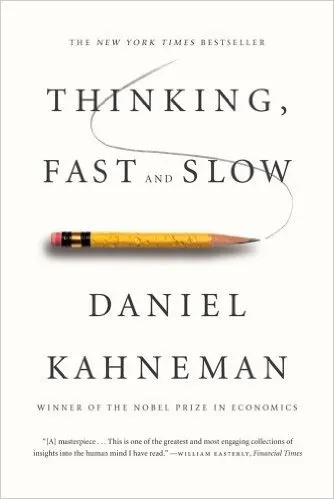
9/10. A Nobel laureate summarizing forty years of work on how judgment fails. System 1 is fast and automatic, System 2 is slow and lazy, and most of what you think is reasoning is System 1 with a justification attached afterward. Some chapters haven’t survived replication and Kahneman said so himself.
Kahneman won the Nobel in economics in 2002 for work done with Amos Tversky on judgment and decision-making under uncertainty. Tversky had died in 1996 and would have shared it. This book is the accessible version of that career, published in 2011, and it’s thick, dense, and worth the effort. It’s not a summary you can skim; the arguments accumulate.
The organizing device is two systems. One is fast, automatic, associative, and always running. The other is slow, effortful, sequential, and reluctant to engage because engagement costs energy. Almost every error described in the book comes from the second failing to check the first.
This book rearranged how I think about my own judgment, and I’m grateful and a little embarrassed about it. It’s hard work to read, and the payoff is watching the book catch your own mind red-handed chapter after chapter.
What is loss aversion?
The finding that losing something stings roughly twice as strongly as gaining the equivalent, and it explains an enormous amount of behavior that otherwise looks irrational. I find it the most humbling idea in the book. It’s the core of prospect theory. That’s the work the Nobel was for. People are risk-averse about gains and risk-seeking about losses. That means the same decision gets made differently depending on whether it’s framed as what you might win or what you might avoid losing.
The practical consequences are everywhere. People hold failing investments because selling makes the loss real. Companies continue failing projects for the same reason. Writers keep working on manuscripts that aren’t going to work, because abandoning one converts two years of effort into a loss and continuing keeps the loss theoretical.
I’ve done that, at length, and knowing the mechanism doesn’t fully cure it. Knowing it does at least let you name what’s happening when a decision refuses to get made.
Watch: Thinking, Fast and Slow by Daniel Kahneman | Animated Book Summary, Antidote
What is the planning fallacy?
The systematic underestimation of how long a task will take, and it persists even in people with direct experience of the same task overrunning.
Kahneman’s example is a textbook project he was part of, estimated at two years by a group who then discovered, when asked about comparable projects, that similar efforts took seven to ten years and a serious fraction were never finished. Theirs took eight.
The finding that matters is that having the base rate available didn’t change the estimate. The group knew the outside view and stayed with the inside view, because the inside view feels like knowledge about this specific project and the outside view feels like a statistic about other people. Every writer knows this and almost nobody corrects for it. The remedy Kahneman offers is reference class forecasting: find comparable completed projects and use their actual durations instead of your estimate. It works and nobody does it, including me.
What does WYSIATI mean?
What you see is all there is, and it may be the most useful thing in the book.
The mind builds a coherent story from whatever information is available and doesn’t register the absence of what it wasn’t shown. Confidence comes from the coherence of the story and not from the quantity or quality of the evidence behind it. That’s why a small amount of consistent information produces more certainty than a large amount of mixed information.
That’s the mechanism behind most bad decisions I’ve watched people make, including my own. A hiring decision made from an interview. A judgment about a business partner made from three meetings. The story hangs together, the confidence follows, and the missing information isn’t missing in any way the mind can detect.
The only defense is procedural: ask what you’d need to know to be wrong, and notice whether you have it.
That single question has more practical value than most whole books on decision-making. I’d print it and tape it above any desk where people make hiring or partnership decisions.
What in Thinking, Fast and Slow has failed to replicate?
Several chapters, especially the priming material, and a reader deserves to hear that up front. The famous studies where exposure to words about old age made people walk more slowly, and related social priming work, haven’t held up under attempted replication. The replication crisis in psychology hit that literature hard.
Kahneman himself wrote publicly, in 2017, that he’d placed too much faith in underpowered studies and that a reader shouldn’t accept that section of his book. He used the phrase that he’d made a mistake, and he was specific about which chapter.
That admission is to his enormous credit and it’s also a reason to read the book with a pencil. The core work on heuristics and biases, which is his own and Tversky’s and which rests on much larger and more replicated foundations, has held up far better than the borrowed social psychology he incorporated. I admire Kahneman enormously for that admission. Scientists rarely stand up and say a famous chapter of their own bestseller was wrong, and his willingness to do it makes me trust the rest of the book more.
What should a writer take from Thinking, Fast and Slow?
Three things beyond the general education.
The planning fallacy, applied to your own deadlines, with reference class forecasting as the correction. Look at how long your last three books took and use that number. Loss aversion, applied to abandoning work. The manuscript you can’t let go of is costing you the next one, and the reason you can’t let it go is a well-documented feature of how humans price losses.
This one stings for writers, and it should. Two years sunk into a dead manuscript feels like an asset when it’s really a debt, and I think every writer owes themselves a hard look at the drawer they keep refusing to close. And WYSIATI, applied to research. The confident story you’ve assembled from the sources you happened to find is exactly what this book warns about, and the discipline of asking what you haven’t looked for is the difference between a researched book and a plausible one.
Verdict
Essential, long, and no longer wholly reliable. That’s an unusual combination. Read it for loss aversion, the planning fallacy, and what you see is all there is.
Discount the priming chapters, because the author did. It remains the best single account of how a competent mind reaches a confident wrong answer.
It’s a demanding read, and I’d push it on anyone who makes decisions for a living. The flaws are real and the author named them himself, and that candor raises my opinion of the book.
Explore further
The Psychology of Writing Hub: what drives creative work and what stops it.