TL;DR
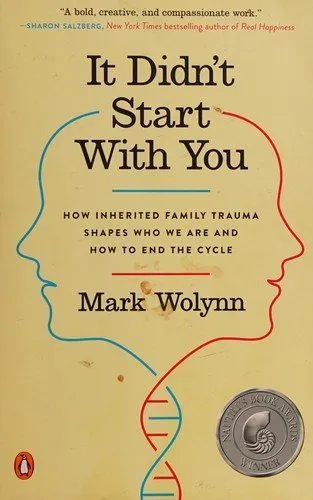
8/10. The argument that trauma leaves marks that pass down a family, and that a fear you can’t account for may belong to a grandparent. The science is more contested than the book admits and the method is better than the science.
Mark Wolynn directs the Family Constellation Institute and works largely with people whose symptoms haven’t responded to conventional treatment: chronic anxiety with no identifiable cause, phobias with no originating incident, depressions that predate anything in the person’s own life.
His premise is that some of what a person carries didn’t originate with them, and that the family history contains the missing information.
He leans on epigenetic research, including studies of Holocaust survivors’ descendants and of the Dutch Hunger Winter cohort. That found measurable differences in stress-related markers in generations that didn’t experience the events.
What is the core language approach in It Didn’t Start with You?
The method, and it’s better than the biology it’s attached to.
You listen for the sentences a person uses about their worst fear, phrased in their most extreme terms. Not what they think will happen, but the catastrophic version underneath: I’ll end up alone with nobody. I’ll lose everything. They’ll take my children. I’ll disappear and nobody will notice. Then you notice that the sentence frequently doesn’t fit their life. A person who was never abandoned saying they’ll end up alone with nobody. A person with a stable income and no history of loss saying they’ll lose everything.
Wolynn’s claim is that the sentence belongs to somebody. Somewhere in the family there was a person for whom it was literally true, and the sentence outlived them.
He supplements this with questions about what was never spoken about, who was excluded from the family story, and what happened around the time the person was born. That’s standard genogram work sharpened to one purpose.
Watch: It Didn't Start With You, Mark Wolynn, Science and Nonduality
Does the biology in It Didn’t Start with You hold up?
Less confidently than the book presents it, and I’m more cautious about it than he is. The studies are real. Rachel Yehuda’s work on Holocaust survivors and their children found differences in cortisol regulation and in methylation of a stress-related gene. The Dutch Hunger Winter cohort shows metabolic effects in people conceived during a famine. The animal work, especially the mouse studies on conditioned fear passing to offspring, is provocative.
The difficulty is that the mechanism in humans isn’t established. Transgenerational epigenetic inheritance is much better showed in plants and in some animals than in people, several headline findings have been difficult to replicate, and the sample sizes in the human studies are small. There’s also a confound the book underplays. A parent traumatized by an event raises a child differently, and that’s a perfectly adequate explanation for a great deal of what gets attributed to biological inheritance. Behavior transmits down families without needing molecules.
The book presents a live research area as an established one, and readers should know that.
What about family constellation work?
It sits in the background of the method and the book mostly keeps it out of view. That’s worth noticing. Family constellation therapy, developed by Bert Hellinger, involves representing family members physically in a group session and observing what emerges. It’s a thin evidence base, and Hellinger’s own structure included metaphysical claims about family systems that many practitioners have moved away from.
Wolynn draws on this lineage without foregrounding it, and the material in the book is presented as inquiry and exercise instead of constellation work. A reader should know the tradition it comes from, because it explains some of the framing.
Why is It Didn’t Start with You useful for memoir?
Because the questions it teaches you to ask are the ones that open a subject who has been giving you the surface version.
In an interview, the useful question is rarely what happened. It’s what was never talked about in your house. Who wasn’t mentioned. What was happening in the family the year you were born. What did your mother’s mother lose. Those questions produce material that direct questioning doesn’t, and I’ve watched them work when nothing else did. A subject who has told the same anecdotes for forty years will stop and reach for something else when asked what the silences were about.
You can use the technique and hold the biology loosely. The interview works whether the mechanism is epigenetic or simply the ordinary way families transmit fear, and for a memoir it doesn’t matter which.
Verdict
Read it for the core language approach, which is a good interview technique and a good self-inquiry, and hold the biology loosely. Especially useful for anyone writing a family memoir, because the questions it teaches you to ask are the ones that open a subject who has been giving you the surface version for forty years.
Explore further
The Memoir Hub: writing a life, including the parts you inherited.