TL;DR
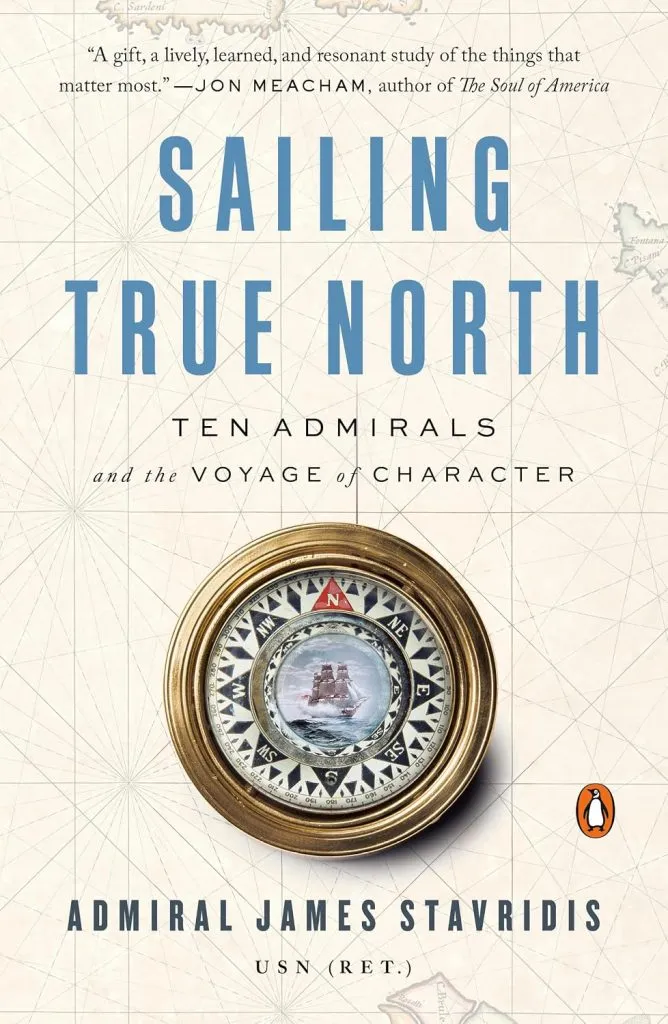
Retired Admiral James Stavridis profiles ten naval commanders across 2,500 years, from Themistocles to Grace Hopper, to show how character is built and lost. It’s a leadership book written through other people’s lives.
Most retired admirals write about themselves. James Stavridis wrote about ten other admirals, and put a good deal of himself in the margins.
Sailing True North came out from Penguin Press in October 2019. It’s a book about character, taught through biography.
What is Sailing True North about?
Each chapter profiles one naval commander. The list runs across roughly 2,500 years: Themistocles of Athens, the Chinese admiral Zheng He, Sir Francis Drake, Horatio Nelson, Alfred Thayer Mahan, Jacky Fisher, Chester Nimitz, Hyman Rickover, Elmo Zumwalt and Grace Hopper. Stavridis doesn’t write them as saints. Drake gets a chapter called “A Pirate and a Patriot,” and Rickover’s is “The Master of Anger.” What he’s after is how each of them built character, and where some of them fell short.
Between the portraits he reflects on his own 37 years in the Navy, from commanding a destroyer to running NATO’s military command. Those passages are short, and they’re what turn a history book into a leadership book. A closing chapter pulls out what the ten had in common: creativity, humility, empathy and the ability to decide.
The chapter titles tell you the angle. Themistocles gets “The Power of Persuasion.” Grace Hopper’s chapter is “Don’t Go Near the Water.” The last one, “Resilience and the Modern Admiral,” pulls the threads together.
Some of the best passages are small. He writes about the compassion Chester Nimitz showed the officer he replaced after Pearl Harbor, and about Elmo Zumwalt’s long fight for veterans exposed to Agent Orange. Shorter sections cover two modern officers he served alongside, Michelle Howard and Bill McRaven.
He calls it a book about character more than leadership, and it followed his earlier Sea Power from 2017.
Who is James Stavridis?
Stavridis graduated from the Naval Academy in 1976 and earned a doctorate from Tufts University’s Fletcher School. He commanded a destroyer and a carrier strike group, led U.S. Southern Command and served as NATO’s Supreme Allied Commander Europe from 2009 to 2013, the first Navy officer in that post. After retiring he became dean of the Fletcher School.
He has also worked as an NBC News international security analyst, as a vice chair at the Carlyle Group and, since 2021, as chair of the Rockefeller Foundation’s board. His other books include Sea Power and the novel 2034, written with Elliot Ackerman.
Kirkus called the book an earnest mix of biography, memoir and leadership lessons, good reading even if it breaks no new ground. The Naval Institute’s Proceedings was warmer, comparing it to David Brooks’s The Road to Character, though its reviewer wished Stockdale or Arleigh Burke had made the list. Time ran an excerpt when it came out.
Why does Sailing True North belong on this shelf?
It shows a third way to write a leadership book.
Memoirs tell your own story and manuals teach a method, and this one teaches through other people’s lives.
That approach suits a leader who’d rather not make himself the hero.
It also needs research, reading and patience. A writing partner can carry much of that load.
Writing about other people also sidesteps the toughest call in any memoir. The author decides how much of himself to show, chapter by chapter, and can always step back behind his subject. For a retired officer who reads history and dislikes the sound of his own voice on the page, it’s a model worth studying.
Keep reading
Hiring a ghostwriter for a retired general’s or admiral’s leadership book: how senior military leaders turn a career into a book, and what has to stay out.
Frequently Asked Questions
Other Books From – History