Latest
Profiles in CourageAmerican SoldierI, RobotA World at Arms: A Global History of World War IICampus BattlefieldTime for a Turning Point21 Days to Success with LinkedIn: Business Social Networking the Gnik Rowten WayLifeOpen: An AutobiographyDid I Ever Tell You This?: A MemoirBeneath a Scarlet SkyLove’s Executioner and Other Tales of PsychotherapyStranger in a Strange LandShattered Sword: The Untold Story of the Battle of MidwayThe Bell JarThe Phone Book: The Curious History of the Book That Everyone Uses But No One ReadsDesigning Casinos to Dominate the CompetitionTrump: The Art of the DealMasters of NetworkingNetworking Your Way to SuccessSoldier for Life: Leader Lessons from the 12th Sergeant Major of the ArmyThe Library BookFlorida Roadkill21 Days to Success Through Networking: The Life and Times of Gnik RowtenPodkayne of MarsRight Wing RevolutionThe MAGA DoctrineThe College ScamStop, in the Name of GodPa’anRadioThe Sage of SagittariusDoes Explicit Sex Sell Books? An Answer to The Absolute Degeneracy of Modern WritingThe Mary Sue: How a 1973 Star Trek Parody Became a Writing TermWhat the AI Writing Survey Says About Jobs, Freelancers and Fiction AuthorsHow Long Does Google Take? Crawling, Indexing and Recovery TimesLife of Pi50 Years of Duty: One Police Officer’s Compelling Journey from State Trooper to County SheriffBreaking Rank: A Top Cop’s Exposé of the Dark Side of American PolicingBlack in Blue: Lessons on Leadership, Breaking Barriers, and Racial ReconciliationCalled to Rise: A Life in Faithful Service to the Community That Made MeVigilance: My Life Serving America and Protecting Its Empire CityTurnaround: How America’s Top Cop Reversed the Crime EpidemicCollaborate or Perish! Reaching Across Boundaries in a Networked WorldThe Profession: A Memoir of Community, Race, and the Arc of Policing in AmericaSTEP-UP and LEAD: A Guide for Dynamic, Innovative Leadership in Law EnforcementStriving for Justice: A Black Sheriff in the Deep SouthThe Diagram GalleryGar Travis: A Tribute to One of the Best Faire PhotographersReverse Tropes: Six Ways to Turn a Tired Trope Inside Out
The Writing King Your Ethical Ghostwriter. Your Story, Done Right.

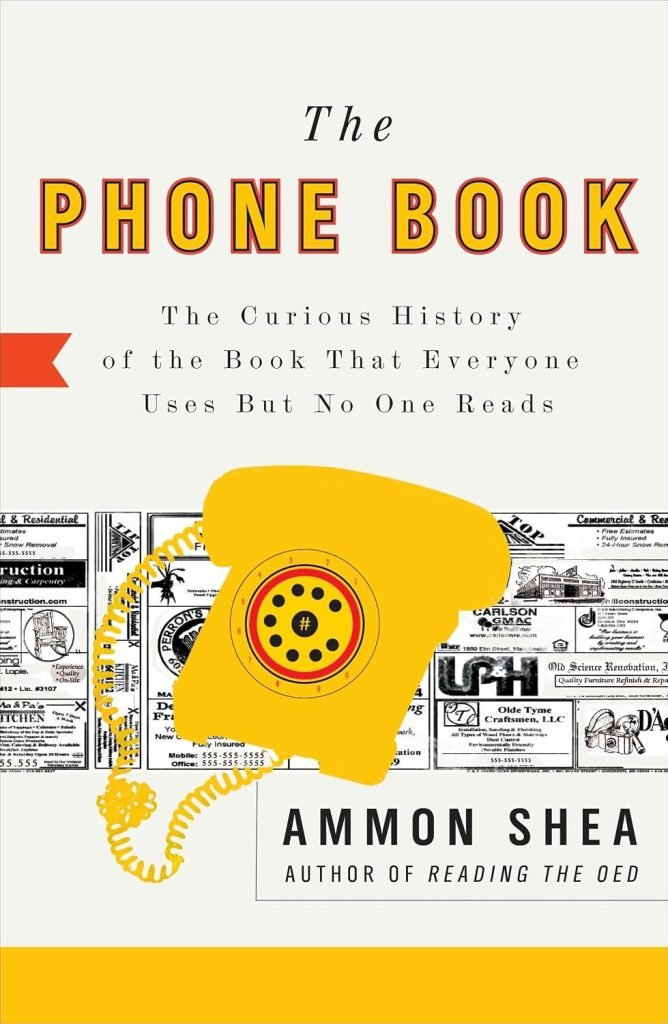
The Phone Book: The Curious History of the Book That Everyone Uses But No One Reads

The Phone Book: The Curious History of the Book That Everyone Uses But No One Reads

The Curious History of the Book That Everyone Uses But No One Reads

Author:Ammon Shea
Category:History
Publisher:Perigee
Published:October 5, 2010
ISBN:0399535934
Pages:240
ISBN:9780399535932
Language:English
Share:

Buy Now

Description:

TL;DR

Ammon Shea’s 2010 history of the telephone directory, from a fifty-name list in 1878 to the doorstop that landed on every porch. It’s short, funny and full of things nobody thought to ask about the phone book.

Ammon Shea once read the entire Oxford English Dictionary, all twenty volumes and more than twenty-one thousand pages, and wrote a book about it. Then he turned to a book with an even worse plot.

The phone book.

What is The Phone Book about?

The whole history of the directory. The first one, printed by the New Haven District Telephone Company in February 1878, listed fifty subscribers and had no numbers in it at all, because the operator knew everyone and you asked for people by name. A second New Haven directory followed within the year, carried advertising and was labeled Volume 1, Number 1. A copy of it sold at auction in 2008 for $170,500.

Growth came fast. American telephone subscribers went from 30,000 to 50,000 during 1880 alone, and by 1954 about sixty million directories were being printed every year. Shea covers Reuben H. Donnelley, whose firm became the biggest directory printer of the twentieth century and showed how much money there was in yellow-page ads, and AT&T’s 1961 campaign that told people to let their fingers do the walking.

The side stories are the fun part. San Francisco’s Chinatown had its own handwritten Chinese directory, and the operators there memorized the subscribers. Lawyers weren’t allowed to advertise in phone books until 1977. The semanticist S. I. Hayakawa fought the phone company’s move from named exchanges like PEnnsylvania 6-5000 to all-number dialing. Early directories even told people what to say when they picked up: hello.

Shea also covers the collectors, the artists who work with old directories, the strongmen who tore them in half on stage and the people who changed their names so they’d be listed first, or last.

He’s honest about one irony. When he wrote it, he didn’t have a listed number himself. The landline was in his wife’s name.

Who is Ammon Shea?

A writer and lexicographer who has worked as a consulting editor of American dictionaries for Oxford University Press. Before that he was a gondolier, a mover and a street musician. His books include Reading the OED, the account of his year with the dictionary, and Bad English, a history of the words and usages that annoy people. Perigee published The Phone Book in October 2010.

Why did phone books matter?

Being listed meant being findable. For a century, the directory was how you found a plumber, a doctor, an old friend or the business down the street. Being in it was a sign you’d arrived. Steve Martin built a whole comic scene around that in The Jerk, where seeing his own name in the new directory is the happiest moment of his life.

Then the internet arrived, the directories thinned out, and most cities stopped delivering them.

Why does The Phone Book belong on this shelf?

Writers of period fiction need these details. A character flipping through the white pages for a name, or tearing out a page so nobody else can find it, is a scene that only works in its era. Shea’s book is a handy reference for how directories worked and what they meant to the people who used them.

It’s also a good example of a writer finding a story in something everybody took for granted. Most of the best nonfiction starts that way.

Keep reading

Obsolete things in fiction: phone books, Rolodexes, card catalogs and the other vanished objects that still make good scenes.

Frequently Asked Questions

What is The Phone Book by Ammon Shea about?
The history of the telephone directory, from the first 1878 listing in New Haven to the mass-distributed phone books and Yellow Pages of the twentieth century.
How many names were in the first phone book?
About fifty. It was printed in New Haven, Connecticut, in 1878, and it contained no phone numbers.
What else has Ammon Shea written?
Reading the OED, about his year reading the Oxford English Dictionary, and Bad English, a history of disputed usage, plus two earlier books of unusual words with Peter Novobatzky.
When was The Phone Book published?
Perigee published it on October 5, 2010.
Why are phone books useful to fiction writers?
They anchor period scenes. Looking someone up, being unlisted or tearing out a page are actions that only make sense before the internet.
Are phone books still printed?
Far fewer are. Most areas stopped automatic delivery of white pages as online search replaced them.
Categories and tags

About the author

Ammon Shea

Ammon Shea is a writer and lexicographer who has worked as a consulting editor of American dictionaries for Oxford University Press. He read the entire Oxford English Dictionary for his book Reading the OED, and wrote The Phone Book and Bad English.

More about Ammon Shea

Back