TL;DR
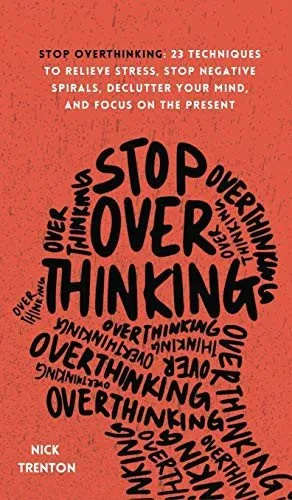
6/10. Twenty-three techniques for breaking the loop where the same thought goes round for an hour and produces nothing. Nothing here’s new if you’ve read in this area. If you haven’t, it’s an efficient place to start, and the mechanical tone is part of why it works.
Trenton’s framing is that overthinking is a habit and not a personality. That means it responds to technique. That distinction does more work than it looks like, because a person who believes they’re an overthinker by nature won’t try anything, and a person who believes they have a habit will.
The book identifies where rumination comes from, mostly a wish for certainty and a fear of the unknown, then works through interventions for interrupting it. Trenton holds a degree in economics and a master’s in behavioral psychology. That’s a modest credential and is disclosed and not inflated.
Books in this category mostly irritate me. They take a handful of ideas from cognitive therapy, pad them with anecdotes, and sell the result as a revelation. Trenton takes the ideas and skips the padding and the pretense, and for that restraint I like him more than several better-selling competitors.
What are the techniques in Stop Overthinking?
The standard toolkit, competently arranged.
Recognising triggers, meaning the situations and times of day where the spiral starts, which for most people is narrower than they assume.
Labelling the worry. That reduces its charge by moving it from a feeling to an object. Separating what you control from what you don’t. That’s Stoic and is here without the philosophy attached.
Scheduling worry into a fixed window. Attention-shifting exercises including sensory grounding. The 4A model for stressors: avoid, alter, accept, adapt. Journaling protocols. Some standard cognitive behavioral work on disputing an automatic thought.
None of it is invented and none of it is misrepresented as invented. That’s more than several better-selling books in this category manage. That modesty pleased me. Self-help authors rebrand old techniques as proprietary systems all the time, and Trenton just hands you the tools and tells you where they came from.
Watch: Stop Overthinking by Nick Trenton (Complete Book Summary), Dark Paint
What is the most useful technique in Stop Overthinking?
Scheduling worry, and it’s worth explaining because most readers skip past it.
The mechanism it works on is one most advice misses. The mind won’t drop a concern it believes is being ignored, and the harder you push a worry away the more insistently it returns, because from the inside suppression looks like neglect of something important.
Give it an appointment, a named time later today when you’ll sit down and deal with exactly this, and the transaction changes. The concern has been acknowledged and scheduled, and it’ll frequently let go until then. When the appointment arrives a good proportion of what seemed urgent has evaporated. That’s itself informative.
I’ve used this on a manuscript problem that wouldn’t leave me alone at two in the morning. Writing down that I’d deal with it at nine, on paper, next to the bed, works often enough to be worth the paper.
It fits the way my day already runs. I work in three blocks, client work in the morning, my own books in the afternoon, and client work again in the evening, and a worry that shows up in the wrong block gets a note and an appointment in the right one. Trenton didn’t invent the trick, and he’s smart to put it front and center.
Is anything in Stop Overthinking original?
No, and reviewers who know this territory report the same thing consistently: solid content, nothing groundbreaking, a bit mechanical and short on the narrative or philosophical depth that makes a book of this kind memorable. That matches my reading. It’s also a fair description of most books in a series, and this one sits in a line called The Path to Calm. It tells you something about how it was commissioned. Books produced to fill a series slot tend toward the competent middle. They have to be complete, they have to be similar to their siblings, and they can’t take a risk that would make one volume unlike the others. This one does exactly that and does it without pretending otherwise.
My reservation is that sameness. A book about getting out of your own head could use a little personality, and this one reads like it was assembled from a spec sheet. It works, and I never once felt a person on the other side of the page.
Who should read Stop Overthinking and who should not?
Read it if overthinking is a live problem right now and you haven’t read in this field. The organization is the value: you can find the technique you need without reading the whole book. That’s exactly right for somebody in the middle of the problem at eleven at night. Don’t read it if you’ve already read Goldsmith, or Clear, or any of the cognitive behavioral material, because you already have most of it in better form.
And be honest with yourself about the difference between rumination and something that needs a professional. This book is aimed at ordinary worry loops, it says so, and it’s not a substitute for treatment when the problem is larger than that. He’s right to draw that line, and more books in the genre should. A book that sells worksheets to someone who needs a doctor is running a nasty business, and Trenton refuses to run it.
Verdict
A manual, and a decent one. If overthinking is a live problem and you haven’t read in the area, this will give you a working set of tools quickly and without asking you to care about the author.
If you’ve read Goldsmith, Clear, or any of the cognitive behavioral material, you already have most of it. Take the worry-scheduling technique and skip the rest.
A six from me. It’s a clean, useful manual with no soul, and for somebody spiraling at eleven at night that might be exactly the right trade.
Explore further
The Psychology of Writing Hub: what drives creative work and what stops it.
Frequently Asked Questions
Other Books From – Self-Help