TL;DR
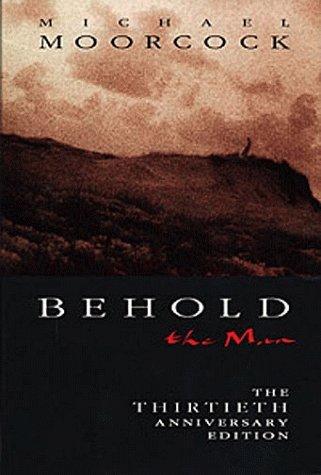
9/10. A modern man travels back to witness the crucifixion, discovers the historical Jesus can’t fulfill the role, and takes his place on the cross. Short, bleak, and the direct seed of my own novel Grim.
Karl Glogauer is a damaged man in 1970s London who gets into a time machine and goes back to AD 28 to see the thing his whole life has circled. What he finds isn’t the figure of the Gospels. The historical Jesus, in Moorcock’s telling, is incapable of being what history needs him to be, and Glogauer steps into the gap.
It began as a novella in New Worlds in 1966, won the Nebula Award for that length, and Moorcock expanded it into a novel three years later. That origin matters, because the compression of the shorter version is still in the book. Nothing here’s decorated.
I think this is the bravest short novel the New Wave produced, and I say that as someone who owes it a book. Moorcock took the most protected scene in Western storytelling and walked a broken man straight into it. The nerve of that still thrills me, and it’s matched by a discipline that keeps the book from turning into a stunt.
What is Behold the Man about?
On the surface it’s a time travel story with a single destination. Glogauer arrives in first-century Judea and is injured. Essenes take him in, and he goes looking for the family at Nazareth.
The novel alternates that search with his life in London: an unhappy childhood, a Jewish father and a mother who wasn’t, a series of failed relationships, a fascination with Jung and with the psychology of myth, and a general sense of a man who has never fitted anywhere he’s been.
The two timelines converge on a single question. That’s what a myth requires. Moorcock’s answer is that it requires somebody to fill the shape, and that whether a suitable person turns up is largely beside the point. History needed a figure at Golgotha. Glogauer is available.
The scene where he finds the actual Jesus is the moment the book turns and it’s deliberately, painfully anticlimactic. I won’t describe it, because how you meet it matters, and it’s the reason the ending works.
That anticlimax is the scene I’d defend against anybody. A lesser writer would have reached for shock or for reverence, and both would have been cheap. Moorcock gives you disappointment, and it’s a colder and truer feeling than either.
Watch: Behold the Man by Michael Moorcock | Vintage Science Fiction Review, News from the Gelding
What makes Behold the Man work as a novel?
The psychology. Glogauer isn’t a hero and the book never pretends he is. His trip backward is transparently an escape from a life he can’t manage, and the closer he gets to the role the less voluntary any of it looks. By the end you can’t separate the man who chose this from the man who was always going to end here.
Moorcock is drawing on Jung explicitly, and the London sections are as much about a man assembling a personal mythology as about anything that happened to him. That could be tiresome and it’s not, because he keeps it concrete. We see the relationships, the arguments, and the specific humiliations, and the theory stays underneath.
The other thing is the period atmosphere. First-century Judea is rendered as a dusty, violent, uninterested place where nobody is aware that anything significant is happening. Soldiers are bored. Crowds are mostly there for the spectacle. The refusal to make the setting complicit in the story’s importance gives the ending its weight.
The bored soldiers are my favorite thing in the book. Nobody at the foot of that hill knows they’re standing in the story, and that indifference moves me more than any amount of thunder and darkness would have.
Why did Behold the Man cause trouble?
Because it takes the central event of Christianity and makes it an accident produced by a neurotic Englishman.
It arrived in the middle of the New Wave, when British science fiction was deliberately breaking with the engineering-problem tradition and going after psychology, sexuality, and religion. Moorcock was editing New Worlds and pushing that shift, and this is one of the books people pointed at when they said the movement had gone too far.
Read now, it’s less shocking than its reputation and more serious. Moorcock is asking what a story of that magnitude demands from the people caught inside it, and answering that it demands everything and doesn’t much care who supplies it.
Anyone who calls it provocation is reacting to the premise and skipping the book. What’s on the page is a serious, almost grieving look at what a myth costs the people who carry it, and I find it more respectful of the material than plenty of pious novels that never dare to look at the crowd.
Where it landed for me
It stayed with me for years and eventually produced a book. I wanted my own story set on that hill, and the first scene I wrote for Grim was a man at Golgotha watching the crucifixion and then being killed and robbed by the Roman soldiers standing there. Everything else in that novel grew outward from that scene.
What Moorcock gave me was permission to treat the crucifixion as a place with people standing around in it, instead of an event that has to be handled reverently. That sounds small and it’s the whole difference. Once the hill is a location and not an icon, you can put a character on it and let them behave like a person.
The reaper came later, and the structure of Grim, which follows a death-attendant across the entire span of human existence, has nothing to do with Moorcock. The hill came from here.
What a writer takes from it
How to make an inevitable ending feel like a choice. Every reader knows within thirty pages where Glogauer is going. The book still generates tension, and it does it by making each individual step voluntary and ordinary, so that the destination arrives without anyone having decided to go there.
That’s a technique worth stealing for any historical fiction that touches a fixed point in the record. The record can’t move. What you control is whether the character walks toward it or is carried, and Moorcock does both at once.
This is the lesson I wish more historical novelists would steal. Too many of them treat the fixed point as a finish line and sprint the character toward it, and the reader feels shoved. Moorcock lets Glogauer drift, and the drift is what makes the ending hurt.
Verdict
Under two hundred pages and it does more with them than most novels three times the length. Not a comfortable read and not intended as one. If you write anything that touches history’s fixed points, study it for how it makes an inevitable ending feel like a decision. If you don’t, read it anyway for the Judea sections. They’re the best rendering of an ordinary day containing an enormous event that I know.
My one complaint is that the London chapters sometimes crowd the Judea ones, and I’d happily trade a failed relationship or two for more time on that dusty road. It’s a small grudge against a book I’d put on any serious writer’s shelf, and that it still unsettles me decades after it was written tells you how deep Moorcock cut.
Explore further
The Writing Hub: craft, technique, and the books worth learning from.