
A body left alone is a problem with an obvious practical solution. Move it away from where you sleep and let the ecosystem handle it. That’s what almost every other species does, and it costs nothing. Humans stopped doing that a very long time ago, and started doing something expensive instead.
Nothing else in the deep past moves me the way this does. Every other animal walks away from its dead, and our ancestors started spending on theirs long before farming or writing, at a price they could barely afford. I think anyone who calls that behavior primitive hasn’t done the arithmetic.
How long have humans buried their dead?
At least a hundred thousand years for clear intentional burial, and the number keeps being pushed back as sites are re-examined.
Qafzeh and Skhul in modern Israel have burials from around that period, some with grave goods including animal remains placed with the body. That’s the point at which burial stops being disposal and becomes a statement, because a jawbone placed in a grave does nothing for anybody.
Neanderthals buried their dead too, and this was contested for decades and is now widely accepted for at least some sites. Shanidar in Iraq, La Chapelle-aux-Saints in France, and others show bodies in deliberate positions in prepared spaces.
The famous claim about flowers at Shanidar, based on pollen in the soil, has been challenged on the grounds that burrowing rodents move pollen around. The burial is real and the flowers are unproven, and popular accounts that still tell the flower story as settled are sloppy.
Earlier claims go further back still and are more contested. What matters is the direction: every time the question is examined, the practice turns out to be older than the previous answer.
What did people spend on the dead?
Sungir is the site that makes this impossible to wave away. Roughly thirty-four thousand years ago, near modern Vladimir in Russia, an adult male and two children were buried with an extraordinary quantity of grave goods. The children were laid head to head in a single pit, and their grave alone held something over ten thousand mammoth ivory beads. Across all three burials the count exceeds thirteen thousand.
Experimental archaeology has been done on those beads. Estimates for producing one, using period technique, run from about forty-five minutes to an hour. The labor for the beads alone therefore exceeds ten thousand hours, buried in the ground with two children in a glacial climate by a population that lived at the edge of its food supply.
There were also ivory spears, carved figures, fox-tooth ornaments, and a headdress. None of it is useful. All of it represents work that could have gone into food, shelter, or clothing for the living. That’s the fact underneath everything else on this subject. The dead cost more than they’re worth, by any calculation available to a hunter-gatherer, and people paid anyway. Sungir is the site I come back to most. Two children in one pit, and somebody put more than ten thousand hours of carving into the ground with them, in a place where one bad winter could kill everyone. I can’t read those numbers without thinking about the people doing the work.
Why bury the dead at all?
Several explanations, and none of them is sufficient alone.
Hygiene and predators. True as far as it goes, and it explains disposal. It doesn’t explain beads.
Grief. Closer, and probably closest to the truth. A funeral is a mechanism for making an absence official, and the effort involved is part of how it works. Cheap rituals don’t do the job.
Belief about continuation. Grave goods are usually read as provision for a journey or an afterlife. This is the standard interpretation and it may well be right, but it’s an inference from objects. Nobody at Sungir left a statement of what they thought was happening.
Status. Elaborate burials mark the living as much as the dead. A family able to bury ten thousand hours of work is showing something to everyone watching.
My reading is that all four work at once and the proportions are unrecoverable. What’s recoverable is the behavior, and the behavior is universal. I don’t trust any account that picks one motive and throws out the rest, because it’s usually the writer’s own beliefs doing the picking.
How different are the practices?
Enormously, and the variety is the second interesting thing after the universality.
A funeral is a mechanism for making an absence official, and the effort involved is part of how it works.
Bodies have been buried extended, flexed, seated, and bound. Cremated and the ashes scattered, or kept. Exposed on platforms and towers for birds, which Zoroastrian practice formalized. Defleshed and the bones reburied. That’s secondary burial and turns up on every inhabited continent. Mummified deliberately in Egypt and in Chile, where the Chinchorro were doing it two thousand years before the Egyptians. Placed in caves, in mounds, in urns, under house floors, and in ships that were then buried or burned.
Some cultures ate portions of the dead. Some kept skulls in the home. Some removed the dead from all speech, so the name is never said again. Set any two of these side by side and they look like opposite responses. What they share is that all of them are expensive and all of them are rule-governed. Doing it wrong is a serious matter in every one of these systems.
What changed in the last two centuries?
More than in the preceding forty thousand years, and mostly in one direction: the dead moved out of the house.
For most of history the family washed and laid out the body, usually at home, and people who had known the person arranged the burial. Death was domestic, frequent, and visible, including to children, because it happened in the room where everyone lived.
Industrialisation and urban public health moved burial from churchyards to cemeteries outside the city. The American Civil War created a business in embalming, driven by the need to send bodies home. Undertaking professionalized. By the mid twentieth century in most Western countries the body left the house within hours and strangers handled it entirely until the funeral.
Cremation, rare in the West for centuries because of Christian objection, is now the majority choice in many countries. Natural burial is a small counter-movement in the other direction. The result is a population with the longest life expectancy in history and the least direct experience of death of any people who have ever lived. Most adults in wealthy countries have never seen a body outside a funeral home, and the practices that carried people through this for forty thousand years have been outsourced within about four generations.
Why write about prehistoric burial as a novel?
Grim began on a hill. The first scene I wrote was a man at Golgotha watching the crucifixion, then killed and robbed by the Roman soldiers on that hill.
It started because of another book. Years ago I read Michael Moorcock’s Behold the Man, in which a modern man travels back to witness the crucifixion, finds the historical Jesus can’t fulfill the role, and takes his place on the cross.
That novel stayed with me, and I wanted my own story set on that hill. It began as a short story about a witness there, a grieving man whose village suffers under plague and Roman taxes, who comes to the cross demanding to know why the righteous suffer and is killed for being in the wrong place.
The reaper came later, and he’s what connects the book to everything above.
Grim can’t take you and judge you until your body is completely gone.
The intact body anchors you in place. Until it’s fully decayed or been destroyed, you wait, and when it’s finally gone he judges you: you go on, or you stay. He doesn’t know where on leads. Nobody does, including him. Staying means being sent back to try again.
The unsettling part is what the anchoring implies, and it’s why the archaeology earlier in this piece is the working machinery of the book. A body destroyed at once, cremated or lost in a fire, releases you almost immediately.
A body decaying slowly on a ridge holds you for years, aware of every stage of it. And a pharaoh, mummified and sealed in a tomb with the body preserved for millennia, is anchored for millennia.
How your remains are treated decides how long your soul is held in place. Every burial practice in the record becomes, in that frame, a decision made about somebody by other people, and the book runs the full length of that spectrum.
The pharaohs are the consequence of that rule I can’t shake. Men who spent fortunes to be preserved forever end up with the longest wait of anyone, and the richest burials in history turn into the worst deal.
How do you write about death without sentiment?
The failure modes here are well worn and both are forms of flinching.
Sentimentality. Death made beautiful, meaningful, and a lesson. This is comfortable and false, and readers who have been near a death can feel the falseness immediately.
Nihilism. Death made meaningless as a pose. That’s the same avoidance from the other side. Insisting nothing matters is as much a way of not looking as insisting everything does.
The material itself points at the real position. Forty thousand years of people spending resources they couldn’t spare on rituals that changed nothing, in every culture, without contact between most of them. Whatever conclusion a writer reaches has to account for that behavior, because it’s the most consistently attested thing our species does.
The practical rule is the same one that governs the rest of this series. Write the physical particulars. What the ground was like.
How long the beads took. Who carried the body. What was said and what wasn’t. The meaning is the reader’s to assemble, and a book that assembles it for them has done the one thing this subject won’t tolerate.
My take
People have spent what they couldn’t spare on the dead for a hundred thousand years. That record should humble anyone writing about death. Ten thousand ivory beads at Sungir didn’t change a thing for those two children. Somebody made them anyway, an hour at a time. Skip the sentiment and skip the pose of nihilism. Write the ground, the beads and who carried the body, and let readers work out what it means.
What the record establishes
Strip out everything speculative and this remains.
For at least a hundred thousand years, humans and at least one closely related species have treated their dead as requiring something beyond disposal.
The practices vary so widely that no single behavior is shared. What’s shared is the expenditure. Everywhere, at every level of technology, people have spent time, materials, and food they needed on the dead, who couldn’t benefit.
Nobody has to accept anything metaphysical to accept this. It’s a fact about what human beings do, established across a longer span and a wider range of societies than almost any other claim about our species. Whatever we’re doing when someone dies, we’ve been doing it since before we had agriculture, writing, cities, or gods anyone would recognize. I find that more convincing than any theory offered to explain it, and anyone who writes the ritual off as superstition the modern world has outgrown is wrong.
The novel is Grim. The rest of the deep past work is collected in the deep past hub. The writing side of it is in how the book came together.
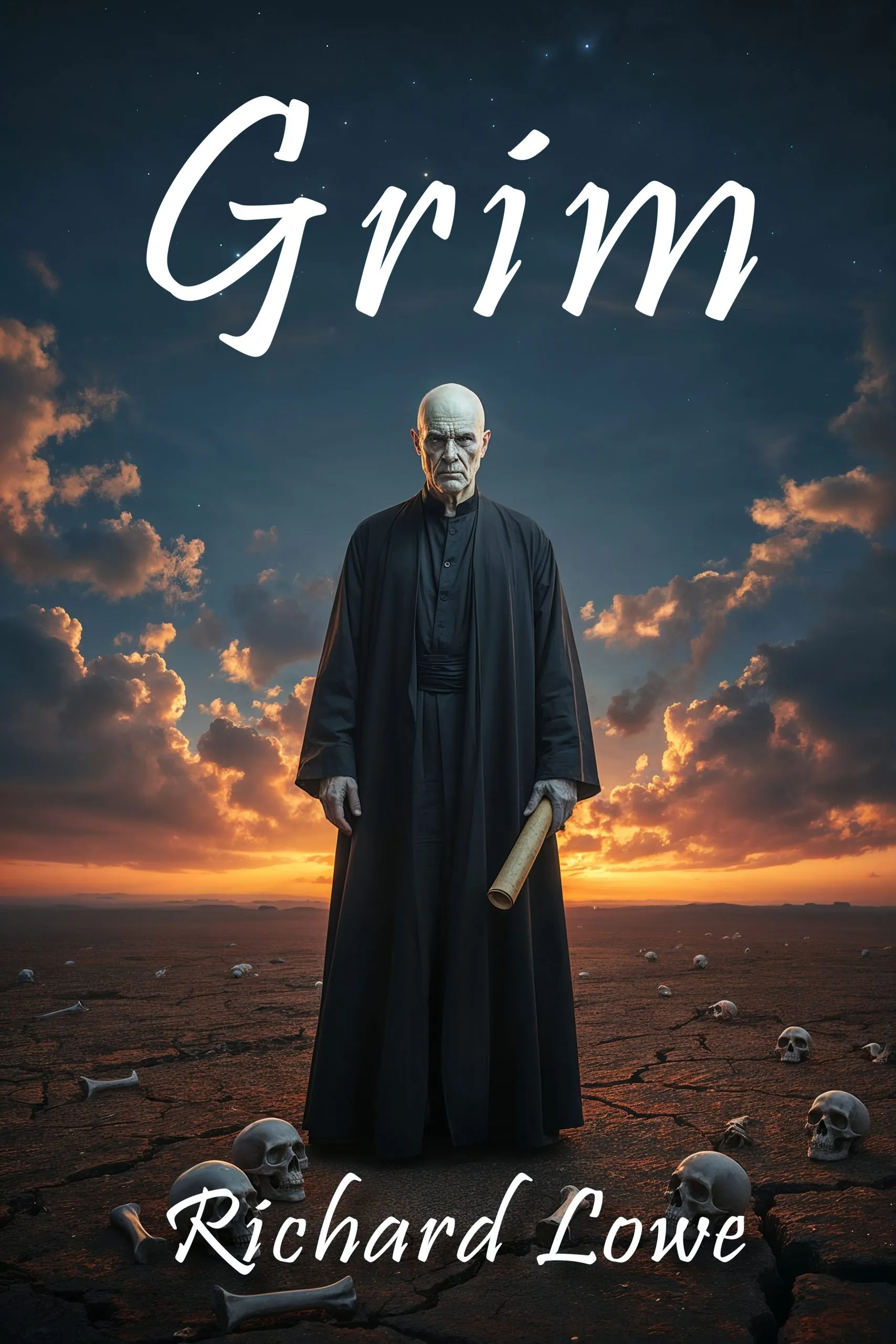
Grim has stood at the edge of human death for forty thousand years. My novel follows thirty-eight souls, starting with a Neanderthal hunter who fell through ice.
