
Grim
An evaluator with a scroll, and forty thousand years of human death
 |
He’s never asked where they go. He’s started watching. Standalone · 360 pages · First person, Grim · Adult content BUY FROM INGRAMSPARKAMAZONKOBOREAD A CHAPTERTABLE OF CONTENTS Paperback ISBN 978-1-972810-49-1 · ebook ISBN 978-1-972810-50-7 |
| 360Pages | 38Souls assessed | 40KYears on the job | 1Scroll |
I never found a word for what made me stay.
Grim, from the novel
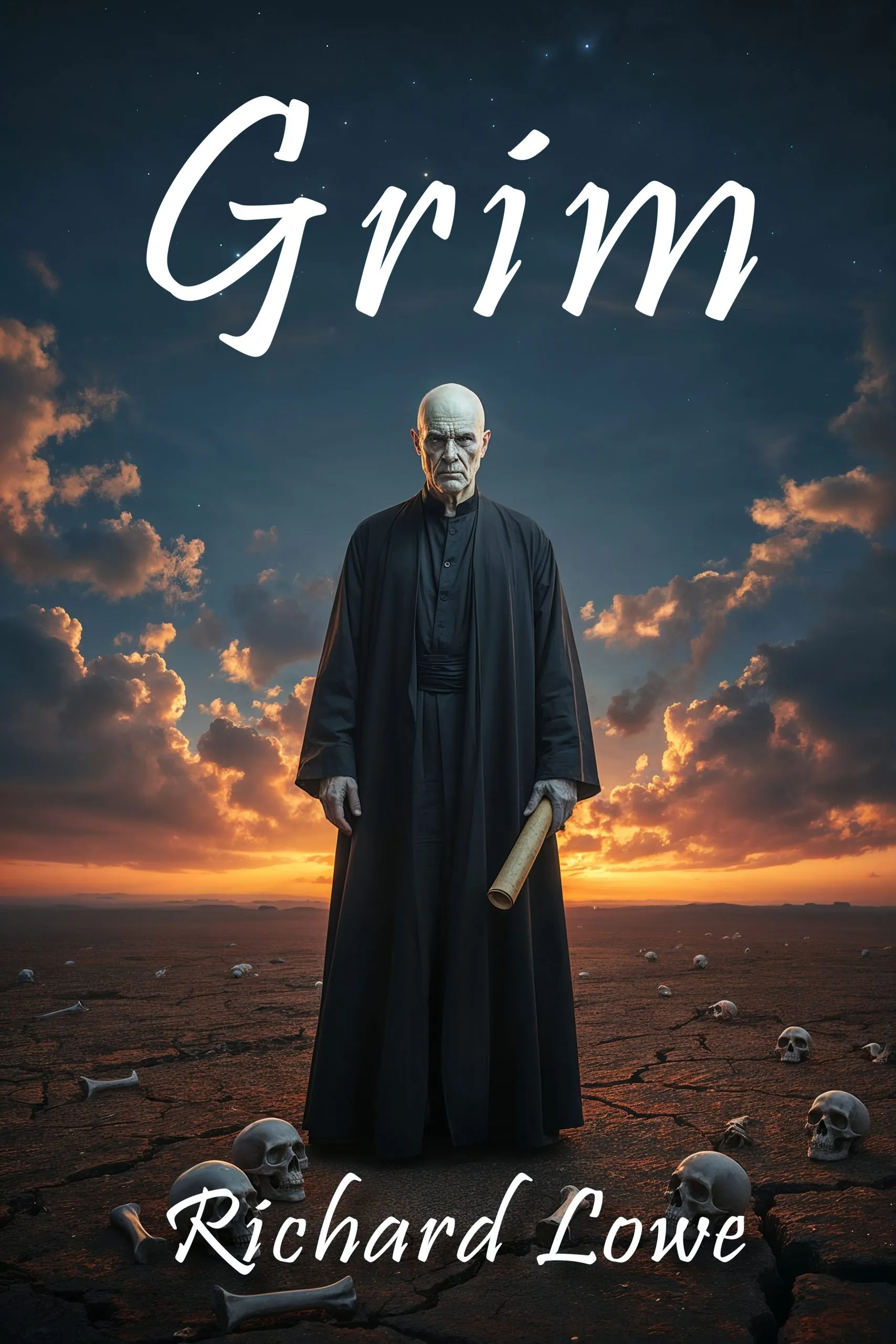
Grim is a functionary. He stands at the edge of a human life, opens his scroll and turns his wheel, and sends the dead on their way. He’s been doing this since before the first human word for death existed and the work has always been sufficient.
Thirty-eight souls, from a Neanderthal hunter who fell through ice and stayed aware through centuries of dissolution to the last person at the edge of the universe. Somewhere in there he stops taking the machinery on faith and looks at where the dead are going, and finds it’s not what he was told. The work continues anyway.
More on the real subject behind this book: a hundred thousand years of burying the dead, Sungir, Shanidar, and what people have spent on the dead.
Closer to Terry Pratchett’s Death than to horror, and darker than Pratchett ever went.
How does Grim open?
Hunter on the Ice
He’s to my left when we spread across the ice. He’s always been to my left. We have run together since we were boys at the edge of the group, too small to hunt, old enough to watch. I don’t think of him with a name. He’s just him, the specific him, the one whose throwing arm I know the way I know my own.
Eight of us. Four pairs. We build the fire small on the bank above the frozen lake, small enough that the smoke won’t carry to the animal before we are ready, and we pass the ochre around in a piece of folded hide and mark each other in pairs the way we always mark each other before a hunt.
My pair presses his palm against my chest and leaves the red there, over my heart, and I do the same to him, and we look at each other. Nothing needed saying. We have done this enough times that the doing is the saying.
The youngest gets the ochre on his chin instead of his cheek. The man beside him fixes it without making a thing of it. The youngest doesn’t know yet that this is kindness. He’ll learn. He’s still learning most things.
Then the dance. The same as always, the steps worn into us the way a path wears into ground. I lead because I lead everything. When it ends I can feel the group in my chest. We’re ready.
The mammoth is on the far side of the lake. I found it yesterday, old male, moving alone, slow with age and anger. I watched it for a long time before I came back to the group. I’ve been reading animals as long as I’ve been reading ice. I know where this animal will go and how fast and what it’ll do when it feels threatened.
Before we spread, I saw something at the far edge of the ice. A dark mark, too straight to be shadow, too large to be a crack. I made a note of it and didn’t think about it again. The mammoth moves the way I said it would move. I’m right about this. I’m right about everything until the moment my left foot goes through.
Not the deep ice, the edge ice, where the shore meets the lake, where I’ve crossed a thousand times and where the thickness is less than I read it this morning. I read it wrong this morning. This has never happened to me before.
The cold arrives before I have time to be surprised by it. It’s total, not cold the way the air is cold but cold the way the water is cold, which is every surface of the body at once, every boundary between the inside and the outside going the same direction at the same time.
My pair shouts my name. I hear it. I hear everything clearly. I can’t make my arms do what arms do in this situation. I’ve told others. I told a young man last winter. The instructions are correct. My arms don’t receive them.
The cold takes the breath. Not the way cold air takes the breath but the way the body stops agreeing to breathe when the cold is this complete. I’m aware of my pair on the ice above me. I’m aware of the sound the ice makes when someone is moving on it carefully. I’m aware that I read the ice wrong this morning.
I was the best reader in the group.
* * *
We spread across the ice the way we always spread, pairs on each flank, my pair and I at the front. The ice says solid under my feet, solid, solid, the old familiar language of it coming up through my soles and I trust it the way I trust my own hands.
I’m running when my left foot goes through.
Not far. Ankle deep, no more, and I’m out before the cold has finished arriving, the weight transferred, one stride broken into two wrong ones. Less than a breath. But I’m running and the mammoth is already turning and a broken stride at this distance is everything.
I stumble. Not down, not fully, but enough. The spear leaves my hand off-balance, the throw already decided by the body before the stumble, going wide of where I needed it.
The mammoth is on top of me.
The tusk finds me in the side. The impact isn’t like anything I have a comparison for, the force of it transferring through me in less than a breath, and then I’m on the ice and the animal is past me and the sky is above me the color of old bone.
I breathe. The air goes in but not far enough, stops somewhere in the middle of my chest where something is no longer the right shape. I try again. Same result. My hand finds my side and what it finds there’s wet and hot and the wrong temperature for the outside of a body.
I know what this is. I’ve put my hands on animals with this kind of damage. I know exactly what my hand is telling me and I lie still with it because lying still is the only thing left that I can choose.
The cold from the wet foot moves through me. It meets the damage in the middle and the two things together change the quality of the pain, make it distant. Distant is the last thing before gone.
The chapter keeps going.
Who should read Grim?
|
Read it if
|
Not for you if
|
► Behind the Book: Grim
How this one got written, what went wrong, and what got cut.
How did Grim come about?
Richard Lowe, the Writing King
The job came first. Give death a functionary with a scroll and a wheel and a territory, put him on the ice with a Neanderthal hunter forty thousand years ago, and let him work.
The interesting part isn’t the dying. It’s that he’s never once asked where they go after he sends them, because asking isn’t in the procedure and the procedure has always been sufficient.
Thirty-eight souls, each one a complete life ending, arranged so the weight accumulates. Some of those chapters are as hard as anything I’ve written. They’re in there because leaving them out would have made the book a lie.
What do people ask about Grim?
Also in What the Dead Leave
|
He doesn’t think of himself as a ghost hunter. He corrects errors. |
A memoir, told by the cat who was paying the most attention |
He does not question the machinery
That held for a very long time.
BUY FROM INGRAMSPARKAMAZONKOBOREAD A CHAPTERTABLE OF CONTENTS
Paperback and ebook.
The Physician’s Daughter
Grim
“Hold still,” I said. “I know it hurts. Hold still anyway.”
The man, his name was Yosef, he’d told me twice, as if the name might help, had a forearm broken in two places where the stone had come down on it. I’d seen this before. My father had shown me how to set it before he showed me most other things, because broken arms were common and needed doing quickly before the swelling made it worse.
“My father was hurt like this,” I said, talking because people held still better when there was something to listen to. “He set it himself. Said it was the only time in his life he was glad to know what he knew.”
“Is he…” Yosef started, and then his breath went out of him as I worked the bone back to where it needed to be.
“He died three months ago,” I said. “His heart. He’d known for two years and hadn’t told me.” She finished the setting and began wrapping. “He thought I’d worry.”
“Would you have?”
“Yes,” I said. “But I would have worried while he was still alive to argue with, which is better.”
Yosef laughed, which was unexpected, and then caught himself. The movement had shifted the arm.
“Don’t,” I said. “Hold still.”
I tied off the wrapping. Outside the courtyard walls the sounds of the siege continued. I’d stopped hearing them the way I’d stopped hearing my own heartbeat, but they were always there, and occasionally something in them changed and my body registered the change before my mind did.
“Will it heal?” Yosef said.
“If you rest it and keep it clean and don’t do anything foolish with it for six weeks. Which in these circumstances,” She stopped. No point finishing the sentence. Both of them understood what the circumstances were.
“My name was Miriam,” I said. I didn’t know why I said it that way, with the was. “My father was a physician. He taught me by letting me be in the room when it happened, and when he died I kept working because no one else knew what I knew and the work didn’t stop.”
“You’re good at it,” Yosef said.
“I know,” I said. Not pride. Just true.
I was twenty-seven years old. I had been frightened most of the time since the siege began and exhausted all of the time and there were days I hated the people I was helping for needing so much help. I kept working because stopping felt worse than continuing.
The wall came down.
The sound arrived before the weight did, a low percussion moving through stone, and my body registered it before my mind understood it. I had time to turn my head. Not enough time.
Limestone dust filled the air before the stones arrived. The dust tasted of old walls and mortar and a thousand years of this city. I breathed it in. I was breathing it in when the first stone hit.
The weight arrived in sequence. The first stones took what they took. Then more. My body received them in the order they came. Between the first and the last I was aware of Yosef’s arm somewhere near me, the arm I’d just set, the six weeks he’d need if he rested it.
The circumstances didn’t allow.
The pain wasn’t what I’d trained myself to expect. In four months of working the rooms where pain was I’d categorized many of its gradations. What arrived was before pain, or perhaps pain had arrived and no capacity remained to receive it as pain.
Still light. Orange, sideways, afternoon light of Jerusalem in July coming through the gap where the wall had been. I’d worked in this courtyard for four months and I hadn’t looked at the light once. I looked at it now.
The sentence was still in my mouth. I didn’t know what it had been going to say.
I rose above the rubble. The courtyard was below me, the stones, the figures underneath them, Yosef’s arm at the wrong angle. I saw myself.
I had been frightened for four months. The frightened stopped first.
The light continued through the gap.
The light continued.
The flies find us within the first hour. Jerusalem in July has those flies, heavy, purposeful, experienced. I spent four months working around them in the rooms where the wounded were. I know exactly what they’re doing now.
Table of contents
Grim
- Hunter on the Ice
- The Watcher on the Hill
- The Heart
- The First Breath
- The Weight of Heaven
- The Field
- The Physician’s Daughter
- The Iron
- The Chariot
- The Decision
- The God King
- The Taiga
- The Silk Road
- The Conquistador
- The Viking Shore
- The Grass
- The Plague Cart
- The Hold
- The Gardener
- The Astronomer
- The Revolutionary
- The Factory Child
- The Mud
- The Number
- The Cartographer
- The Between
- The Cauldron
- The Unnamed
- The Stake
- The Comfort Woman
- The Fast One
- The Collector
- The Scientist
- The Minister
- The Administrator
- The Threshold
- The Climate
- The Upload
- The Station
- The Machine Mind
- The Door
- The Reunion
- The Voice
- The Watcher on the Threshold
- The Work