
Most business books are lectures.
The author stands at the front of the room for two hundred pages and explains things, with a few thin examples tossed in to keep you awake, and the reader’s attention dies somewhere around chapter three. If you’re writing a business book, I’d bet two formats never crossed your mind. Both of them beat the lecture for the right book: the business novel and the companion workbook.
Picture a rookie cop. He can sit through a class on traffic stops, or he can spend a shift in the passenger seat of a squad car watching a veteran do the job, and he’ll remember the shift long after he’s forgotten the class. Which one would you rather learn from? A business novel is the ride-along. The workbook comes after, when the rookie finally gets the keys.
What is a business novel?
A business novel teaches a business idea through a story with characters, a plot and a deadline. The reader watches people struggle with a problem, make mistakes and figure it out, and the lesson rides along inside the story.
The best-known modern example is The Phoenix Project by Gene Kim, Kevin Behr and George Spafford, first published in 2013. Its hero is Bill, an IT manager at a company called Parts Unlimited. He’s handed a project that’s massively over budget and behind schedule, and the boss gives him 90 days to fix the mess or his whole department gets outsourced. Over the course of the book he learns that IT work has more in common with a manufacturing plant than he ever imagined.
Nobody gives a lecture on DevOps. You just watch Bill sweat his way through the problem, one bad day at a time.
And the book sells. The publisher’s own description says it has passed half a million copies (as of 2026), and a sequel, The Unicorn Project, followed in 2019. The paperback runs 432 pages. I’d guess that’s somewhere around 80,000 to 90,000 words, long for a business book, but it reads fast because it’s a novel.
Watch: Why writing a book is important when selling to the affluent, Mark Satterfield
Why I like the Phoenix Project format
I like this format a lot.
It’s fun to write and it’s fun to read, and it gets the point across because you’re following people through the problem. When you’ve watched a character fail at something, you remember why he failed. Nobody remembers a bullet point about failure.
Most coaching books I’ve read are plain narrative. They mention stories, but the stories are minor vignettes, a paragraph about a client here and a sentence about a CEO there, and then it’s back to the lecture. Those books bore me, and I suspect they bore most of the people who buy them.
Ghostwriting brought me to the format. One of my early projects, back around 2014, was a business book written as a novel, and the client wanted it done in the Phoenix Project style. So I read the Phoenix Project, because I had to know what he was asking for.
Then the client changed careers, and the book was never finished.
I hated losing that one.
There aren’t many books written this way. If you’re willing to try one, that gap works in your favor. Walk into the business section of a bookstore and count the novels on the shelf. You won’t need both hands.
Where the business novel came from
The Phoenix Project wasn’t the first.
Its authors have said openly that they wrote it as an homage to The Goal, Eliyahu Goldratt’s 1984 novel about a plant manager trying to save his factory. Goldratt used a story to teach his theory of constraints, and the book became standard reading in operations courses for decades. Kim and his co-authors took the same idea and moved it from the factory floor into the IT department, where plenty of readers had been living Bill’s nightmare for years without a book that described it.
Patrick Lencioni built a career on the same move. The Five Dysfunctions of a Team, published in 2002, is a leadership fable about a new CEO and a dysfunctional executive team, followed by a short section that lays out the model. Fables and parables have been teaching people for thousands of years. Business publishing forgot that for a while and buried readers under dry lectures, and the authors who remembered sold a lot of books.
When does a business novel work better than a standard business book?
Business novels work best when the lesson is about how people behave under pressure. Leadership, team dysfunction, a failing project, a turnaround, a culture rotting from the top: those are human problems, and readers learn them better by watching humans deal with them. The Phoenix Project lands with leaders because every one of them has lived through a version of Bill’s bad quarter.
It works badly for reference material. Got a tax guide in mind? Nobody wants to wade through a plot to find the tax rule they need on page 140. Bury that rule under a plot and I’d want to throw the book across the room.
Think of nonfiction formats this way. Narrative format is what you see in most business books, and it just talks about the subject. Academic format gets into the nitty gritty and goes too deep for most business readers. A novel tends to get read once and thrown away, while people keep a narrative book on the desk and refer to it over and over. If you want a big splash, write the novel. If you want to stay on their desk, go narrative.
Your reader matters too. An executive who reads on planes will happily follow a story for three hours, while a busy owner who wants the answer in ten minutes won’t. If you already speak or train, a novel gives you characters and scenes you can use on stage, and most authors never consider that bonus. I’ve written separately about turning a book into courses, talks and posts, and a story-driven book feeds all three.
Count the cost before you commit. A business novel needs characters who feel like people, a plot that builds, and dialogue that doesn’t sound like a press release. Those are fiction skills, and plenty of brilliant executives don’t have them. If you don’t either, that’s fine. You can hire somebody who writes characters that feel real, the same way you’d hire an accountant to do your taxes.
A lecture tells you how the job works. A business novel lets you ride along while somebody does it. – Richard LoweShare on X
How do you structure a business novel?
You have two choices, fully novelized or a hybrid.
The Phoenix Project is fully novelized. The story carries everything, and the lessons come out of what the characters say and do. That’s the purest form and the hardest to write, because every idea you want to teach has to show up as an event in the plot. If a lesson can’t be dramatized, it doesn’t make it into the book.
My favorite is a variation on that. Open each chapter with a couple of paragraphs of plain narrative that introduce what the reader is about to see. Then run the novel for the bulk of the chapter, at least half of it, more if the story needs room. Close the chapter with another couple of paragraphs that tie it up and ask what lessons should be learned from what just happened. Your reader gets the story and the takeaway, and anyone skimming can read the bookends and still come away with something useful.
Hybrids are easier to outline, too. Each chapter maps to one lesson, and the story beats line up behind them. If you’ve already worked out how to structure a thought leadership book, the bones are the same; you’re dressing them in scenes.
Not sure which one fits? Write the first chapter both ways, only a few pages of each, and read them side by side. You’ll know in about ten minutes which one sounds like your book. It costs a day of writing and saves you from committing two hundred pages to the wrong voice.
Pick a cast you can live with. One protagonist is easier for your reader to follow, and the Phoenix Project mostly stays with Bill. A wider cast lets you show different departments, cultures and points of view rubbing against each other, but every extra character is one more name the reader has to track. Keep your plot simple, because a twisty thriller plot will bury your lesson.
Should a business book have a companion workbook?
Some should, and most authors never ask the question. A workbook gives your reader exercises, worksheets, prompts and space to write, chapter by chapter, so they can apply what you taught them to their own business. A reader who fills in forty pages of a workbook has done something with your ideas. That reader remembers you.
Sell it separately. Don’t bundle it into the back of the main book.
A separate workbook is its own product with its own listing and its own price, and it gives anyone who loved your book a second thing to buy from you. If you coach, consult or train, you’ll get the most out of this, because the workbook becomes the handout for every workshop you run. It also turns a single book into a small product line, the kind of business I write about in Make a Living as a Self-Published Author.
A workbook is a bad idea when the book has nothing to practice. A memoir doesn’t need one, and neither does a book of opinions about your industry. If you can’t write at least one real exercise for every chapter, skip it, because a workbook padded with blank lines and inspirational quotes insults the reader who paid for it.
I hate those.
Build the workbook alongside the book
You can write the workbook as you go or do it at the end. Either way it’s a separate project, with its own schedule and its own budget, and you should plan it that way from the start.
A workbook is a bad idea when the book has nothing to practice.
Build it as you go and the two stay in step. Each chapter of the book becomes a chapter in the workbook, so the two line up and lead right into each other, and the exercises get written while the chapter is fresh in your head. When you finish chapter four, you sit down and ask what a reader should do with chapter four. Right then, the exercises are obvious. Six months later you’ll be rereading your own manuscript to remember what you meant.
If you wait until the end, you get one advantage. You know exactly what the finished book says, so nothing in the workbook points at a section that got cut in revision. If you build as you go, budget a cleanup pass after the manuscript is final to catch those orphans.
Decide in the first month which way you’re going. Do you want to discover halfway through the manuscript that everybody assumed the workbook would appear by magic at the end? I don’t.
Is Lulu a good printer for a spiral-bound workbook?
For the binding, yes. I recommend a spiral-bound workbook that lies flat, and Lulu is a print-on-demand company that does coil binding well.
A workbook that snaps shut every time you put your pen down drives people crazy. In 2024 I found few printers that did spiral binding at all. For a workbook, it’s really cool.
Check the distribution before you commit, though. As of 2026, Lulu says coil-bound books aren’t eligible for its retail distribution, because Amazon, Ingram and most other distributors won’t handle that format. You can sell a coil-bound workbook through Lulu’s own bookstore, through your website with Lulu Direct and a Shopify or WooCommerce integration, or by listing it on Amazon as a merchant seller, ordering copies and shipping the orders yourself.
If you want the workbook on Amazon with no fuss, publish a perfect-bound paperback edition too, and let the spiral version live on your own site and at your workshops. My main books go out through IngramSpark, and a paperback workbook can go the same way.
Print it in black and white or grayscale.
Color printing raises the cost of every copy, and the cost goes straight into the retail price. Your readers will pay a reasonable price for a workbook. Nobody wants to pay a color-printing price for a book they’re going to scribble in with a ballpoint.
Plan the art for the workbook early
If you’re doing a workbook, you want artwork. It makes the thing fun to build and fun to use, and it needs planning from the first month.
I don’t do artwork.
With the tools I have, I can build simple flowcharts and diagrams, and a lot of workbook art is exactly that: a decision tree, a two-by-two grid, a timeline with blanks to fill in. For anything more, hire an illustrator, and quote it as its own small project so it doesn’t surprise anybody on the invoice.
AI image tools can help you sketch an idea, but most of what they produce is crap for a printed book. Ask one for a picture of a person and you get somebody with eight fingers on each hand, wrapped in ways that look like the hand got broken. Put that in a workbook and your reader will notice before they notice anything you wrote. Keep the art simple, in grayscale, and check every image at print size.
My take
Consider the business novel before you write another lecture. The Phoenix Project teaches by putting the reader inside a crisis. A crisis sticks better than a list of principles. A companion workbook gives readers something to do with what they learned. Build it chapter by chapter with the book, print it in black and white, and plan the art early. Keep the art simple, because most AI images are crap in print.
Pick the format before you write chapter one
Format is the decision authors skip, and I’d make it first.
Plenty of business books don’t work for reasons that have nothing to do with the ideas inside them. The author picked the default format without thinking, and the default is a lecture. Ask yourself whether your idea would teach better as a story about people under pressure. Ask whether your readers would turn into clients after filling in a workbook with your name on the cover. Both formats cost more time up front, and both deserve a conversation before the outline gets locked.
You’ll find the rest of what goes into a business or executive book on the ghostwriting hub, and my executive ghostwriting process explains how I work with leaders who want a book that gets read. I’m sick of business books that lecture at people. Put your reader in the passenger seat, let them watch somebody do the job, and then hand them the keys.
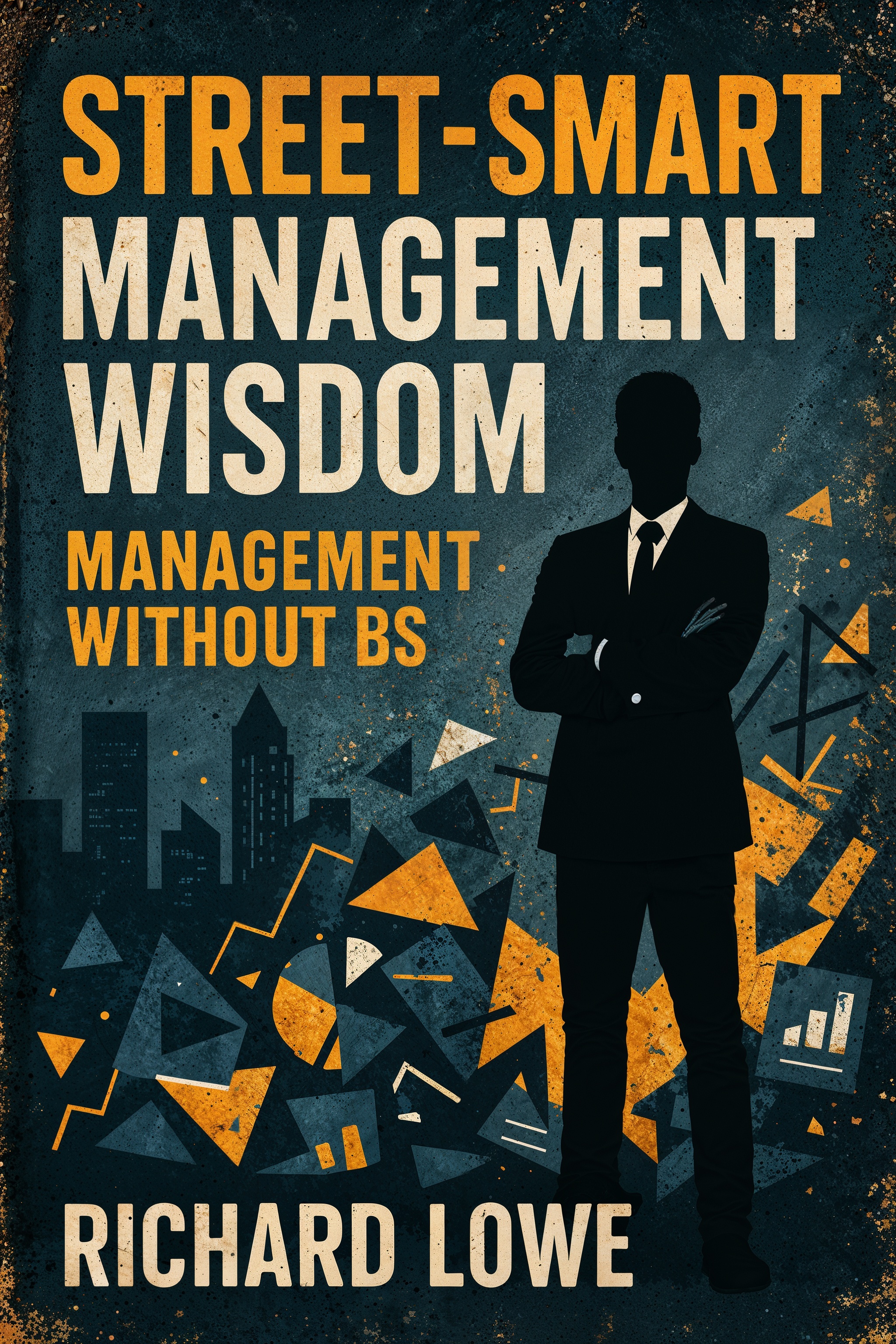
Street-Smart Management Wisdom is my own management book told through three managers you follow across fourteen chapters. It shows the story format working on business lessons.
