
What does a business book change for its author?
I want every executive with real expertise to write a business book, because I’ve seen what one does for its author. A client’s book raised $30 million in venture capital. Others brought in consulting contracts, speaking invitations, courses and a promotion. I tell every client they’re very unlikely to earn the money back through book sales. The return comes from using the book as the foundation of their marketing.
From the podcast
Jeff Hassemer describes what changed about buyers, and why the material has to do the work long before any conversation, on Leaders and Their Stories:
Buyers don’t want to talk to a salesperson until they’re ready to buy.By the time a prospect calls you, they have already decided. A book is what they read while deciding.I learned this with my own work first. Purdue used my consulting book as a course textbook four years in a row, and it kept working for me long after I’d stopped thinking about it. A good business book does that for anybody who writes one.
As an entrepreneur or consultant, the most effective way to establish authority in your field is to publish a book.Share on X
- Establish yourself as the foremost expert in your domain, because you literally wrote the book on the topic
- Attract higher-caliber clients who arrive pre-sold on your expertise
- Secure keynote speaking engagements and charge higher fees for them
- Build a foundation for TED and TEDx talks
- Develop online courses using your book as the core resource
- Capture media attention and press coverage
- Translate chapters into structured seminars and workshops
- Provide a platform for launching new business ventures
- Secure venture capital and funding by proving credibility
These aren’t hypothetical benefits. Several of my ghostwriting clients have used their books to raise over $30 million in venture capital. Others have received TEDx speaking invitations directly because of their published work. My own consulting book was adopted for coursework at Purdue University. Another hit bestseller status and parlayed it into a traditional publishing deal. For more, see why ghostwriting costs what it does. The book is the tool that makes everything else possible.
Why haven’t you written your business book yet?
Plenty of executives keep promising themselves they’ll write it next quarter. Others can’t write it in English at all, and clients with limited or no written English are one of the main reasons I’m hired. Neither a full calendar nor a second language is a good reason to leave your expertise locked in your head while a competitor with half your knowledge publishes first.
Writing a book requires sustained focus, expert storytelling, strong editing skills, research, and discipline. It takes hundreds of hours from first interview to finished manuscript. If your time is worth hundreds or thousands of dollars per hour, those are hours you can’t afford to spend writing when you should be running your business. That’s the practical case for hiring a ghostwriter. It’s a strategic decision that protects your time while ensuring the book is written at a professional level by someone who does this for a living. I write 10,000 to 12,000 words a day. I have ghostwritten 54+ books, and my clients have published 113+ books total. You can find current ghostwriting pricing on the ghostwriting page.
What Does a Business Book Ghostwriter Do?
I want every executive with real expertise to write a business book, because I’ve seen what one does for its author.
My job is to pull the frameworks out of your head and get them on paper in your voice. After every interview I make a summary document from the transcript with AI’s help and send it to you, so you can watch your own thinking take shape. AI is my digital assistant every day. I still write the book myself, and I’d be wary of any writer who can’t say the same.
A ghostwriter isn’t a typist who writes down what you say. A good ghostwriter is a strategic partner who understands how publishing drives business growth. The right ghostwriter knows the correct questions to ask to extract the stories, insights, and expertise that make your book unique. They capture your voice through interviews so the book sounds like you. They understand book structure, narrative arc, and how to organize your experience into chapters that keep readers engaged from beginning to end. What to look for:
- Business strategy understanding: Your ghostwriter should know how to use your book to achieve specific business outcomes, not just produce a manuscript
- Interview skills: The book’s authenticity depends on the ghostwriter’s ability to draw out your stories and replicate your voice through structured interviews
- Publishing knowledge: Whether you self-publish or pursue traditional publishing, your ghostwriter should understand the territory and guide you through it
- Marketing awareness: The whole purpose of a business book is to use it as a tool to market yourself, your products and services, and your business
- Professionalism and reliability: Deadlines met, communication clear, project managed efficiently from start to finish
How does the business book ghostwriting process work?
Hard deadlines are common in this work: a conference, a birthday, a startup launch that can’t move.
The fastest I’ve delivered was an 80,000-word communications book in three months. A rush like that carries a higher rate, because for those months you become one of my only clients. I tell people that on the first call so nobody’s surprised when the launch date shows up.
The process from first conversation to finished manuscript typically takes 8 to 12 months, in these stages:
- Initial alignment: We discuss the book’s objective, core message, and target audience through a series of Zoom interviews. This is where we define what the book needs to accomplish for your business.
- Outline and first chapter: After you approve a detailed outline, I write the first chapter. Your review ensures it matches your voice, style, and tone. Every later chapter is written to match.
- Structured interviews and chapter development: Regular interviews capture your insights, stories, and expertise. Each chapter is developed from these conversations.
- Review and revision: You review each chapter as it is delivered. Feedback-driven revisions ensure the content fits your vision before we move forward.
- Final manuscript: Delivery of a polished manuscript ready for professional editing.
- Managing the full process: A book is more than words. I help you get everything completed, often coordinating freelance professionals for editing, book cover design, self-publishing setup, author bios, book descriptions, PR, and social media.
- Optional: book proposal: If you plan to pursue traditional publishing, a professional book proposal is essential. This is a specialized skill that should be handled by your ghostwriter.
Post-publication support includes help with marketing strategy, content repurposing, speaking engagement preparation, and maintaining momentum after launch.
The business-book ghostwriting process
Strategy call
Define the book’s goal, audience, and business purpose.
Interviews
Capture your structures, stories, and expertise.
Outline
Map the argument so it builds chapter to chapter.
Writing
Draft in your voice, delivered chapter by chapter.
Revisions
Refine together until it reads exactly like you.
Publish
Manuscript, bio, and description ready to launch.
My take
Treat your business book as a marketing tool first and a book second, and build it that way from the first call. Plan on 8 to 12 months. If you have a hard date like a conference or a launch, say so up front, because a rush changes how the whole project runs. Approve the outline and the first chapter before the rest gets written. Every chapter after that matches the first one, so take your time on it.
How do you start a business book with a ghostwriter?
Start with one conversation about what the book is supposed to do for your business, and let everything else follow from that answer. An executive who waits five years and then watches a competitor with thinner expertise publish the book buyers read while they’re deciding pays for it. The knowledge was theirs, and the credibility went to whoever showed up first.
If you’re considering a business book, the next step is a conversation. No commitment, no pressure. We talk about your goals, your expertise, and whether a book is the right move for your business. Schedule a free consultation
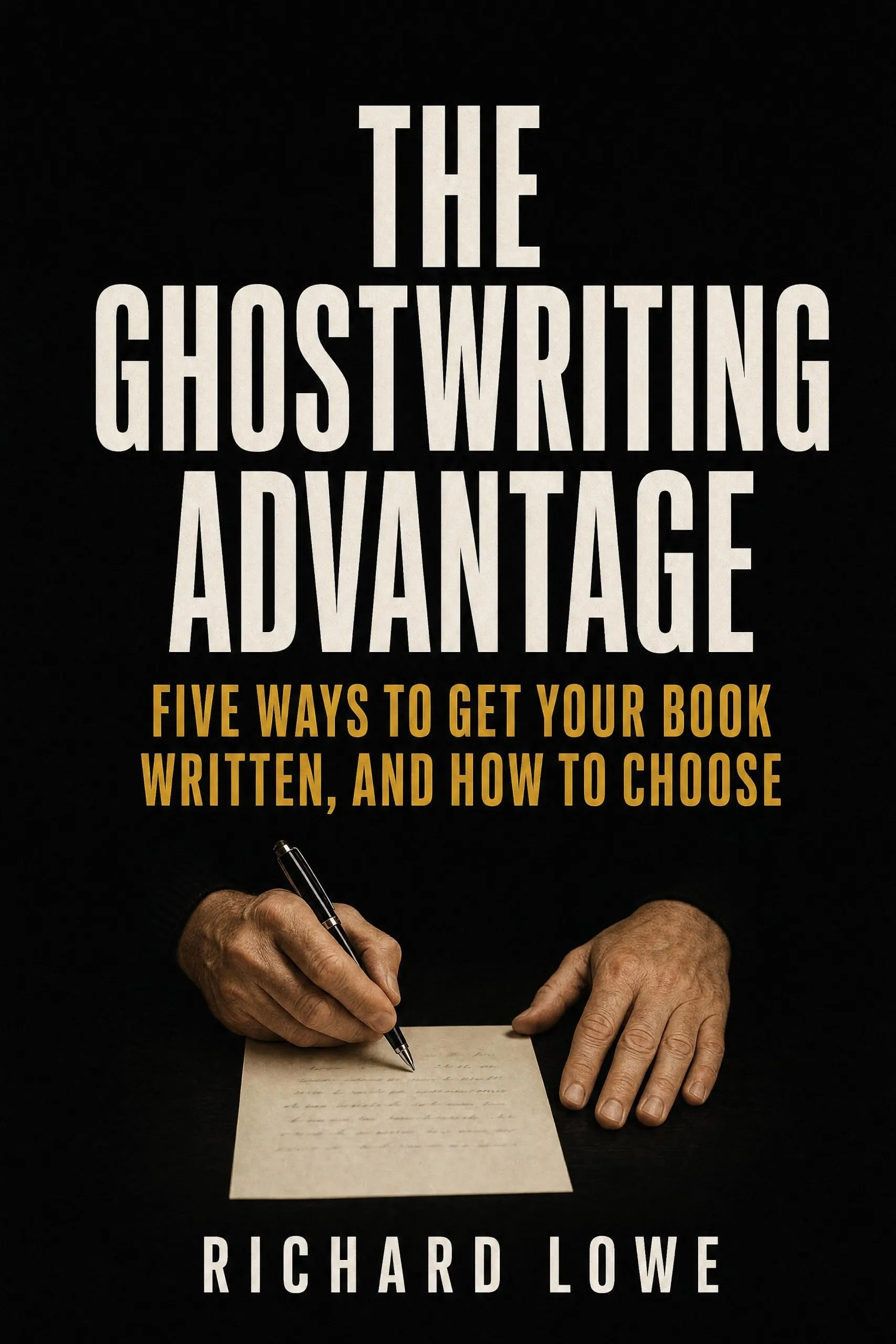
Executives weighing a business book can see how the work gets done in The Ghostwriting Advantage, drawn from the 54+ books I’ve ghostwritten for people with expertise and no time to write.
Frequently Asked Questions
For current rates and what drives them, see the full pricing guide: What Does a Ghostwriter Cost?



