TL;DR
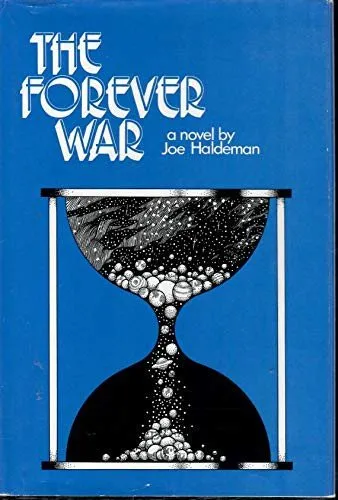
7/10. A soldier fights an interstellar war where relativity means every tour costs him centuries at home. The best novel ever written about coming back to a world that’s moved on. Very good for two thirds, then, for my money, the ending falls apart.
William Mandella is conscripted into a war against an alien species nobody understands. Because the fighting happens across interstellar distances at relativistic speeds, a few months of combat costs decades or centuries back on Earth. He returns from his first tour to a planet that’s reorganized itself without him, goes back out because there’s nowhere else to be, and the gap widens each time.
Haldeman was drafted, served in Vietnam as a combat engineer, and was wounded there. The book is transparently about that, and it won the Hugo, the Nebula, and the Locus. It’s close to a clean sweep. The science-fiction frame does something a realist novel couldn’t. It makes the alienation literal and measurable. You can put a number on how far Mandella has fallen out of his own world.
What does The Forever War get right?
The returns home. Each one is worse, and the deterioration is handled without a word of authorial commentary.
Language shifts. Social norms move, sometimes in directions Mandella finds incomprehensible. The economy reorganizes. On one return calories have replaced the currency. On another, the sexual norms of the society have inverted and he’s the deviant. He becomes a museum piece who’s still expected to fight, and by the third homecoming he’s stopped trying to belong.
The combat is also honest in a way military science fiction usually isn’t.
It’s confusing, badly explained from the inside, and frequently pointless. People die because of equipment failures, because a suit malfunctions, because somebody gave an order based on information that was already old. The famous early sequence where the training itself kills recruits is the clearest statement of the book’s position on how war treats the people inside it.
And the enemy is never explained. The Taurans remain incomprehensible for almost the entire novel, and the reveal about why the war started is the most devastating page in the book.
Watch: The Chilling Reality of the Forever War | Is This Humanity's Future?, Quinn's Ideas
Where does The Forever War fall apart?
The last third, and I hold this position against a good deal of affection for the rest of it. The book is very good up to roughly two thirds through, and then it reaches for a resolution with a scale and a tidiness that the preceding four hundred pages have every reason to refuse. The ending resolves the war, resolves Mandella’s isolation, and gives him an outcome that the entire structure of the novel has been arguing isn’t available.
I understand why it’s there. A reader who has been through those homecomings wants something, and Haldeman gives it. But the power of the first two thirds comes from nothing being given, and the ending spends that.
How does The Forever War compare to Starship Troopers?
They’re usually paired and they argue with each other. That’s the reason to read them together. Heinlein’s book makes a case for military service as the qualification for citizenship, with a functioning society, a coherent chain of command, and a war that means something. Haldeman’s shows a soldier losing every attachment a citizenship could hook onto, in a war whose purpose nobody can state.
Haldeman has said he wasn’t writing a rebuttal, and the books work as one anyway. Read consecutively they cover the range of what military science fiction can argue, and neither is complete without the other.
Where I part company with it
My other reservation is structural, and it applies to almost all war fiction and not to Haldeman.
Even at its best this book stays inside the military. It narrows to one soldier’s experience of the fighting. That’s a legitimate choice and is the reason I did the opposite in Shield of Ashes.
My conviction is that war is about people. Yes it’s about armies, and yes it’s about leaders, and underneath all of that it’s about people. That means the ordinary kitchens and the streets where the bombs land and not merely the ones carrying weapons. Most war fiction, and most nuclear-war fiction, stays with the war and the soldiers, and often not even the soldiers, just the armies and the maps and the strategy. Haldeman is far better than that and he still stops at the edge of the uniform.
Verdict
Still among the most important war novels in the genre, and required reading if you write military science fiction. Read it for the homecomings, which nobody has bettered, and for the reveal about the war’s origin. Be ready for an ending that doesn’t hold the standard of what precedes it, and read Starship Troopers alongside it so the argument has both sides.
Explore further
The Writing Hub: craft, technique, and the books worth learning from.