Latest
Bad Boys: Ride or Die (2024)Vesuvius Day: The Teenager Who Wrote Down Pompeii’s Last DayAnti-Communism Week: Remembering the Writers Communism SilencedVoyager 1 One Light-Day: Fifty Years to Travel One Day of LightVellum Added an Optional AI Feature. A Pile-On Killed It in a Day.Are AI Subscriptions Losing Money? The Gym Membership Math Says NoAI Terms Every Writer Should Know, and Why Each One MattersWorking While Sick: What 24/7 On Call Cost MeHe Banned AI From His Writing Group. His Own Cover Got Called AI Slop.Who Writes the Fake Fan Mail Authors Get? Inside the Scam CompoundsSMS Appointment RemindersFree BooksDarrell Stern: Stop Being Invisible, Become UnmissableJoe Rockey: Ghostwriting His BookHow to Turn Your Expertise Into a Book People Want to Read | The Expert MethodWhat’s New at The Writing King: Week of October 25, 2026Challenger Remembrance Day: The Engineer Who Wouldn’t SignJoel Salomon: The Truth About MoneyReddit Is Putting Up a Login Wall. Wikipedia Won’t Be Far Behind.Victoria Chemko: The Body Is the First TechnologySir Patrick Stewart: A TributeA Year in the Bank: ADHD, Face Blindness and the Freedom to Walk Out | The Impossible Puzzles Show, Episode 326A Yale Economist Says We Won’t Be Missed. He Forgot the Bread Line.Walter Koenig: A TributeI Don’t Post Bad ARC Reviews. I Send the Author a Note.AI Has Paid Off Outside Tech. Apollo Is Reading the Wrong Scoreboard.The Little Red Book of Stuff That Works!Your Kids Are Your Own FaultGrow a PairYou’re Broke Because You Want to BeIt’s Called Work for a Reason!No Time for TactShut Up, Stop Whining, and Get a LifeWilliam Bessette: AI Enablement and Child Welfare TechnologyFree Book Planning ToolsWhat’s New at The Writing King: Week of October 18, 2026Ghostwriting by the Numbers: Timelines, Word Counts and the First CallPromising Young Woman (2020) ReviewBillions for AI, Pennies for the Plumbing: AI Companies Should Pay to Keep PHP AlivePHP2Shell: AI Found a 22-Year-Old Crack Under Your Website in Two DaysPetrov Day: The Officer Who Didn’t Believe the ComputerKindle Unlimited Is Now Kindle+. AI Audiobooks Just Joined the BuffetMo Gawdat Says the AI Dystopia Starts in 2027. Read the List, Skip the DatesThe Society of Authors Signed an Ethical AI Charter, Then Ran From It in Eight DaysChina Is Using Bots to Fan the Data Center Backlash. The Backlash Is Still Real.When to Quit Writing a Book: I’ve Abandoned Dozens, and I’d Do It AgainGetty Images Filed for Bankruptcy. Can You Prove You Licensed Your Book’s Images?Fluff Words: Cut Them From Your Prose, Keep Them in Your DialogueWhere Can Writers Learn Storytelling From Movies? Richard Lowe Publishes 1,226 Film and TV Reviews With Writing Craft NotesWhere Are the Independent Bookstores and Public Libraries Worth Visiting in Tampa Bay? Author Richard Lowe Profiles 44 of Them

Joe Haldeman

Joe Haldeman

Joe William Haldeman was born in Oklahoma City in 1943 and studied physics and astronomy at the University of Maryland. He was drafted in 1967, served in Vietnam as a combat engineer with the 4th Infantry Division, and was severely wounded in 1968, receiving the Purple Heart.

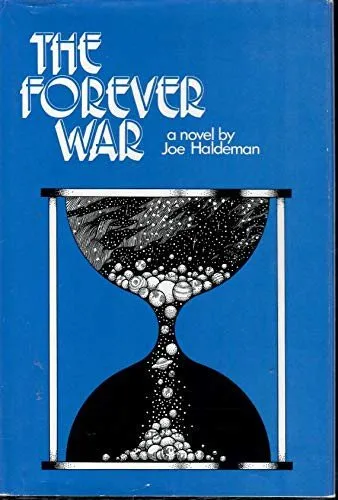
That experience produced The Forever War, published in 1974 after being rejected by numerous publishers who found it too bleak. It won the Hugo, the Nebula, and the Locus awards, which is close to a clean sweep, and it remains one of the small number of science fiction novels that people outside the genre read.

Its device, in which relativistic travel means each tour of duty costs the soldier decades or centuries at home, makes the alienation of a returning veteran literal and measurable in a way realist fiction cannot.

He returned to the material repeatedly. Forever Peace, published in 1997, is not a sequel but a thematic companion and won the Hugo, Nebula, and John W. Campbell Memorial Award. Forever Free, in 1999, is a direct continuation. The 1968 novel War Year and the later 1968 draw on his tour more directly.

Outside the war novels he has written The Hemingway Hoax, Camouflage, The Accidental Time Machine, and a substantial body of short fiction, and he has won five Hugos and five Nebulas across his career.

He taught writing at the Massachusetts Institute of Technology for more than thirty years, where generations of science fiction writers passed through his workshops, and he was named a Grand Master by the Science Fiction and Fantasy Writers of America in 2010. He is also a painter and a poet, and has published a verse collection.

He married Mary Gay Potter in 1965 and they remained together until her death. He has spoken about the difficulty of writing about combat honestly for an audience that mostly wants either heroism or condemnation, and his work consistently refuses both.