
The screenshot came through my feed with the joke already built in. An essay in the Times Literary Supplement, titled “AI and the crisis of the author,” under the subtitle “Can literary culture survive in the era of machine intelligence?” Below it sat an editor’s note dated September 21, 2026.
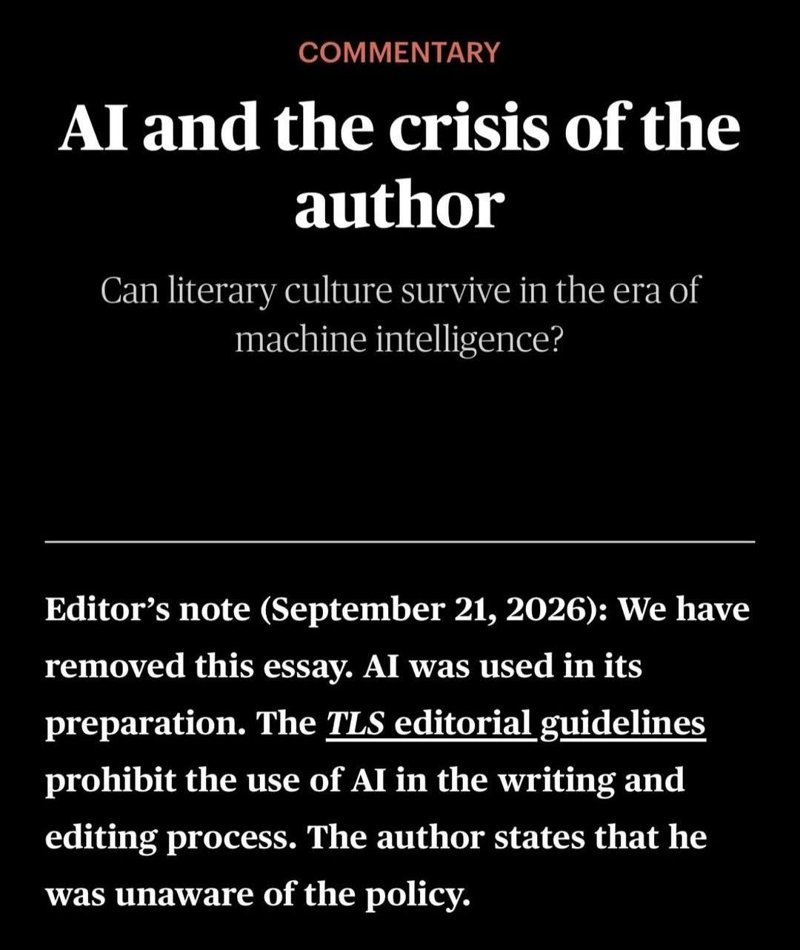
I laughed, and anybody would. An essay worrying about AI and authorship, pulled because AI helped write it, is the kind of irony a novelist would cut for being too neat.
Then I read the comments under the post, and I stopped laughing.
The referee and the crowd
A referee sees a foul, blows the whistle and shows the card. The player walks off, and play resumes. The system works, and nobody in the stadium has to do anything else.
Some crowds can’t leave it there. They boo the player all the way down the tunnel, chant his name for the rest of the half, and a few of them throw things. None of them saw the replay or know what the player was told before the match. They know which team they hate, and a man just handed them a reason.
The TLS was the referee. The comments were the crowd.
Watch: Can AI Detectors Be Trusted? Pangram 4 and the False-Positive Problem, Dr. Michael Litman
Why did the TLS remove the essay “AI and the crisis of the author”?
The editor’s note is four short sentences. The essay has been removed, AI was used in its preparation, the TLS editorial guidelines prohibit AI in the writing and editing process, and the author states he was unaware of the policy.
That’s a clean piece of editing. The magazine has a written rule, and the essay broke it. The note names the rule, links to it, and records the author’s side without comment. Nobody gets called a liar or a fraud. A zero-AI rule isn’t the one I’d write for my own work, but a magazine gets to set its own rules and enforce them. The TLS did that with some dignity.
What the crowd did with it
The post collected the reactions you’d expect. “What a loser.” “The very definition of thieving.” “How meta.” A few people just swore. One commenter compared the author to a sex toy, and the next said that was unfair to sex toys and nominated something that comes out of the other end of the body. Somebody pictured him giggling at his own cleverness while he typed.
Every one of those was aimed at a named man. His byline sat right there in the screenshot. I blacked it out of the copy above, because he doesn’t need one more page on the internet where his name sits next to the word “loser.”
The crowd knew almost nothing. The essay was gone. They didn’t know how much AI was involved, whether it drafted whole paragraphs or tidied a bibliography, or what the author was told when he was commissioned. They knew the irony and the name, and for a pile-on that’s plenty. That’s AI Derangement Syndrome in one sentence. The AI was the only fact anybody needed.
What did they think they were accomplishing? The essay was already gone. The magazine had already acted. Nothing was left to hurt except the man, so they hurt him, by name, over a rule most of them had never heard of until that morning.
“Thieving” doesn’t hold up either. Theft takes something from somebody. Whatever the author did, he broke a publication’s rule about process, and the publication caught it and dealt with it. The word is there to make the commenter feel righteous.
The two comments worth reading
Two people in that thread said something useful.
One asked how the TLS made its determination. If the magazine ran the essay through an AI detector, he said, it was fooling itself. He’s right about detectors. I’ve written about why AI detection can’t be treated as evidence and about what a detector score on your manuscript is worth. Those tools flag innocent writers, and a flag is enough to wreck a career. Another commenter answered that the note reads as if the author admitted it, and I read it the same way. “The author states that he was unaware of the policy” is what an editor writes when the author isn’t disputing the use.
The other said the AI taboo was boring, that these are useful tools, and that he wished people could judge the essay on what it said. I have sympathy for that. I use AI every day, and a lot of the anger at it is aimed at the wrong target. He’s wrong about this case, though. The TLS was enforcing a rule the essay broke, and it never ruled on the argument. A publication that bans AI in its pages is entitled to mean it.
The same week, a prize went further
Four days after the TLS note, the Goncourt Academy removed a novel from the longlist of the Prix Goncourt, France’s top literary prize. An anonymous online account had accused the book of being written with AI. As reported by The Citizen, the Academy concluded the novel was “in all likelihood, very largely the product of artificial intelligence,” and noted plagiarism accusations as well. The author, a Canadian-Haitian novelist, denied it and said he was gathering documentation with his publishers to prove he wrote the book.
I use AI every day, and a lot of the anger at it is aimed at the wrong target.
The two cases share a headline and little else. The TLS had a written policy and an author who didn’t dispute the use. The Goncourt had an accusation from an anonymous account, a finding of “in all likelihood,” and an author who says he’s innocent. One is enforcement. The other is a verdict reached on probability. That second kind frightens me, and it ought to frighten every writer who has ever been flagged by a detector.
Two weeks later it was the Caine Prize for African Writing. It named its 2026 winner on October 6, and on October 11 a report on the review that followed laid out the problem: Pangram had flagged nearly all of the winning story as machine-written, while an earlier story by the same author came back clean.
The prize opened a review. The chair of its trustees said she wants proof that doesn’t come from a machine, and her plan is to talk to the judges, reread the story, ask the author how he works and look at his earlier drafts. That’s the right order. It’s slower than a verdict on a percentage, and it’s the only one that’s fair to the writer, whichever way it comes out.
Do literary magazines allow AI in submitted essays?
It depends entirely on the publication, and the author says that’s the trap he fell into.
Some publications ban AI in writing and editing outright, the way the TLS does. Some allow research and grammar tools and ban generated text. Some ask for disclosure and leave it there. I’ve written about how much AI is too much in writing, and your own answer to that question stops mattering the moment you submit. The publication’s answer is the one that counts in its pages.
Before you submit anywhere, read the contributor guidelines, and read them again before you hit send. If they say nothing about AI, ask the editor in writing what’s allowed, and keep the reply. Tell the editor every tool you used, including the ones you think don’t count. Grammar checkers and transcription services run on the same technology, and the publication gets to decide where its line falls. When a publication bans AI, keep it out of the drafting and the editing, including the tidy-up pass at the end.
My take
The TLS did its job in four sentences, and the crowd should have left it there. A publication enforcing its own rule is a referee calling a foul. Strangers insulting a named man after the essay had already come down is a dogpile, and it fixes nothing. If you submit anywhere, read the guidelines twice, disclose every tool, and get the editor’s answer in writing. Let the whistle be enough.
Let the whistle be enough
A publication that enforces its rules calmly is doing something rare online. It named the problem, recorded the author’s side, and moved on.
The crowd couldn’t let that be enough. It needed a villain, and a byline in a screenshot was right there. I stopped joining writing groups because they were hostile long before AI gave them a new target, and this thread shows why. The commenters called it defending literature, and they had a fine time doing it, at the expense of a man whose name is now tied to this story in every search. Any one of them would be furious if strangers did it to them.
That’s the pattern I track in the Dogpile series, and I wrote about a gentler version of it when a mother asked how to publish her daughter’s bedtime story and got called a thief. If you’re working out where AI belongs in your own writing, start at the AI & Writing Hub, and if you want help with it, my AI services are built for that. The next time a referee blows the whistle on somebody, let the whistle be enough. The game goes on fine without your contribution from the stands.

Crowds like that one did not form by accident. In Sins of the Internet I show how people sat in rooms and chose to build platforms that reward fury, and what it costs the rest of us.
