
Forget the idea that a writing group is a place where writers help each other.
That picture is comforting, and on a good day it’s even true. People post a cover, ask for honest opinions, and walk away with better work than they came in with. That’s what the group is for, and that’s what it says on the label.
This week I watched two of those groups turn into something else. The gap between what they claim to be and what they did says everything about where the indie writing world has gone.
Two authors asked simple questions. One wanted to know which of three covers worked best. The other wanted honest readers for a book he’d just published.
Neither did a single thing wrong. What they got back was a stoning, and I came away from both threads thoroughly disgusted at the lack of civility and basic humanity in the answers.
I think the commenters in both threads ought to be ashamed of themselves, and their own words make that case better than any summary could. Two people who’d done nothing wrong deserved better, and the crowd that did the damage shouldn’t get to decide afterward that it was all in good fun.
A community that promised to help
I’ve been publishing since 2013. More than a hundred books under my own name, dozens more ghostwritten for other people, and a lot of years spent inside writing communities of every kind. The promise of these groups has always been the same. You’re not alone out here. Other writers know how hard this is. They’ve been where you are. They’ll tell you the truth in a way that helps you get better. That promise is why the groups exist and why people join them.
For a long time the promise mostly held. Somebody would post a rough cover and get real notes. The font is hard to read. The title is too long. The colors fight each other. Try moving the author name down. None of it was gentle, because good craft feedback doesn’t coddle. All of it aimed at the same thing. Making the book better and helping the person who made it.
Then something curdled. I don’t know exactly when, and I’m not sure it matters. What I know is that a certain kind of writer stopped showing up to help and started showing up to punish. The group became less a workshop and more a hunting ground, and all it needed was a target the room agreed was fair game. This week it found two.
What did the two authors ask the writing community?
Look hard at what these authors did, because the size of the response only makes sense once you see how small the so-called offense was.
The first author used an image generator to mock up three possible covers for a book in his series. He posted all three, labeled them A, B, and C, and asked which one worked best. He didn’t claim the art was hand-painted. He didn’t lie about where it came from.
He had three options, couldn’t pick between them, and did the sensible thing and asked the room to vote. People post covers for votes in these groups every single day.
The second author published a book on Amazon and asked for honest readers. He was careful about it. Not five-star reviews, he said. Just genuine thoughts. He offered to send the link to anyone interested and thanked people in advance for supporting independent authors. His cover also looked like it came from an AI tool, and that was all it took.
Two people. Two ordinary, hopeful questions. Both of them proud of something they’d finished, and that’s more than most of the people in those comment sections have ever managed.
What the mob wrote
The volume is the point, so let me show you what it looked like. This was a pile-on, and it got worse as it went, the way these things always do once people feel a crowd forming at their back.
On the cover post, the answers included they all look like trash, these look like ass, shit from a butt, I’ve seen nicer dog shit, hot garbage, AI slop garbage, and possibly the worst post I’ve seen in this group. One person made a meme reading let’s slop them up. Another posted a graphic that said your AI generated content is bad and you should feel bad.
A third dug up a newspaper quote to lecture the author that there’s no ethical way to use these tools at all. One man wrote looks like doodoo from a butt. A little later someone else circled back to shit from a butt a second time, as if the joke got funnier on the rerun.
Read those as a group and look for the feedback. There’s none. Not one of those comments tells the author what to fix or why. They’re insults dressed up as critique. The man asked which cover worked best, and stranger after stranger answered by comparing his work to excrement in front of an audience.
The second author got read what the writing AI did for you.
He also got a line calling his post a trifecta of slop, from someone who decided in one breath that the cover was AI, took some political stance, and stole a stadium image. One person told him thirteen dollars was too much for a novella, which at least had the decency to be about the book. The rest were variations on a single theme.
You used a tool we hate, so we’ve decided everything you made is worthless, and we’ll say so in public, loudly, together.
When the tool is AI, I call that AI Derangement Syndrome.
One man on the cover thread wrote that the covers all scream AI, just like a white man would. He looked at three book covers and what came out of him was contempt for an entire category of person. Others piled onto the title and turned the thread into a referendum on the author’s character instead of his typography. None of them had read the book. They never intended to. The book was never the point.
Did anyone in the pile-on read the book?
That gives the game away, and the mob won’t look at it directly. Almost none of these people read either book. They couldn’t have. One was three covers and a title. The other was a link the author hadn’t even sent yet.
So what were they judging? Not the writing, because they had no access to the writing. They were judging a person’s decision to use a tool they disapprove of.
Then they used that decision as a permit to say the ugliest thing that came to mind. A few of them admitted the logic right out loud. If he used AI for the cover, they reasoned, he probably used it for the book, so they’d never read it.
They’d decided his work was worthless based on the one thing in front of them that had nothing to do with his work. The verdict came first and the reasoning got built backward to justify it.
Then they typed shit from a butt and felt like heroes. I find that harder to forgive than the insult itself, because it’s cowardice wearing the costume of principle.
A real critic engages with the work. A person hunting for permission to be cruel finds a reason to skip the work entirely, because reading it might complicate the verdict they’ve already reached.
The AI cover was perfect for them because it let them condemn the book without the inconvenience of opening it. They got to feel like principled defenders of art while doing the one thing no defender of art would ever do. Trashing a book they refused to read.
Don’t judge a book by its cover is the oldest piece of advice in the language. It’s so old it’s become a punchline, the kind of thing printed on a poster in a school library. These people took it and ran it in reverse. They judged the book entirely by its cover, announced they were proud to, and called it ethics. The single most universally understood lesson about fairness, inverted and applauded.
How does an online pile-on work?
I want to name the mechanism, because people were mean online is far too small for what this was.
A pile-on has a shape, and it’s always the same.
First, somebody becomes acceptable to hurt. A label does that. Once a person is an AI grifter or a slop merchant, they stop being quite a person, and the ordinary rules about how you speak to a stranger switch off. Second, the group senses permission. The first few comments set the temperature, and once those insults draw no pushback, everyone understands the room has approved this target.
Third, people rush in, because there’s no cost to landing a blow and there’s real reward for landing the cleverest one.
That last part is what drives it, and you can see it in both threads. Watch what people are competing over. Not who gives the most useful note. Who’s the funniest, the most savage, the most quotable. I’ve seen nicer dog shit is a bid for laughs from the crowd, and the crowd pays out in likes and little laughing faces.
The AI cover was perfect for them because it let them condemn the book without the inconvenience of opening it.
Every meme, every ew ew and more ew, every fresh escalation exists for one reason. Cruelty performs well in front of an audience that’s already agreed the target deserves it. The author in the middle isn’t even the real audience for these comments. The other commenters are.
That’s why a pile-on feels so different from honest criticism even when a single line could pass for it. The energy is wrong. Honest criticism wants the work to get better. A pile-on wants the target to feel small, and it wants an audience watching it happen. Strip the AI question out of these threads entirely. What’s left is a hundred grown adults taking turns kicking two people who showed up asking for help, then glancing at each other to see who kicked hardest.
I know how fast a label lands, because one landed on me. I joined a thread once and used the word babe in a reply to a woman. For a baby boomer that’s a natural habit, a word we use a lot. Overnight there were about a thousand comments putting me on a cross. How dare you. Sexist.
I hold the people who run these groups responsible too. Admins set the temperature of a room long before any single thread starts, and a group where comparing a stranger’s cover to excrement passes for critique is a group somebody decided to tolerate. Every insult that stays up tells the next commenter the target is fair game.
Leave a room like that alone long enough and the insults stop being the ceiling. In a large creative writing group, a member complained about how much AI was in the feed, and a commenter answered that people who use AI deserve to be castrated. Nobody had been caught at anything, and nobody objected. I wrote about that thread in People Who Use AI Deserve to Be Castrated.
The few who stayed human
A handful of people in both threads behaved decently, and they deserve to be pointed out. In a pile-on, the ones who refuse to join are doing something hard. Going along is free. Standing apart costs you something with the crowd, and they paid it.
Some simply answered the question. B first, then A, then C, because B matched the series colors. C, because it best separated the series name from the title. They looked at three covers, formed an opinion, and voted. That was the entire job, and they did it without theater. Nobody handed them a prize for it. They just helped the man, the way the group is supposed to.
One person made an argument the mob was too busy frothing to hear. Other writers aren’t the audience for this book, she said, and despite what writers want to believe, plenty of readers don’t care about AI covers at all. Look at the top hundred in any genre on Amazon and you’ll find them. People who understand these tools know they’re not magic book machines, and readers are already buying AI-assisted work without filing complaints. Use the tools how you want.
That’s a real position, argued in good faith with evidence behind it, and it got buried under ew. Notice she didn’t even tell him to keep using AI. She made the narrower and harder point that the people screaming in the thread weren’t the ones who would decide whether his book sold. The mob had no answer for that, so it scrolled past.
And one man wrote the single thing in either thread that should shame everyone else in it.
Nobody here knows a single thing about this author, he said. Maybe the writing isn’t AI at all. Maybe he couldn’t afford a cover designer. Maybe he was just excited and didn’t want to wait another month for art. A lot of people are far more comfortable criticizing than creating, he said, and the loudest voices in the thread had probably published little or nothing themselves.
A book with an imperfect cover still exists. A book that never gets published doesn’t. He was right on every count, and that he stood nearly alone is the whole sickness in one image.
What does useful feedback in a writing group look like?
There was a real conversation buried under the filth, and pretending otherwise would put me in the same dishonest place as the mob.
Some questions in those threads were legitimate. Whether AI covers cost sales is a fair thing to raise, because some readers do avoid them and an author should know that walking in. Whether a weak cover undersells a strong book is fair too, because covers set expectations and a bad one can waste a good book’s first chance. A few of the practical notes were simply correct. The title was clunky, and the person who said so did the author a favor.
Twenty dollars is steep for a paperback from an unknown writer. Thirteen for a novella is a lot. A few people made these points cleanly and moved on, and that’s the group working the way it’s supposed to.
Real feedback has a recognizable quality. It’s specific. It names a thing and points at a fix. It treats the author as a colleague who wants to improve, not a target who needs to be put in his place. You can disagree with it and still feel the good faith underneath. There were three or four notes like that scattered across both threads.
The authors should grab every one. Buried in all that filth was a little real help, worth more than the rest of the comments combined.
But that’s not what most of it was, and we shouldn’t flatter the mob by pretending it was. The label did what a slur used to do. It marked these men as outside the circle of people you owe basic decency, and once the mark was on them, anything went. Racial cracks. Scatological insults. Memes built for no reason except to humiliate. Strangers telling a proud new author that his unread work was excrement, and then competing over who could phrase it most colorfully.
The test never changes. Feedback wants to fix the book. A pile-on wants to break the author. Hold each comment up against that and the threads sort themselves in a heartbeat.
| Trait | Honest feedback | Pile-on |
|---|---|---|
| Goal | Make the work better | Make the target feel small |
| Real audience | The author | The other commenters |
| Content | Names a thing and points at a fix | Insults dressed up as critique |
| Treats the author as | A colleague who wants to improve | A target to be put in his place |
| What people compete over | The most useful note | The funniest, most savage, most quotable line |
| Relationship to the work | Engages with the work | Skips the work and judges the label |
What worries me most is everybody who read those threads and never typed a word. Somewhere in that group is a new writer with a finished manuscript who just learned that asking a simple question gets you stoned in public. Some of them won’t post a cover, a chapter or a book for a long time because of what they watched, and the mob will never count that cost.
My take
Feedback wants to fix the book, and a pile-on wants to break the author. Hold every comment up to that test and the thread sorts itself. The worst damage lands on the people reading silently, new writers with finished manuscripts who now won’t post anything. If you see a stoning, be one of the few who stays human, answer the question the author asked, and leave the mob talking to itself.
To the two authors, and to the rest of us
You finished something. You put it into the world. You asked an honest question and you got an answer no one should have to take.
The people who told you your work was garbage have, almost to a person, finished nothing and risked nothing.
They’ve never uploaded a book and waited to see what strangers would say. Doing that means making something first, and making something is the one thing the mob has never tried. Sitting in the comments being savage is free. It costs nothing and it proves nothing.
You did the thing they’re afraid to do, and they punished you for it, because your nerve made their lack of it visible and they couldn’t stand the sight.
So take the real notes, the few that survived the pile-on, and use them. Fix the cover if it needs fixing. Tighten the title. Look hard at the price. That’s what professionals do, and not one bit of it requires you to apologize for the crime of trying.
Then keep publishing. A book that exists with an imperfect cover beats a book its author never wrote because they were scared of people like these. They’ll always be louder than you, always faster with an insult, always better at performing contempt for a crowd. They’ll never be braver. And in five years, when you have a shelf of books and a real readership and covers you’re proud of, every one of them will still be down in the comments, finishing nothing, kicking whoever wanders in next.
I started by saying these groups were built to help writers, and on a good day they still do. The disgust I feel reading these threads is at watching a community designed for generosity get hijacked, over and over, by people who came to wound. Civility isn’t weakness and decency isn’t censorship. You can hate AI art with your whole heart and still answer a stranger like a human being.
The writers in these threads forgot that, and two people paid for it in public. I’m sick of watching it happen and I’m done treating a pile-on as the internet being the internet. Anyone who typed an insult at a stranger’s book cover in those threads owes the person they went after an apology.

Pile-ons are what the platforms were built to reward. Sins of the Internet covers how they chose anger over empathy, including Facebook’s own 2018 finding that angry posts got six times the engagement.
Frequently Asked Questions
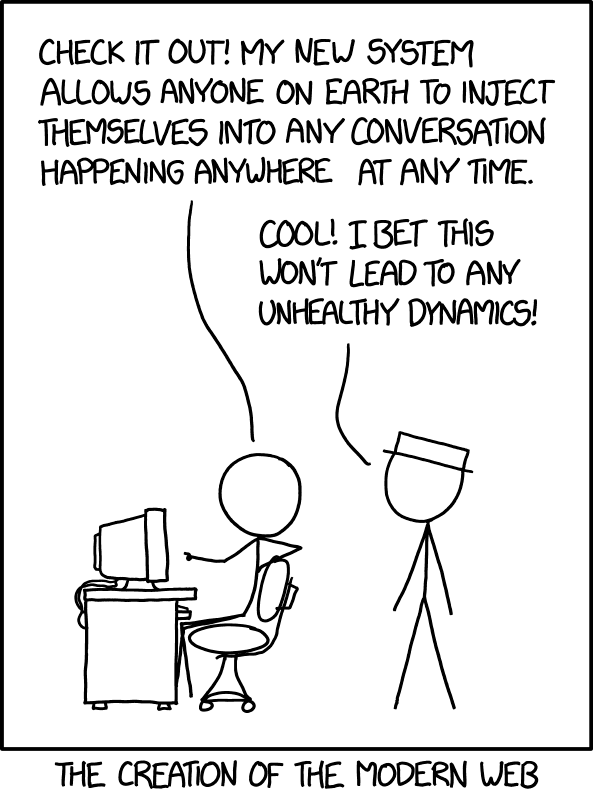
- Conversational Dynamics, xkcd (Randall Munroe)
